Reverse Engineering A 1.5 Inch Photoframe

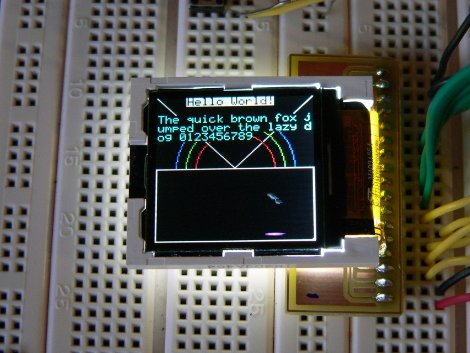
Little, no name, 1.5 inch LCD photo key-chains are all over the place for practically nothing. Not too surprisingly these things do not vary much in the parts that they use, some flash ram, a little lipo battery and a 16 bit color LCD. Wanting to find a way to reuse that LCD [Simon] Has an excellent tutorial on how to reuse a FTM144D01N LCD with a ILITEK ILI9163 LCD driver for your electronic projects.

Two units were used, one was ripped apart and soldered to a home made breakout board, the other was kept intact so its logic could be sniffed out with an oscilloscope. A pin-out was quickly determined since these things typically use a 8 or 16 bit data bus. Then a driver library was put together for AVR micro controllers, which includes some basic shape drawing and a 5×8 font.

While you may not be lucky enough to get this exact LCD screen from your local bargain store, there are a lot of pointers in here to hopefully get you up and going. We will be trying our luck on a very similar screen this afternoon as these things do have a decent picture and fairly quick response times already packaged in a hand-held case.

Join us after the break for a quick video.

Continue reading “Reverse Engineering A 1.5 Inch Photoframe”

Weapon Of Mass Graffiti

What uses a fire extinguisher, a bike pump, and provides hours of probation, community service, and possibly jail time? If you said an automatic graffiti writer you’re correct! [Olivier van Herpt] calls this little job the Time Writer. We call it defacing property… but tomato, tomahto.

Details are a bit scarce, but you get a fine overview of the system from the video after the break. [Olivier] tagged the post as Arduino; it’s obviously running the dot matrix printer made up of seven solenoid valves on a metal rod. These are fed ink via a tube connected to a fire extinguisher which serves as the reservoir. The bike pump is used to pressurize the enclosure so that a pump isn’t necessary when out and about.

Obviously you shouldn’t try this at home, but let’s talk about possible improvements as an academic exercise. First off the mix of the ink/paint needs to be reigned in to get rid of the dripping. We’d also like to see the inclusion of some proper spray can nozzles to tidy up the results. That, paired with an IMU board should be able to smooth out the printed designs.

This might make an interesting add-on to that rainbow graffiti writer.

Continue reading “Weapon Of Mass Graffiti”

Overclocking A Starfox Game Cartridge

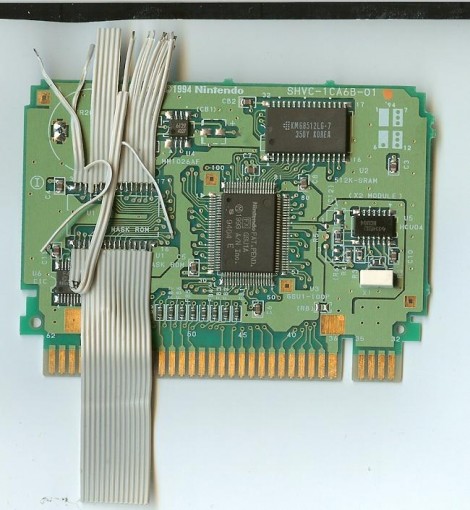
Some of our younger readers will never have experienced this before, but back in the day your video games would slow way down if there were too many moving objects on the screen. The original Castlevania comes to mind, but many will remember the problem while playing the fantastically three-dimensional Super Nintendo game Starfox. [Drakon] isn’t putting up with that hardware shortfall any longer, he hacked this cartridge to run at 42 MHz, twice as fast as the design spec.

We only occasionally look in on the cart hacking scene so it was news to us that three different versions of a pin compatible chip were used in this hardware. The first two suffer from the slowdown problem, but the final revision (SuperFX GSU 2) doesn’t. It can also be overclocked as high as 48 MHz but because of the video frame rate you won’t see added improvement with the extra 6 MHz.

[Drakon] used a Doom cartridge as a guinea pig because it offers the most RAM, and set to work rerouting the traces for the ROM chip to an EEPROM so that the hardware can be used with different games. He also took this opportunity to patch in the faster clock signal.

Telegraph Key Makes For A Fantastic Twitter Input

In the interests of interface archaeology, [Martin] sent in the Tworse Key, a telegraph key that posts to Twitter using Morse code. It’s a fantastic build that nearly looks like something out of the 1900s.

We’ve seen a ton of Morse keyboards over the years, but never one so well-engineered for a single purpose. The guts and brains of the Tworse Key is an Arduino Ethernet that connect to Twitter over the API. The Tworse Key automagically posts all the Morse messages to Twitter. The Tworse Key may have fallen off the table a few times in the past 24 hours, but we do see a few purposeful messages like ‘sos’ and [Bell]’s preferred telephone salutation.

We could say that nobody uses straight telegraph keys anymore, but outside a few hardcore CW HAM radio guys nobody uses Morse anymore. This isn’t meant to be used as an everyday input device, though. It’s more of an exercise in interface archaeology. That being said, an iambic key would be a far more ergonomic solution. Check out the video of the Tworse Key after the break.

Continue reading “Telegraph Key Makes For A Fantastic Twitter Input”

Using Google Documents As A Web Proxy

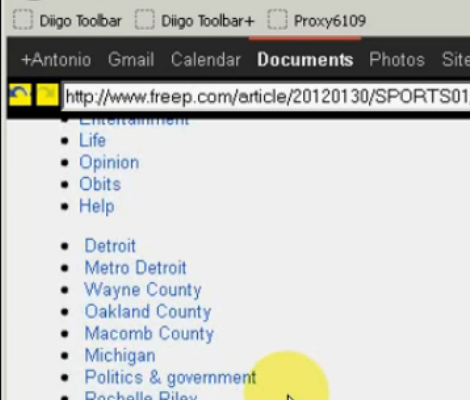
As weird as it might sound, there’s a way to use Google documents as a web proxy. The image above is a screenshot of [Antonio] demonstrating how he can view text data from any site through the web giant’s cloud applications. Certain sites may be blocked from your location, but the big G can load whatever it wants. If all you need is the text, then so can you.

The hack takes advantage of the =IMPORTDATA() function of Google Spreadsheet. We guess the command is meant to make import of XML data possible, but hey, that’s pretty much what HTML data is too, right? But what good it the raw webpage code in a spreadsheet? This is where [Antonio] made a pretty brilliant leap in putting this one together. He authored a bookmarklet that provies a navigation interface, hides the raw code which is stored in the spreasheet, and renders it in the browser. This ties together a user supplied URL, reloading data on the hidden spreadsheet and refreshing the window as necessary. See for yourself in the clip after the break.

Continue reading “Using Google Documents As A Web Proxy”

NAS Firmware Hack: Synology Running On QNAP Hardware

[XVortex] pulled off a pretty incredible firmware hack. He managed to get a firmware upgrade for Synology running on a QNAP machine. These are both Network Attached Storage devices, but apparently the Synology firmware is better than what QNAP supplies with their offerings.

The nice thing is that this is not a one-off hack. You can download the raw image and give it a spin for yourself. A few words of warning though. It will only work on models which use the Atom and ICH9R chipset, you’re out of luck if you have one sporting an ARM processor. You will also need to format the drives once the new firmware is flashed so do this before you fill them up.

This harkens back to the days when DD-WRT was first being run on Linksys routers. We don’t remember if that started with upgrade image hacks like this one uses, or if the source code was available (Linksys was compelled to release it once it was proven they were in violation of the GPL).

See a proof video of this hack after the break.

Continue reading “NAS Firmware Hack: Synology Running On QNAP Hardware”