Ask Hackaday: Hacking Lingo Fails

header

Ah, CSI. What other television show could present digital forensics with such two-bit dialogue?

It’s time once again to put on your hacker hats – a red fedora, we guess – and tell us the worst hacker dialogue you’ve seen in movies or TV. We’ve seen a ton of shows and movies where writers and directors spend zero time doing any sort of research in whatever technology they’d like to show off in the story they’re trying to convey. Usually this results in lines like, “I’ll create a GUI interface using Visual Basic. See if I can track an IP address.” It’s technobabble at its best, and horribly misinformed at its worst.

We’re wondering what you, the readers of Hackaday, think are the worst examples of hacker lingo fails. Anything from, ‘Enhance!’ to the frightening real-life quote, “the Internet is not a big truck. It’s a series of tubes.”

We’ll compile your suggestions in a later post, but I’m betting something from Star Trek: Voyager will make the #1 technobabble/hacking lingo fails. There’s just too much in that show that isn’t internally consistent and doesn’t pay any heed to the laws of (fictional) physics. Warp 10, I’m looking at you. Of course there was the wonderful Habbo reference in last week’s Doctor Who, but I’m betting that was intentional as [Moffat] seems pretty up to speed on the tropes and memes of the Interwebs.

About a month ago, we asked you for your take on the worst hacking scenes ever shown on TV or film. The results made for good viewing, albeit with a surprising absence of Lawnmower Man. Now we want some dialogue to go with these horrendous hacking scenes. So, what say you, Hackaday? What are the worst hacking lingo fails you’ve seen or heard? Please be specific about what movie/TV show you’re referencing. Last time some good stuff probably slipped by because people just said a few words without context assuming we’d know exactly what they were referring to.


Dual Displays On A Playstation 2

scope

At the Revision 2013 demoparty held last weekend, visitors and guests wanting to check out the latest advances in programming old video game consoles got a real treat. [Abyss] took a Playstation 2, connected the composite video out port to a TV and an oscilloscope, and created the first dual display PS2.

From the official video of the demo, the two video signals are generated from a single video out on the PS2. Generating the composite video out is understandably fairly easy, but the second display – an oscilloscope – is driven during the Vblank period in the composite signal. There’s no audio trickery here; video signals are used for video, and audio signals are used for audio.

[Abyss] took first place in the wild demo competition at Revision 2013. Understandably, too, because this is one of the best demos we’ve ever seen. You can check out the official video from [Abyss] after the break, and the wild competition video after the break.

Continue reading “Dual Displays On A Playstation 2”

An EQ Display For A Pedal Board

EQ

There are a lot of tinkerers out there who got their start in electronics with musical hacks. Surprisingly though, we don’t see many submissions to our tip line covering boost circuits for electric basses, rewiring guitar electronics, or even more complex effect pedals. [Deadbird], though, is bucking that trend with an EQ display stomp box that fits neatly on his pedal board.

[Deadbird]’s build isn’t a graphic equalizer that can change the volume of different frequency bands; instead, he used the MSGEQ7 chip to listen in on the signal his guitar is producing and display that on a 128×64 graphic backlit display.

The entire project was prototyped on a breadboard with an Arduino. After he got all the components working – a momentary switch to turn the pedal on and off, 1/4″ jacks for the input and output, and a power supply – [Deadbird] took an Arduino prototyping shield and made everything more permanent. Now he’s got an attractive pedal on his board that shows the signal coming from his guitar in seven neat bands.

How-to: Turn On A Light Bulb

header

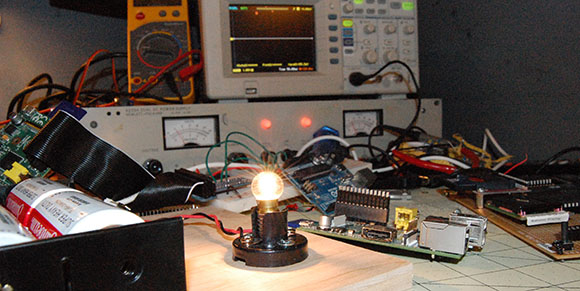
All too often, the commentors here on Hackaday display some parsimony in their engineering prowess. If someone uses a Raspberry Pi to blink a few LEDs, someone will invariably chime in that an ARM microcontroller would do just as well. Switching a relay on and off belies the capabilities of a 32-bit Cortex microcontroller when a simpler 8-bit build would certainly suffice. Of course this can always be reduced to a 555 circuit and further still to conditioned pigeons tapping a key in response to either food or opiates. I’d like to take this opportunity to present a tutorial. Not just any tutorial, but the actual foundation of everything we love here at Hackaday: blinky, glowey things.

You can check out the rest of this tutorial after the break.

Continue reading “How-to: Turn On A Light Bulb”

SNES Headphones Scream Out For Bluetooth Control

Here’s a build that just exudes nerd cred. It’s an SNES controller modified into a pair of headphones, straight from the workshop of [lyberty5].

The build began by stealing a controller from a PAL SNES and carefully dremeling the buttons and d-pad loose from their plastic frame. The PCB was cut in half, and the remaining plastic was carefully crafted into round speaker enclosures with the help of some epoxy. hot glue, and possibly a few pieces of styrene.

The result is a perfectly formed pair of SNES headphones, with a build quality right up there with the best case mods we’ve seen. Unfortunately, while the buttons are still attached to the PCB, they don’t do anything. We’re thinking a small Bluetooth adapter – or even repurposing a set of Bluetooth headphones with volume and play controls – would be a wonderful use for the 20-year-old, candy-like buttons.

Still, an awesome build, and [lyberty5] really shows off his craft by constructing these wonderful headphones. You can see the time-lapse of the build after the break.

Continue reading “SNES Headphones Scream Out For Bluetooth Control”

Windmill Made From Washing Machine, 555 Chip

Green hacks implement one of two philosophies. The first is über-technical, with very expensive, high-quality components. The other side of this coin creates green power out of junk. [Timot] obviously took the latter choice, building a windmill out of an old washing machine motor and a few bits of PVC.

The generator for the windmill is based on a Fisher and Paykel direct drive usually found in clothes washing machines, rewired to provide 12 Volts at low RPM. At high speeds, the generator can produce 80 Volts, so a charge controller – even one based on a 555 chip – was an excellent addition.

For the other miscellaneous mechanical parts of the build, [Timot] cut the blades of the windmill out of 200 mm PVC pipe and sanded them down a bit for a better aerodynamic profile. With a custom fiberglass spinner, [Timot] whipped up a very attractive power station that is able to provide about 20 watts in normal conditions and 600 watts when it’s very windy. Not enough to power a house by any means, but more than enough to charge a cellphone or run a laptop for a few hours out in the back country.

Kindle Weather And Recycling Display

kindle-weather-and-recycling-display

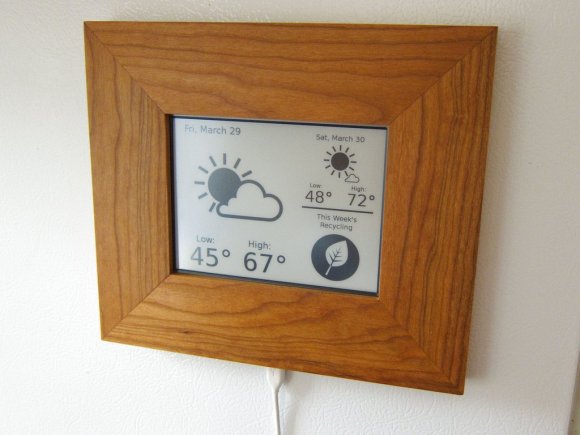
We’ve seen a fair number of hacks like this one that reuse a Kindle basically just for its ePaper display. [HaHaBird] has this device hanging on his refrigerator to display the weather and remind him about recycling day. It kind of make us wonder why we’re not seeing cheap ePaper modules on the hobby market?

The concept isn’t new, but [HaHaBird] does move it along just a little bit. He started by following the guide which [Matt] wrote after pulling off the original Kindle weather display hack. It uses a separate computer running a script that polls the Internet for weather data and generates a vector graphic like the one seen above. The Kindle then loads the image once every five minutes thanks to a cron job on the rooted device. But why stop there? [HaHaBird] tweaked the script to include a reminder about his municipality’s irregular recycling schedule.

Don’t overlook the quality of the hardware side of this hack. With its prominent place in the kitchen he wanted a nicely finished look. This was achieved by building a frame out of cherry and routing passages on the back to make room for the extension cable (so it could hang in landscape orientation) and a toggle to hold the Kindle firmly in place. Additional information on the build is available here.