Hacking The Linksys WRT120N

[Craig Heffner] recently found himself on the case of the Linksys WRT120N router. The router’s firmware was using some previously unknown form of obfuscation, causing headaches for those wishing to run their own software. The WRT120N, being a 2009 model is somewhat out of date at this point. That didn’t stop [Craig] though, as he dove into reverse engineering the firmware obfuscation.

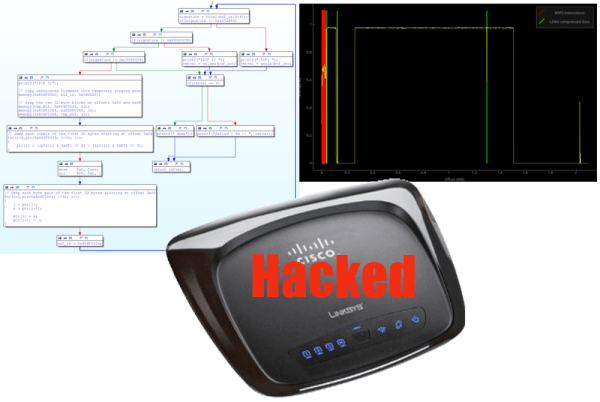
[Craig] started by running the firmware through his own Binwalk tool. Binwalk analyzes firmware files for known data, be it embedded filesystems, raw compression streams, or binary files. In this case Binwalk only found a small LZMA block which contained the compressed html files for the router’s web interface. The rest of the firmware was unknown data with a high level of entropy. [Craig] couldn’t do anything more with the firmware update file alone, so he ordered a router to attack from the hardware side. Inside he found typical low-end router components:  An Atheros AR7240 SoC, a 2MB SPI flash chip, 32MB of RAM. He also found serial and JTAG headers.

[Craig] connected to the serial port and was greeted with a boot menu. This allowed him to run some commands on the router, but didn’t give him any way to dump memory. He had to go straight to the source – connecting directly to the router’s SPI flash with an FTDI C232HM cable. Using libmpsse, another of his open source tools, [Craig] was able to dump the flash. He now had the un-obfuscated bootloader code, albeit in MIPS assembly. [Craig] was then able to go after the bootloader with IDA Pro. After a bit of work, the obfuscation system was exposed. The system was simple – several byte and nibble swaps had been performed between the LZMA header block and the first few bytes of data. [Craig] finished out this part of his hack by writing a simple C program to de-obfuscate and decompress the firmware.

Robot Chameleon Teaches Little Girl About Camouflage

IMG_8407

[Markus] has been teaching his daughter about animals using a big old animal encyclopedia. A few days ago, they stumbled upon the chameleon, and when he tried to explain its camouflage abilities, she didn’t quite understand. So he decided to make her a pet color-changing chameleon robot. The best part is he built it during her nap!

It’s a fairly simple circuit consisting of an Arduino Uno, a TCS3200 color sensor with breakout board, a ping pong ball, some resistors, and an RGB LED. He plans on adding temperature sensing as well as a capacitive sensor for touch later on. So far, his daughter loves it and plays with it all the time. She’s starting to learn how some chameleons can change their skin color in order to camouflage — and she’s learning the names of some new colors too!

As always, there’s a demonstration video following the break.

Continue reading “Robot Chameleon Teaches Little Girl About Camouflage”

Turning A Broken Laptop’s LCD Into A Fancy Monitor

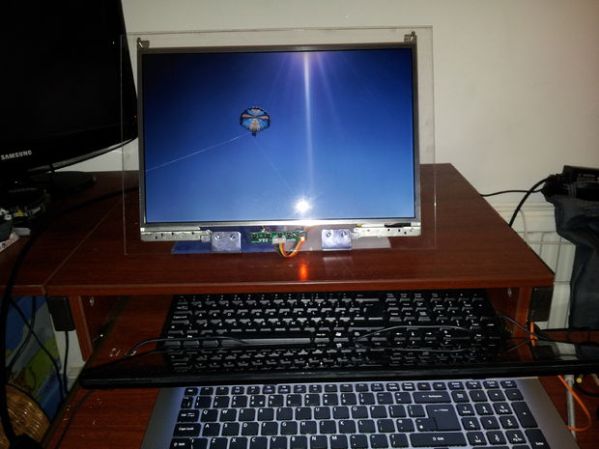
Seems like you can find broken laptops everywhere these days — so why not do something with them? [Damutsch] shows us how to make a rather cool looking monitor from a laptop’s LCD display.

First, you’ll need to salvage a working LCD from a dead laptop. Once you have the panel out you can identify the serial key and order a controller board off eBay, which will allow you to plug a normal video input such as VGA or HDMI into the panel. We browsed around a bit and it looks like you can get driver boards from around $15-$30, so not too bad price-wise. It wasn’t so long ago that salvaged LCD panels were basically unusable because of a lack of these driver boards. Continue reading “Turning A Broken Laptop’s LCD Into A Fancy Monitor”

Plastic Recycling At Home Promises A Revolution In Local Plastic Production

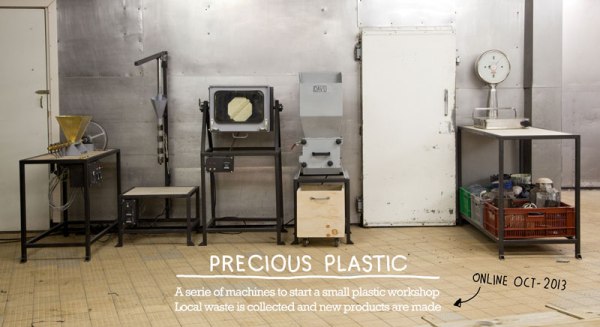
[Dave Hakkens] graduated from the Design Academy of Eindhoven and decided to try his hand at making affordable plastic recycling machines.

His reasoning?

“We recycle just 10% [of waste plastic],” says Hakkens. “I wondered why we recycle so little so I investigated it. I went to all these companies and I realized that they don’t really want to use recycled plastic. So I wanted to make my own tools so I could use recycled plastic locally.”

Typical plastic production, like injection molding, uses very large and expensive machines — so expensive that most of the time, companies don’t want to risk using inferior recycled plastic, as it might damage the machine, or slow production time. Not convinced that recycled plastic is “inferior”, [Dave] has built his own line of machines capable of making recycled plastic parts.

Continue reading “Plastic Recycling At Home Promises A Revolution In Local Plastic Production”

Pi-Powered Radio Over IP

Pi

[KP4TR] connected a Raspberry Pi to a small, cheap handheld radio, allowing anyone within a few miles of his house to connect to amateur radio operators all around the world.

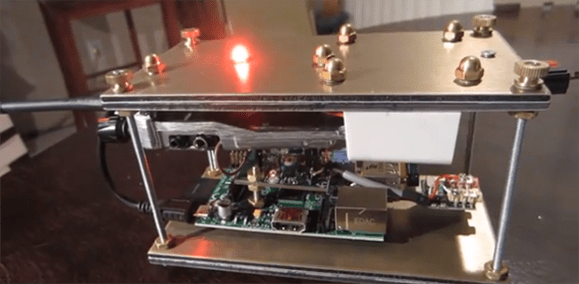
For the hardware, [KP4TR] is using a Raspi, a Baofeng BF-888s 400MHz – 470MHz walkie-talkie radio, a USB sound card, and a pair of transformers for the 5V and 3.7V lines. All this is tucked away in a remakably vintage-looking plate and standoff enclosure, complete with acorn nuts and an RGB LED connected to the Raspi’s GPIO to indicate whether the radio is transmitting or receiving.

The software used is SVXLink, a Linux port of the Echolink software. This app allows hams the world over to connect to very distant radios over the Internet.

You can check out the video demos of the system below.

Continue reading “Pi-Powered Radio Over IP”

Exploded Hardware Wall Art

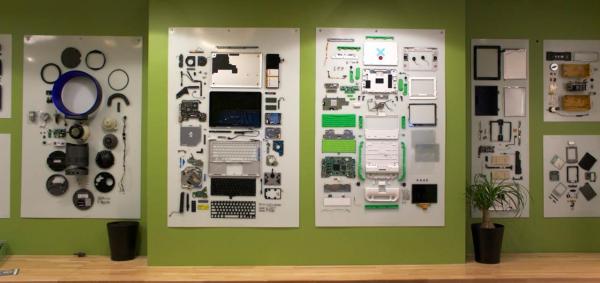
The gang at Bolt.io realized that the walls in their office deserved some special attention, and they got it by mounting exploded hardware throughout the space. They sourced the used devices from eBay, then carefully broken them down into their components and mounted each on its own sheet of PETG. The result: exploded views of some of their favorite hardware, including a MacBook Pro, a Roomba, a Dyson Air Multiplier, and more.

Is it a hack? Eh, maybe. This is the first example we’ve seen of a collection of devices on display in this fashion. Regardless, it’s worth a mention considering what happened in the office as a result of the installation. Though the original purpose was simply to decorate the walls, it seems employees have been staring at them regularly, learning more about the designs, the plastics, and the component choices. Think of it as still life—depicting that moment you cracked open a device to inspect its guts—frozen in permanence and on display for both inspiration and convenience.

[via reddit | Thanks Buddy]

Fail Of The Week: Oil Expeller And Hasty PCB Layout

fotw-oil-extractor-hasty-pcb-layout

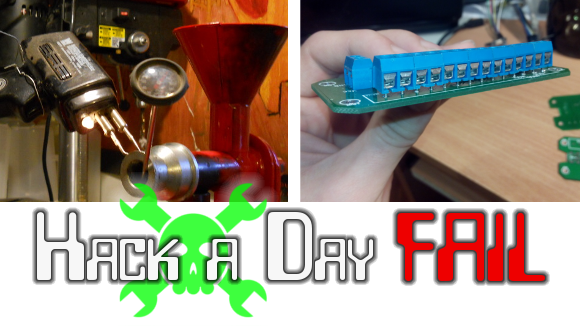
This Fail of the Week is a twofer. On the left we have an attempt to heat the output of an oil expeller. After a bountiful crop of sunflower seeds [Mark] picked up the oil expeller to make is own cooking oil. He tried to use the soldering gun as a heat source but after just a couple of minutes of on-time it melted the soldering iron’s plastic case. He’s looking for an alternate heat source but we wonder why he can’t just ditch the plastic and bolt this to a heat sink?

To the right is the product of hasty PCB layout. [Andrew] needed a USB to GPIO converter to use with his Android stick. He had built several of these before, etching the PCBs himself. But now he didn’t have the time to do his own etching and figured he could lay out a revision of the board and have it fabbed. Turns out this isn’t the time saver he had hoped. Problems with the location of silk screen labels aren’t a huge deal, but the ‘V’ in the board where his USB connector is located blocked any cable he tried to plug in. A bit of cutting solved that but he also had to deal with spring terminals whose leads wouldn’t fit the diameter of holes drilled in the board. We always print out the Gerbers and compare the footprints to our parts before submitting to the fab house. But we’re not sure we would have caught the USB cable clearance issue doing it that way. What checklists do you use before submitting your own boards?


2013-09-05-Hackaday-Fail-tips-tileFail of the Week is a Hackaday column which runs every Wednesday. Help keep the fun rolling by writing about your past failures and sending us a link to the story — or sending in links to fail write ups you find in your Internet travels.