Reading Paper Tapes From Scratch!

Home made tape reader

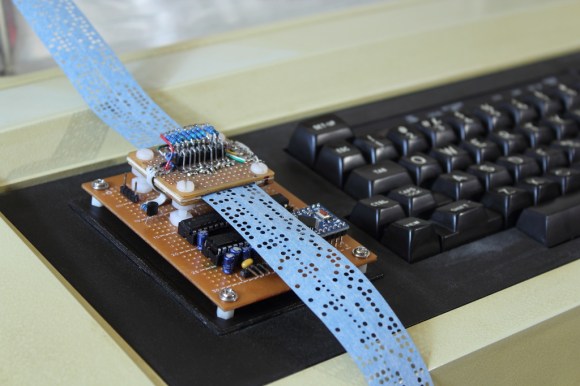
Feeling a little nostalgic? Dying to read some paper ticker tapes? You can do it manually, but that’d take forever! [NeXT] decided to make a little PCB to help him out.

Having searched for paper tape readers for years, and even getting halfway through building the mechanical portion of it in his high-school tech class, [NeXT] decided to take a serious stab at it — and by golly, it works!

The reason he finally decided to go down this route is because you just can’t buy them (well, for cheap), and even the DIY or hobby ones out there are notoriously slow — what better reason to design it from scratch?

Continue reading “Reading Paper Tapes From Scratch!”

Hackaday Space: Final Transmission Minecraft Puzzles Explained

This is the last part in our round up of the ARG that we ran throughout April. Just in case you’ve had your head buried in a hole this last week, it was a month-long series of puzzles that lead up to the announcement of the frankly awesome Hackaday Prize. During the week we’ve covered Transmissions 1, 2 and 3 detailing how we put the puzzles together and the things that went wrong. For the final stage we wanted something a bit different. Throughout the ARG we had been inspired by the book Ready Player One, so in this stage we wanted a high score table that people could compete over.

Since we’d managed to get reasonably far ahead of ourselves during Transmission 3 we had just over a week to plan this round. We pitched some ideas around the office for video games we could make with high score tables. None of these really stuck and we soon realized we didn’t have the resources to get the graphic design work done for most games. Someone suggested that we try making a MUD themed around a space port with rescue for Major Tom being the last stage. This seemed like a great idea at first and I began work on it using the RanvierMUD framework. It soon became clear however that writing all the text for a full featured MUD is actually a massive endeavor and I frankly am not that great of a writer.

Learn the secrets and watch a video tour of the Minecraft world below.

Continue reading “Hackaday Space: Final Transmission Minecraft Puzzles Explained”

This Weekend: Hackaday At The Southeast Vintage Computer Festival

VCF

The Vintage Computer Festival hits Roswell, GA this weekend for the second year, packed with museum displays dating back to the Kenbak 1 and hobbyist vintage exhibits. The Apple Pop-Up museum is back as well, along with last year’s popular retro gaming area and a maker-styled kit building area. Here’s an album packed with images from last year’s festival, so you know what you’re getting yourself into.

You can check out the scheduled speakers and workshops here. While you’re there, look for the short, nerdy guy wearing a Hackaday shirt and I’ll be sure to throw some Hackaday stickers at you.

Circular Saws In The Kitchen, Good Idea Or Best Idea?

Kitchen centrifuge using a circular saw

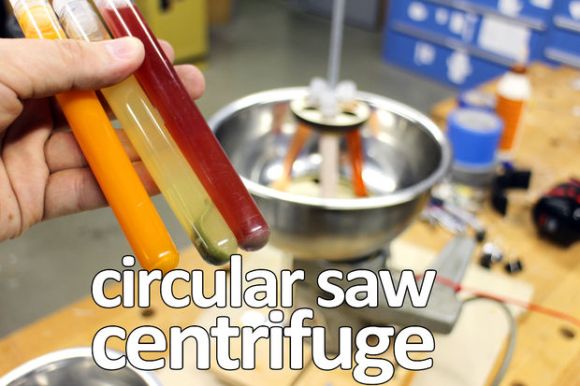
[Mike Warren] was contemplating risky but exciting projects he could do when he came up with this magnificent contraption. A centrifuge made out of an old circular saw!

First question — why? Well if you’re a foody or you enjoy the study of molecular gastronomy, bringing a centrifuge to the kitchen can allow for some more technical dishes. It suddenly becomes possible to separate food based on its density, just like how it works in the lab. Practical applications for super fancy dishes — we’re not too sure — but it involves relatively unsafe power tools and food so we felt obliged to share it!

Let’s start off with the generic warning — in fact, [Mike] states this before the Instructable begins:

Do not replicate this project, it is incredibly dangerous!

The project makes use of an old corded circular saw, a few salad bowls, some threaded rod, a few nuts, some binder clips and some metal plates to hold the plastic test tubes. At 4900RPM (the speed of his saw),he’s calculated his G-Force to be around 1879G’s. Holy cow. A person passes out at around 10Gs, and a bullet fired from a typical handgun is well over 50,000 — on the extreme end of things, a professional lab ultra-centrifuge can hit over 300,000.

These all of course pale by comparison to the Large Hadron Collider, which can accelerate protons at approximately 190,000,000G’s! And to conclude, this is what happens when lab centrifuges blow up. Don’t do it — but do watch the following video and enjoy!

Continue reading “Circular Saws In The Kitchen, Good Idea Or Best Idea?”

Magsafe On An Android, Cats And Dogs Living Together

Mag

We’re thinking most Hackaday readers have at one time or another been tasked with replacing the power connector in a laptop. Anyone who has done so can easily see the genius behind the Apple Magsafe connector. Since the second gen iPhone, there have been rumors Apple will release a cellphone with the Magsafe connector, a great idea, seeing as how cell phones are thrown around even more than laptops. [Tony] got tired of waiting, and had an Android device anyway, so he decided to retrofit a Magsafe power adapter to his Note II.

In the interest of excess, [Tony] is using the absurdly large ZeroLemon 9300mAh battery and case for his device, giving him a lot of room for this hardware mod. A tiny 3D printed adapter fits around a slightly modified Magsafe connector, and with a little bit of super glue and solder, the connector is wired up to the charging port.

Of course the charger isn’t a stock Apple power supply; it’s just another Magsafe plug wired into a 5V wall wart. We’re not going to take a guess at what would happen if [Tony] plugged a stock Apple charger into his modded phone, but the mod works perfectly without the danger of ripping a USB port out of his phone.

Hack A Camera, Win A Nikon

nikonchallenge_620x250_01jbr1

Several juicy prizes from Nikon are ripe for the plucking. Our friends at MAKE are hosting a Nikon sponsored challenge. Grand prize is an Nikon 1 V3 with three extra lenses, and there are two runner-up prizes which offer the same without the extras. They’re basically asking for your best camera hack. Now the submission process is a one-shot deal (no posting and iterating) which may explain why the contest — which started 4/15 and ends 5/13 — only has two entries. Still, we’d love to see a Hackaday reader waltz in and claim the loot.

Need some examples to get you rolling? Connectivity is a fun topic; try interfacing your camera with something like a Nintendo DS. Everyone needs to make at least one motion rig like this Ikea slider. We can’t stop listing examples without at least one shutter trigger. Here’s a sound activated one to capture things that happen extremely quickly.

If you end up winning make sure to tell us so we can share in your delight.

Sending Open-Source Satellites To Space

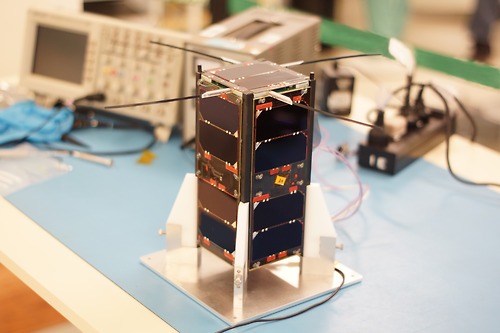
An anonymous reader tipped us about two Argentinian satellites (satellite one, satellite two) that were sent in 2013 to space. What is interesting about them? They are both based on commercial off-the-shelf (COTS) components, and the team released the framework & flight computer software for their main platform (named cubesat, GitHub link). Gunter’s space page not only impresses us by showing the quantity of small/amateur satellites sent each month to space, but also lets us know that the hardware source files for CudeBug 1/2 are meant to be released. In the meantime we can only gather that they’re using a Texas Instruments TMS570 running FreeRTOS. Nevertheless, the two different web pages (in spanish and english) offer us a very interesting glimpse of what it takes to send an electronic project to space and how it later behaves.

You may also be interested in checking out ArduSat, a successful kickstarter campaign aimed at sending Arduino experiments in space.