Fractals Among Us

Think not of what you see, but what it took to produce what you see

Benoit Mandelbrot

Randomness is all around you…or so you think. Consider the various shapes of the morning clouds, the jagged points of Colorado’s Rocky Mountains, the twists and turns of England’s coastline and the forks of a lightning bolt streaking through a dark, stormy sky. Such irregularity is commonplace throughout our natural world. One can also find similar irregular structures in biology. The branch-like structures in your lungs called Bronchi, for instance, fork out in irregular patterns that eerily mirror the way rivers bifurcate into smaller streams. It turns out that these irregular structures are not as irregular and random as one might think. They’re self-similar, meaning the overall structure remains the same as you zoom in or out.

The mathematics that describes these irregular shapes and patterns would not be fully understood until the 1970s with the advent of the computer. In 1982, a renegade mathematician by the name of Benoit Mandelbrot published a book entitled “The Fractal Geometry of Nature”.  It was a revision of his previous work, “Fractals: Form, Chance and Dimension” which was published a few years before. Today, they are regarded as one of the ten most influential scientific essays of the 20th century.

Mandelbrot coined the term “Fractal,” which is derived from the Latin word fractus, which means irregular or broken. He called himself a “fractalist,” and often referred to his work as “the study of roughness.” In this article, we’re going to describe what fractals are and explore areas where fractals are used in modern technology, while saving the more technical aspects for a later article.

Continue reading “Fractals Among Us”

New 3D Printer M3D Pro Hits Kickstarter

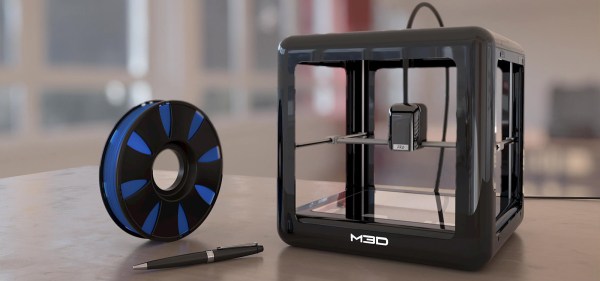
M3D just launched their second 3D printer on Kickstarter. The M3D Pro offers more professional features than its predecessor, the M3D Micro, which is still one of cheapest 3D printers around. Despite the higher price of $499, the campaign reached its $100,000 funding goal within hours.

Continue reading “New 3D Printer M3D Pro Hits Kickstarter”

The Turing Tapes

The recent movie “The Imitation Game” gave [Alan Turing] some well-deserved fame among non-computer types (although the historical accuracy of that movie is poor, at best; there have been several comparisons between the movie and reality). However, for people in the computer industry, Turing was famous for more than just helping to crack Enigma. His theoretical work on computing led to the Turing machine, which is still an important concept for reasoning about computers in a mathematical way. He also laid the foundation for the stored program computer that we take for granted today.

What’s a Turing Machine?

A Turing machine is deceptively simple and, like many mathematical models, highly impractical. Leading off the inpracticalities, the machine includes an infinite paper tape. There is a head that can read and write any symbol to the tape at some position, and the tape can move to the left or the right. Keep in mind that the head can write a symbol over another symbol, so that’s another practical difficulty, although not an insurmountable one. The other issue is that the symbol can be anything: a letter, a number, a jolly wrencher, or a bunch of dots. Again, not impossible, but difficult to do with practical hardware implementations.

Continue reading “The Turing Tapes”

Capacitive Imaging With A Raspberry Pi Touch Screen

We use touch screens all the time these days, and though we all know they support multiple touch events it is easy for us to take them for granted and forget that they are a rather accomplished sensor array in their own right.

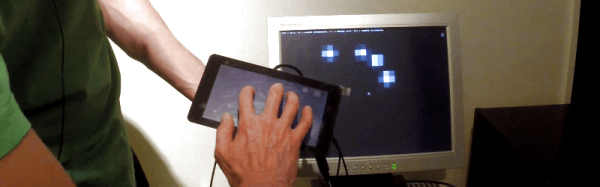
[Optismon] has long held an interest in capacitive touch screen sensors, and has recently turned his attention to the official Raspberry Pi 7-inch touchscreen display. He set out to read its raw capacitance values, and ended up with a fully functional 2D capacitive imaging device able to sense hidden nails and woodwork in his drywall.

Reading the capacitance values is not a job for the faint-hearted though. There is an I2C bus which is handled by the Pi GPU rather than the processor, and to read it in software would require a change to the Pi’s infamous Broadcom binary blob. His solution which he agrees is non-optimal was to take another of the Pi’s I2C lines that he could talk to and connect it in parallel with the display line. As a result he can catch the readings from the screen’s sensors and with a bit of scripting make a 2D display on the screen. The outlines of hands and objects on his desk can clearly be seen when he places them on the screen, and when he runs the device over his wall it shows the position of the studding and nails behind the drywall.

He’s posted his code in a GitHub repository, and put up the YouTube video of his capacitive imaging in action which you can watch below the break.

Continue reading “Capacitive Imaging With A Raspberry Pi Touch Screen”

Infrared Targeting On A Small Scale

Sometimes, a person has a reason to track a target. A popular way to do this these days is with a camera, a computer, and software to analyze the video. But, that lends itself more to automated systems, like sentries. What if you want to be able to target something by “painting” it with a laser?

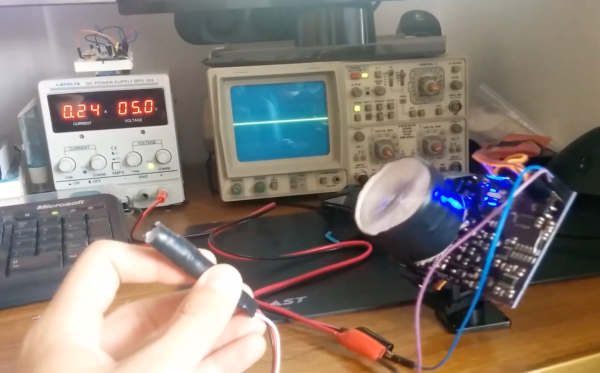
That’s exactly what [Jeremy Leaf] wanted to do, and the results are pretty impressive. He was able to track a .06 milliwatt laser at 2 meters. His design does this using three photodiodes in order to determine the position of a laser spot using triangulation.

Once the location of the laser spot has been determined, it can either simply be reported or it can be tracked. Tracking is achieved with a gimbal setup which updates quickly and accurately. Of course, it can only track the laser if the laser has something to be projected upon. If you need to track something in open 3D space, there are alternatives that would be better suited to the task.

Continue reading “Infrared Targeting On A Small Scale”

Hackaday Prize Entry: Robot Shore

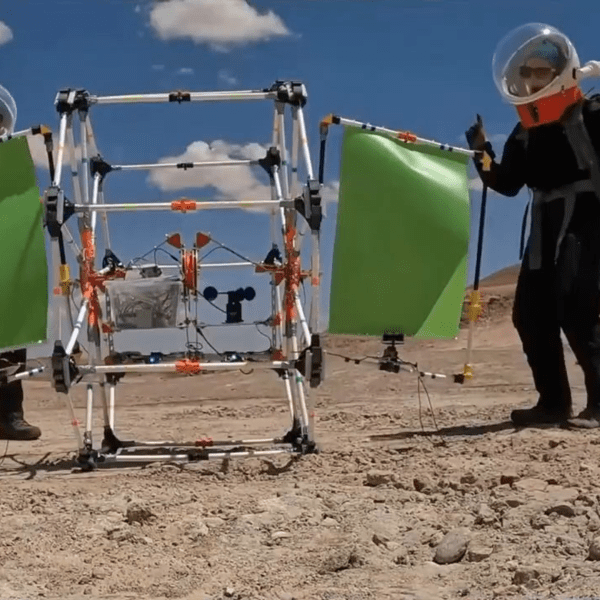
Everyone knows the ocean is not a gigantic garbage can, but unless you live in the middle of Asia, below sea level, Utah, or some other inhospitable place, all trash eventually makes it to sea. This is a problem not only for the the sea and the Great Pacific Garbage Patch, but for shorelines as well. For her Hackaday Prize entry, [Erin] is building a series of robots designed to walk the shore, pick up garbage, deposit it in a bin, and do it again after the next high tide.

The key problem for a robot that picks up trash is simply finding that trash. This means cameras and a lot of computing power. Lucky for [Erin], smartphones are cheap and have excellent cameras and a ton of processing power. The brains for these robots will be built around an off-the-shelf smartphone mounted on a pan/tilt mast on the bot.

[Erin] is already testing her bot, and after a few field tests she noticed a family left behind their trash on the beach. The robot moved into action before the flying rats could choke on a bottlecap, and the cleanup operation was a success. Not bad for a prototype, and an excellent entry to the Hackaday Prize.

Struggling Robot Made With DIY Soft Limbs

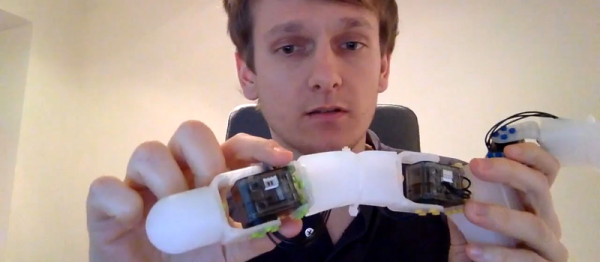
[Jonathan Grizou] is experimenting with robot designs, and recently stumbled upon a neat method for making soft robots. While his first prototype, a starfish like robot, doesn’t exactly “whelm” a person with it’s grace and agility, it proves the concept. Video after the break.

In this robot the frame is soft and the motor provides most of the rigidity for the structure. The soft parts of the frame have hardpoints embedded into them for mounting the motors or joining sections together. The sections are made with 3D printed molds. The molds hold the 3D printed hard points in place. Silicone is poured into the mold and left to cure overnight. The part is then demolded and is ready for use.

Continue reading “Struggling Robot Made With DIY Soft Limbs”