Lego-Like Chemistry And Biology Erector Set

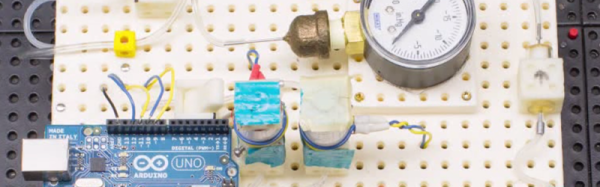
A team of researchers and students at the University of California, Riverside has created a Lego-like system of blocks that enables users to custom build chemical and biological research instruments. The system of 3D-printed blocks can create a variety of scientific tools.

The blocks, which are called Multifluidic Evolutionary Components (MECs) appeared in the journal PLOS ONE. Each block in the system performs a basic lab instrument task (pumping fluids, making measurements or interfacing with a user, for example). Since the blocks are designed to work together, users can build apparatus — like bioreactors for making alternative fuels or acid-base titration tools for high school chemistry classes — rapidly and efficiently. The blocks are especially well suited for resource-limited settings, where a library of blocks can create a variety of different research and diagnostic tools.

Continue reading “Lego-Like Chemistry And Biology Erector Set”

Intel Releases The Tiny Joule Compute Module

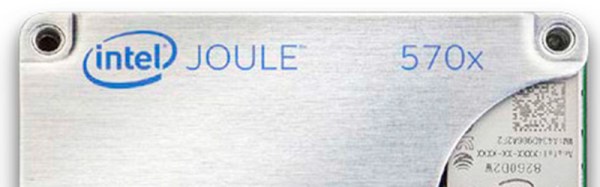
At the keynote for the Intel Developers Forum, Intel CEO Brian Krzanich introduced the Intel Joule compute module, a ‘maker board’ targeted at Internet of Things developers. The high-end board in the lineup features a quad-core Intel Atom running at 2.4 GHz, 4GB of LPDDR4 RAM, 16GB of eMMC, 802.11ac, Bluetooth 4.1, USB 3.1, CSI and DSI interfaces, and multiple GPIO, I2C, and UART interfaces. According to the keynote, the Joule module will be useful for drones, robotics, and with support for Intel’s RealSense technology, it may find a use in VR and AR applications. The relevant specs can be found on the Intel News Fact Sheet (PDF).

This is not Intel’s first offering to the Internet of Things. A few years ago, Intel partnered up with Arduino (the Massimo one) to produce the Intel Galileo. This board featured the Intel Quark SoC, a 400MHz, 32-bit Intel Pentium ISA processor. It was x86 in an Arduino format. This was quickly followed by the Intel Edison based on the same Quark SoC, which was followed by the Intel Curie, found in the Arduino 101 and this year’s DEF CON badge.

We’ve seen plenty of Intel’s ‘maker’ and Internet of Things offerings, but we haven’t seen these platforms succeed. You could spend hundreds of thousands of dollars in market research to determine why these platforms haven’t seen much success, but the Hackaday comments will tell you the same thing for free: the documentation for these platforms is sparse, and nobody knows how to make these boards work.

Perhaps because of the failures of Intel’s IoT market, the Joule differs significantly from previous offerings. Although it can be easily compared to the Raspberry Pi, Beaglebone, and a hundred other tiny single board computers, the official literature for the Joule makes a comparison between it and the Nvidia Jetson easy. The Nvidia Jetson is a high-power, credit card-sized ‘supercomputer’ meant to be a building block for high-performance applications, such as drones and anything that requires video or a very fast processor. The Joule fits into this market splendidly, with demonstrated applications including augmented reality safety glasses for Airbus employees and highway patrol motorcycle helmet displays. Here, the Joule might just find a market. This might even be the main focus of the Joule – it can be integrated onto Gumstix carrier boards, providing a custom single board computer with configurable displays, connectors, and sensors.

The Intel Joule lineup consists of the Joule 570x and 550x, with the 550x being a bit slower, a Gig less RAM, and half as much storage. They will be available in Q4 2016 from Mouser, Newegg, and other Intel reseller partners.

Solar-powered Weather Station Has The Complete Suite Of Sensors

There was a time when getting weather conditions was only as timely or as local as the six o’clock news from the nearest big-city TV station. Monitoring the weather now is much more granular thanks to the proliferation of personal weather stations. For the ultimate in personalized weather, though, you might want to build your own solar powered weather station.

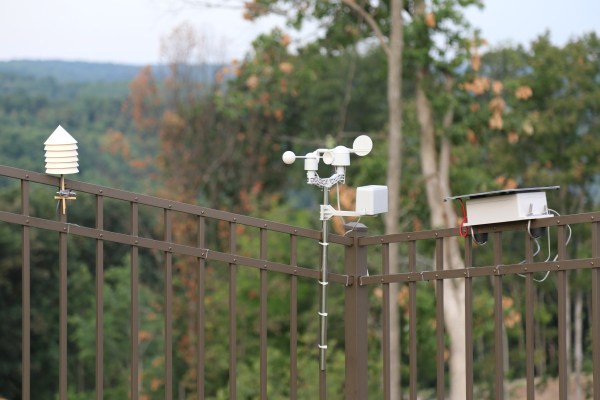
It looks like [Brian Masney] went all out in designing his weather station. It supports a full stack of sensors – wind speed and direction, rain, temperature, pressure, and dew point. About the only other parameters not supported (yet) are solar radiation, UV, and soil moisture and temperature. The design looks friendly enough that adding those sensors should be a snap – if fact, the 3D models in his GitHub repo suggest that he’s already working on soil sensors. The wind and rain sensor boom is an off-the-shelf unit from Sparkfun, and the temperature and pressure sensors are housed in a very professional 3D printed screen enclosure. All the sensors talk to a Raspberry Pi living in a (hopefully) waterproof enclosure topped with a solar panel for charging the stations batteries. All in all it’s a comprehensive build; you can check out the conditions at [Brian]’s place on Weather Underground.

Weather stations are popular around these parts, as witnessed by this reverse-engineered sensor suite or even this squirrel-logic based station.

Universal Serial Abuse

It’s probable that most Hackaday readers are aware of their own computer security even if they are not specialists. You’ll have some idea of which ports your machines expose to the world, what services they run, and you’ll know of a heap of possible attack vectors even if you may not know about every last one.

So as part of that awareness, it’s likely you’ll be wary of strange USB devices. If someone drops a Flash drive in the parking lot the chances of one of you blithely plugging it into your laptop is not high at all. USB ports are trusted by your computer and its operating system, and to have access to one is to be given the keys to the kingdom.

Our subject today is a DEF CON talk courtesy of [Dominic White] and [Rogan Dawes] entitled “Universal Serial aBUSe“, and it details a USB attack in which they create an innocuous USB stick that emulates a keyboard and mouse which is shared across a WiFi network via a VNC server. This gives an attacker (who can gain momentary physical access to a USB port to install the device) a way into the machine that completely bypasses all network and other security measures.

Their hardware features an AVR and an ESP8266, the former for USB and HID work and the latter to do the heavy lifting and provide WiFi. They started with a Cactus Micro Rev2, but graduated to their own compatible board to make the device more suitable to pose as a USB stick. Both hardware and software files can be found on their GitHub repository, with the software being a fork of esp-link. They go into significant detail of their development and debugging process, and their write-up should be an interesting read for anyone.

Below the break you can find a video description of the attack. It’s not a shock to know that USB ports have such little defense, but it is a sobering moment to realize how far attacks like this one have come into the realm of what is possible.

Continue reading “Universal Serial Abuse”

Tips For Buying Your First Milling Machine

If you’re interested in making things (and since you’re reading this, we’re going to assume you are), you’ve almost certainly felt a desire to make metal parts. 3D printers are great, but have a lot of drawbacks: limited material options, lack of precision, and long printing times. If you want metal parts that adhere to even moderately tight tolerances, a milling machine is your only practical option. There is, after all, a very good reason that they’re essential to manufacturing.

However, it can be difficult to know where to start for the hobbyist who doesn’t have machining experience. What kind of milling machine should you get? Should you buy new or used? What the heck is 3-phase power, and can you get it? These questions, among many others, can be positively overwhelming to the uninitiated. Luckily, we — your friends at Hackaday — are here to help give you some direction. So, if you’re ready to learn, then read on! Already an expert? Leave some tips of your own in the comments!

Continue reading “Tips For Buying Your First Milling Machine”

Introducing The Teensy 3.5 And 3.6

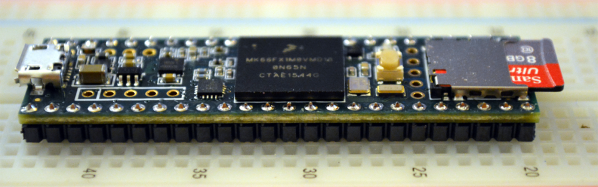
Paul Stoffregen has built a new Teensy. The latest in the line of very powerful, USB-capable microcontrollers is the Teensy 3.5 and 3.6 development boards. It’s faster, more capable, and bigger putting even more pins on a solderless breadboard.

The first Teensy was one of the first Arduino compatible boards with native USB. The Teensy 2.0 was even better with support for USB keyboards, mice, and MIDI. Even today, the Teensy 2.0 is the de facto board to use if you want to build anything like a USB keyboard. The Teensy 2.0 was followed by the exceptionally powerful Teensy 3.0, the first 32-bit Arduino compatible board, and thanks to Paul’s contributions of a pile of Arduino libraries, doing cool stuff faster has never been easier. Since the launch of the Teensy 3.0, its successors, the 3.1 and 3.2 have launched. If you want the power of an ARM microcontroller with the deepest Arduino library support, there’s only one board you should consider.

Like the launch of the Teensy 3.0, Paul is Kickstarting the launch of the latest Teensys with a crowdfunding campaign. Let’s dig into everything these new boards have to offer.

Continue reading “Introducing The Teensy 3.5 And 3.6”

Nerd-Bait: ESP8266 + ILI9341 Screen

In honor of my-own-damn-self, we’re going to call it Elliot’s Law: “When any two interesting parts get cheap enough on eBay, someone will make an interface PCB for them.”

IMG_3830

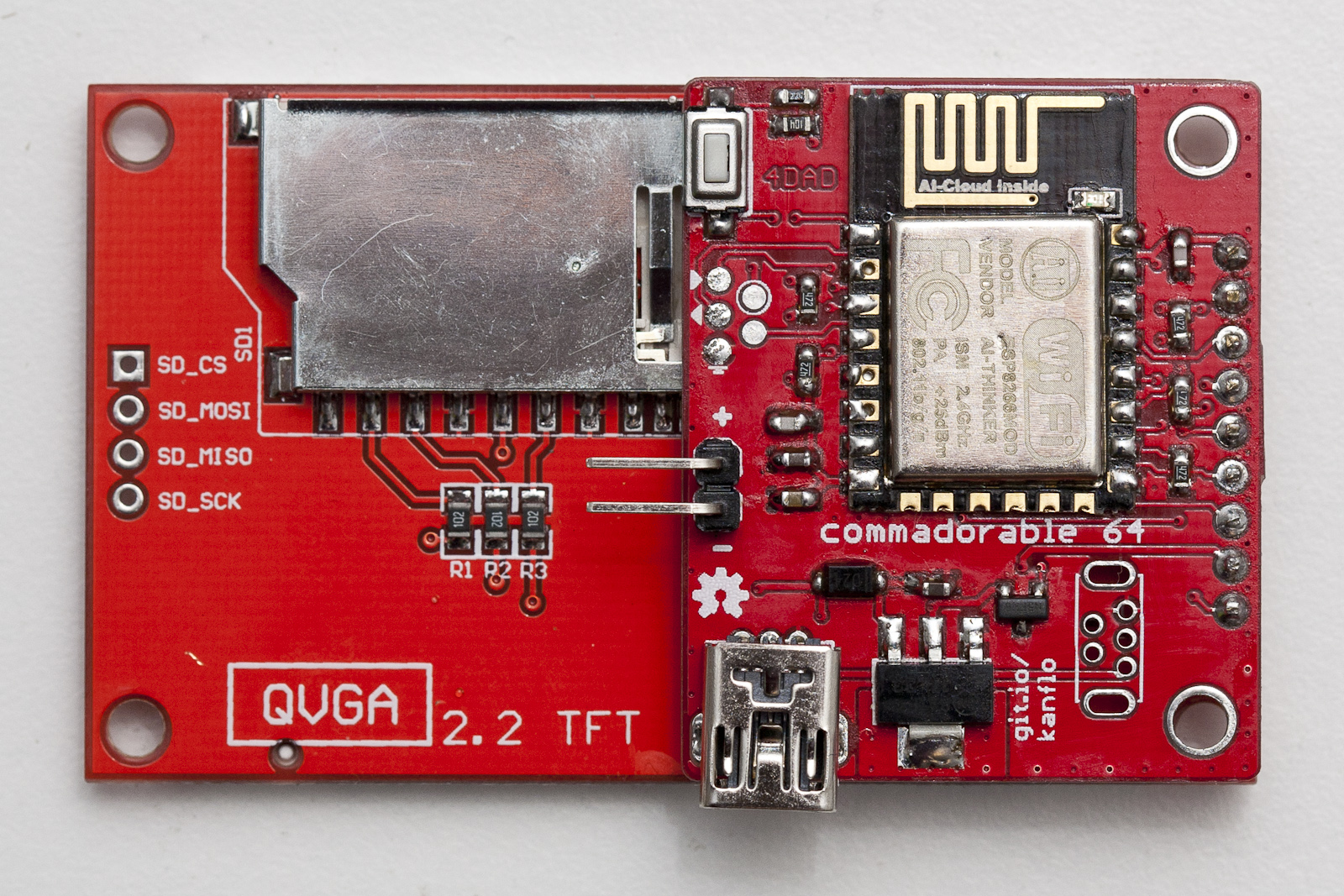
And so it is with [Johan Kanflo]’s latest bit of work: a PCB that mounts an ESP8266 module onto the back of an ILI9341 color display, with user button, power supply, and an auxiliary MOSFET. Four bucks for the screen, four bucks for the ESP8266 module, and a few bucks here and there on parts and PCB, and you’ve got an Internet-enabled, full-color, 320×240 graphical display. That’s pretty awesome, and it’s entirely consistent with Elliot’s Law.

However, we almost can’t forgive [Johan] for the extreme geek-baiting. Posting the cuuuute little screen next to a Stormtrooper Lego figure is already hitting below the belt, but displaying a Commodore-64 startup screen, in what’s got to be exactly the right font and color combo, borders on being pathologically emotionally manipulative. You’re playing with our hearts, [Kanflo]!

We love projects like his ESP8266-and-RFM69 mashup and his gutted-Macintosh-planespotter-gizmo, so we’re inclined to forgive. And besides, we’re still on a high from naming our first law and we’re wondering which two eBay parts are up next.