The Physics Behind Antennas

If you have done any sort of radio work you probably have a fair idea about what antennas do. It is pretty easy to have a cursory understanding of them, too. You probably know there’s something magic about antennas that are a quarter wave long or a half wave long and other multiples. But do you know why that matters? Do you understand the physics of why wire in a special configuration will cause signals to propagate through space? [Learn Engineering] does, and their new video is one of the best graphical explanations of what’s really going on in an antenna that we’ve seen. You can watch the video below.

If you tackle antennas using math, it is a long discussion. However, this video is about 8 minutes long and uses some great graphics to show how moving charges can produce a propagating electromagnetic field.

Continue reading “The Physics Behind Antennas”

Motorized Lens Controller Techs Up Your Webcam

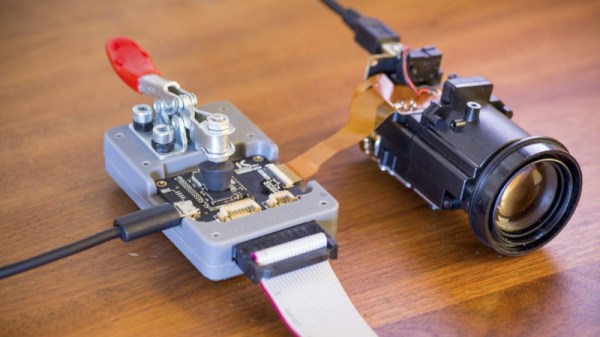
If you’re familiar with the DSLR camera market, you’d know that modern lenses are works of technological art. Crammed full of motors and delicate electronic assemblies, they’re bursting with features such as autofocus, optical stabilization and zoom. [Saulius Lukse] has been experimenting with motorized lenses for webcam applications, and has built a controller to make working with them a snap.

The controller is capable of controlling up to 3 stepper motors, as well as a voice coil, which should be enough for the vast majority of lenses out there. Microstepping is supported, which is key for optical systems in which tiny adjustments can make a big difference. The controller speaks USB and I2C, and is now based on an STM32 chip, having been upgraded from an earlier version which used the venerable ATmega328. The board is designed to be as compact as possible, to enable it to neatly fit inside camera and lens assemblies.

The board has been used to successfully control an 18x zoom lens, among others. Combining such a lens with a webcam and a good pan and tilt mechanism would create a highly capable surveillance package, or an excellent vision system for a robot.

It’s not the first time we’ve seen work from [Kurokesu] in these parts – they’ve done work on pedestrian detection before, too.

This Nerf Gun Is Terrifyingly Huge

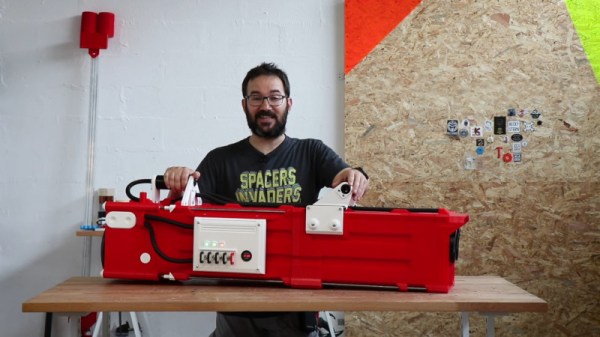
Gatling guns were an early attempt at creating a rapid-firing weapon, and were popular amongst armies in the 19th century. Today, the basic design remains in use as a heavy weapon for putting many rounds downrange very quickly. [Ivan Miranda] decided that the Nerf world was missing a piece of the action, and got started on his own design (Youtube link, embedded below).

As per most [Ivan] builds, this one is a glorious pile of 3D printed parts turned into something functional and fun. It’s an ingenious design that’s more a Gatling in spirit than reality as it lacks the multiple barrels of the original, and it uses smart ducting to allow a single electric fan to both fire the foam Nerf balls as well as suck them in to reload the next shot. In testing, it achieved a muzzle velocity of 60 mph, firing at a rate of approximately 10 rounds/second. The presentation is great too, with plenty of cable wrap, meaty switches, and glowing lights to add to the aesthetic. There are even a couple of bright LED lamps on the front to help dazzle your targets into submission.

Once again, [Ivan]’s work is a great example of what is achievable with a 3D printer and smart design. His water jet drive ain’t bad, either. Video after the break.

Continue reading “This Nerf Gun Is Terrifyingly Huge”

Adding LoRa Long Range Radio To Smartphones And Connected Devices

Would you add another radio to your smartphone? No, not another WiFi or cellular radio; a smartphone already has that. I’m talking about something that provides connectivity through ISM bands, either 433 or 915 MHz. This can be used where you don’t have cell phone coverage, and it has a longer range than WiFi. This is the idea behind Skrypt, a messaging system that allows you to send off-the-grid messages.

Skrypt is an ESP32-based hardware modem that can communicate with a smartphone, or any other device for that matter, over Bluetooth or USB. Inside, there are two modules, an ESP32 WROOM module that provides the Bluetooth, WiFi, USB connectivity, and all of the important software configuration and web-based GUI. The LoRa module is the ubiquitous RFM95W that’s ready to drop into any circuit. Other than that, the entire circuit is just a battery and some power management ICs.

While LoRa is certinaly not the protocol you would use for forwarding pics up to Instagram, it is a remarkable protocol for short messages carried over a long range. That’s exactly what you want when you’re out of range of cell phone towers — those pics can wait, but you might really want to send a few words to your friends. That’s invaluable, and LoRa makes a lot of sense in that case.

Learning About Wearable Engineering While Trying To Un-Taboo A Topic

When you build a machine you can usually count on having precise dimensions for an organized and orderly set of parts, one fitting into the next exactly as you have designed them. You can count on cause and effect — when the user pushes a button or flips a switch a specific behavior will take place. But the She Bon project shows that adding the human body to the mix quickly turns an easy design into a challenging one.

During her Hackaday Superconference talk Sarah Petkus discusses her latest project that uses wearable technology to sense and react to her own body. She Bon is reminiscent of the French for “so good” and is a project whose aim transcends the technical challenges. Sarah uses engineering as a way to facilitate adults having healthy dialogs with one another about sex.

Depending on your profession, this discussion is likely not appropriate for work — it’s not sexual, but it’s fundamentally about sex — so don’t click through the video without thinking twice. But we respect Sarah’s courage for leading a project that wants to make sure there actually are places where it is possible to have these conversations and a way to get them started.

How Do You Begin an Intelligent Conversation?

Mixing an engineering challenge with a somewhat taboo topic works surprisingly well, as you can see in the video below. It’s a technical talk about sensing body temperature, heart rate, galvanic response, blush response, facial expression, and muscle tension. But it’s also a story of her attempt at creating a Suit of Amour, her tongue-in-cheek “Sexual Gundam”. Don’t be fooled, this is no gimmick. The discussions quickly leads to the real life challenges facing prosthetics designers and those developing wearable products. There’s a ton to be learned here.

Join me below for more on the hardware covered in Sarah’s talk. This out-of-the-ordinary hardware creation adventure made it a great entry in the 2018 Hackaday Prize and a particularly delightful talk at the 2018 Hackaday Superconference. We’re once again on the hunt for hardware creators to present at the 2019 Hackaday Superconference — and we can’t do it without you. Submit a talk proposal, or just grab a ticket and join us in Pasadena this November. Bonus points for those who have also entered their projects in the 2019 Hackaday Prize. Okay, now onto the hardware talk.

Continue reading “Learning About Wearable Engineering While Trying To Un-Taboo A Topic”

Minimalist Word Clock Does Things Neatly

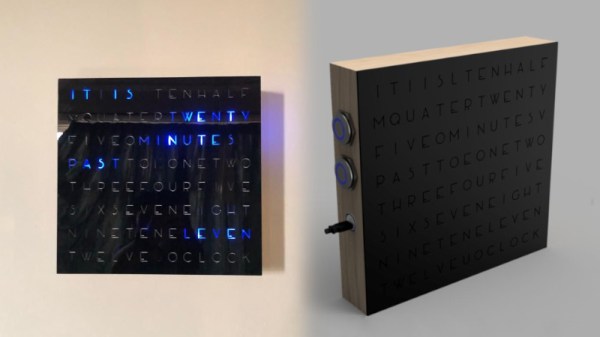
Word clocks are a cool way to tell the time. While they could have probably been built back in the 1960s with a bunch of relays and bulbs, they really only came into their own in the LED-everything era. [Vatsal Agarwal] built one of his own, showcasing his maker credentials.

It’s a build that relies on good woodworking practices from the ground up. Maple wood is used for the frame, cut and prepared on a miter saw for accurate assembly. MDF is used for panels that are out of sight, and teak strips act as light barriers to ensure only the right words are lit at any given time. The front panel is a sleek black acrylic piece, adding to the minimalist look. Neopixels serve as the light source, controlled by an Arduino Uno. As a finishing touch, some glowy stainless steel buttons are mounted on the side to control the clock.

It’s a build that serves as a great introduction to woodwork, as well as more modern skills like CAD design for laser cutting, as well as programming. They’re a great way to get stuck into making, and you can even go pocket-sized if you’re truly brave. Incidentally, if you do take up the challenge of an all-analog relay-based build, make sure you drop us a line.

Robotic Dishwashers And Dishwashing As A Service

There’s a story that goes back to the 1980s or so about an engineering professor who laid down a challenge to the students of his automation class: design a robot to perform the most mundane of household tasks — washing the dishes. The students divided up into groups, batted ideas around, and presented their designs. Every group came up with something impressive, all variations on a theme with cameras and sensors and articulated arms to move the plates around. The professor watched the presentations respectfully, and when they were done he got up and said, “Nice work. But didn’t any of you idiots realize you can buy a robot that does dishes for $300 from any Sears in the country?”

The story may be apocryphal, but it’s certainly plausible, and it’s definitely instructive. The cultural impression of robotics as a field has a lot of ballast on it, thanks to decades of training that leads us to believe that robots will always be at least partially anthropomorphic. At first it was science fiction giving us Robbie the Robot and C3PO; now that we’re living in the future, Boston Dynamics and the like are doing their best to give us an updated view of what robots must be.

But all this training to expect bots built in the image of humans or animals only covers a narrow range of use cases, and leaves behind the hundreds or thousands of other applications that could prove just as interesting. One use case that appears to be coming to market hearkens back to that professor’s dishwashing throwdown, and if manufacturers have their way, robotic dishwashers might well be a thing in the near future.

Continue reading “Robotic Dishwashers And Dishwashing As A Service”