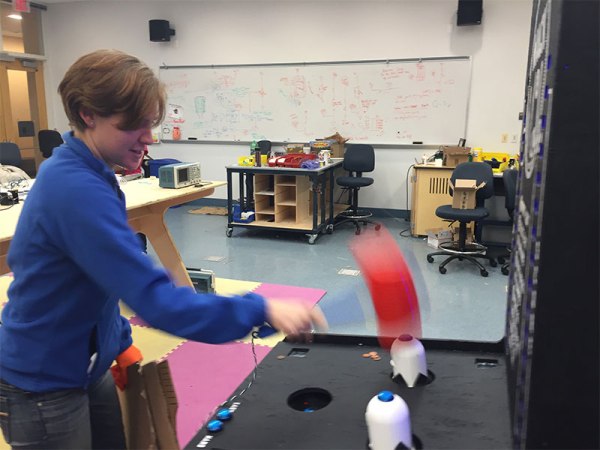
Engineers Create Super-Hard Whack-a-Mole

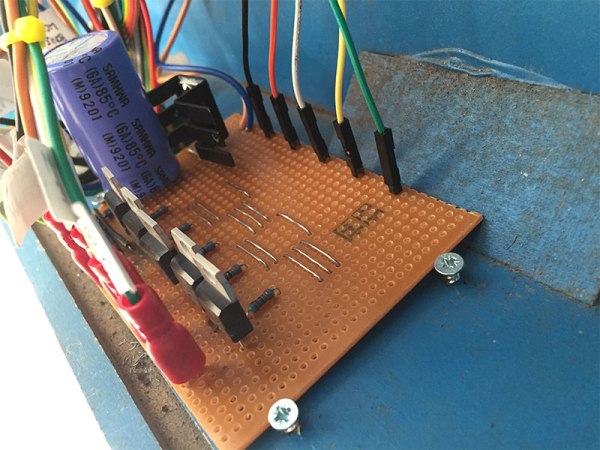
Is your latest project driving you mad? Are you subject to occasional fits of rage? This project might help: for a class called elecanisms at Olin College, [Forrest] and a team of three other students made a whack-a-mole arcade game that lets you vent your rage on a helpless furry animal by whacking it with a large hammer. He built most of it from scratch, creating his own solenoid driver and LED sensor board. However, there is a twist in here that gives the moles a fighting chance: there is an accelerometer built into the hammer that lets them know that your heavy hammer of doom is approaching.

Will they escape before your righteous wrath descends upon them? That depends on how you decide to set it up, and how merciful you want to be. The build even includes a coin-operated pay-to-play slot. They kept the cost low at a penny, but this is just begging to be installed at the local pub to rake in those quarters.

This course has been the source of a few projects that we have featured before on Hackaday, including the Confectionary Canon, which tracks your face and fires marshmallows right into your gaping maw.

Continue reading “Engineers Create Super-Hard Whack-a-Mole”

Amazon Echo Orders The Roku About

You can add the Roku media player to the list of devices that can be bossed about by the Amazon Echo and its built-in AI: Alexa. [Julian Hartline] has figured out how to use Amazon’s voice-controlled Echo device with a Roku media player. He did this by using the Alexa Skills Kit, the SDK that provides a programmer’s interface into the functions of the device. That allows you to add functions to the Alexa and the AWS Lambda cloud service that processes the voice commands (Amazon calls this an Alexa Skill).

Rather than have the cloud service talk directly to the Roku, though, he decided to have a local node.js server act as an intermediary. The Alexa sends the voice command to the AWS Lambda service, which processes it, sends the command to the node.js service, which finally sends the command to the Roku. It works, but it seems a little slow to respond: see the video after the break. In the example shown, Alexa actually causes the Roku to launch Netflix and input a search string for the requested show. Pretty slick!

Continue reading “Amazon Echo Orders The Roku About”

Ghost Guitar Plays Hendrix

Purple Haze all in my brain,
lately guitars they don’t seem the same,
[Josh] is playin’ funny but I don’t know why
‘scuse me while he electrifies.

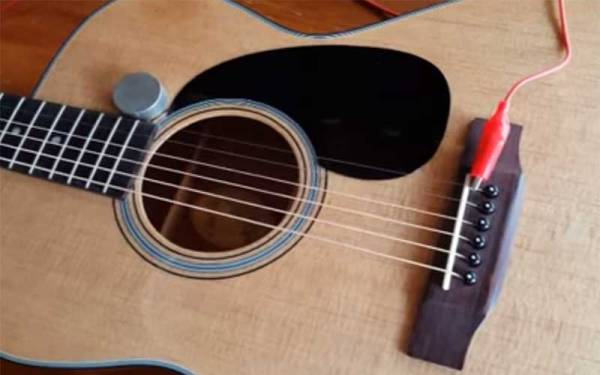
[Josh] wanted to experiment with playing a guitar by different means. We’ve seen a few guitar hacks that use servos to play, and Arduino-based guitars that replace the strings with membrane potentiometers, but he decided to try a different approach. He’s using a permanent magnet and the electromagnetic effect to play the string.

Purple Haze all around,
all those amps are runnin’ up or down.
Are my strings all goin’ left or right?
Whatever it is, electromagnetism is pushin’ me outta sight.

To do this, he put a large permanent magnet next to the string and ran an alternating current through the string itself. When the current and the magnetic field interact, the string is pushed, like the bearing of a motor.  When the current goes the other way, the string is pushed in the opposite direction. Because he is using an alternating current (driven through a MOSFET tied into a frequency generator), he was able to control the frequency of this, and find the frequencies that made the string resonate, including the harmonics that give guitars their unique sound. It’s a pretty neat hack, but don’t forget that he is dealing with quite a lot of juice: if you were to inadvertantly touch the string and ground it to earth, there is enough current in the circuit to kill you.

Yeah, [Josh’s] hack is all about the right hand rule,
I know that he’s no hacking fool,
you’ve got my E string resonating, resonating so fine
just don’t touch it, or you’ll end your time
Help me, yeah, Purple Haze!

(with apologies to the ghost of [Jimi Hendrix], guitar hacker supreme)

Continue reading “Ghost Guitar Plays Hendrix”

Old Kindle Upcycled To Emailable Fridge Messageboard

We’ve all got a pile of old devices lying around somewhere that are waiting to be torn down for parts, or turned into something useful. [Peter Voljek] decided to do the latter with an old Kindle eBook reader, turning it into a neat message board that can be stuck onto a fridge. With the addition of some server-side Ruby code, you can send messages to this by email, and it automatically displays the last message received. Throw on some magnetic sticky tape and you have a neat fridge door noticeboard.

[Peter] runs his Ruby web server on a Raspberry Pi, but it should run on any platform that supports Ruby, so you could run it on a NAS device, or pretty much anything that has a web server built in. The Kindle side of the hack exploits some secret commands to disable the screensaver, then uses AJAX and JavaScript to automatically refresh the webpage the RPi is serving.

Hey, why not combine this with the Kindle weather station hack to create a noticeboard that tells you what you need from the store, and reminds you why you shouldn’t leave the house at the same time?

Teardown Of Intel RealSense Gesture Camera Reveals Projector Details

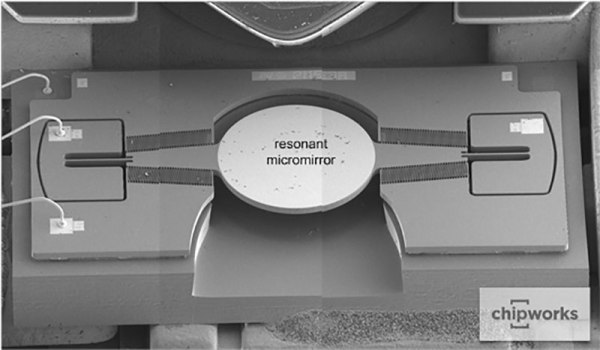
[Chipworks] has just released the details on their latest teardown on an Intel RealSense gesture camera that was built into a Lenovo laptop. Teardowns are always interesting (and we suspect that [Chipworks] can’t eat breakfast without tearing it down), but this one reveals some fascinating details on how you build a projector into a module that fits into a laptop bezel. While most structured light projectors use a single, static pattern projected through a mask, this one uses a real projection mechanism to send different patterns that help the device detect gestures faster, all in a mechanism that is thinner than a poker chip.

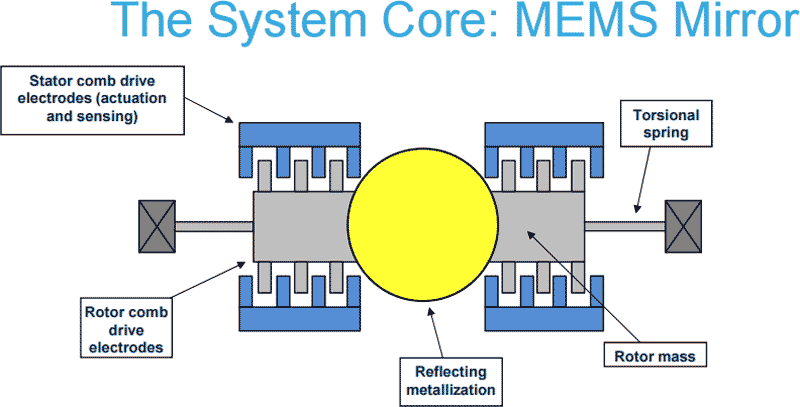
mechanism1It does this by using an impressive miniaturized projector made of three tiny components: an IR laser, a line lens and a resonant micromirror. The line lens takes the point of light from the IR laser and turns it into a flat horizontal line. This is then bounced off the resonant micromirror, which is twisted by an electrical signal. This micromirror is moved by a torsional drive system, where an electrostatic signal twists the mirror, which is manufactured in a single piece. The system is described in more detail in this PDF of a presentation by the makers, ST Micro. This combination of lens and rapidly moving mirrors creates a pattern of light that is projected, and the reflection is detected by the IR camera on the other side of the module, which is used to create a 3D model that can be used to detect gestures, faces, and other objects. It’s a neat insight into how you can miniaturize things by approaching them in a different way.

Pinball Table Gets New Lease Of Life With Arduino

Forget all of this video game nonsense: pinball is the real king of gaming. After all, it involves large pieces of metal flying around at high speed. [retronics] agrees: he has resurrected an old Briarwood Aspen pinball table using an Arduino.

pinball-table-repairWhen he bought the table, he found that the electronics had been fried: many of the discrete components on the board had been burnt out. So, rather than replace the individual parts, he gutted the table and replaced the logic board with an Arduino Mega that drives the flippers, display and chimes that make pinball the delightful experience it is. Fortunately, this home pinball table is well documented, so he was able to figure out how to rewire the remaining parts fairly easily, and how to recreate the scoring system in software.

His total cost for the refurb was about $300 and the junker was just $50 to start with. Now for $350 you can probably find a working pinball table. But that’s not really the point here: he did it for the experience of working with electromechanical components like flippers and tilt switches. We would expect nothing less from the dude who previously built an Android oscilloscope from spare parts.

Continue reading “Pinball Table Gets New Lease Of Life With Arduino”