Better Stepping With 8-Bit Micros

The electronics for motion control systems, routers, and 3D printers are split into two camps. The first is 8-bit microcontrollers, usually AVRs, and are regarded as being slower and incapable of cool acceleration features. The second camp consists of 32-bit microcontrollers, and these are able to drive a lot of steppers very quickly and very smoothly. While 32-bit micros are obviously the future, there are a few very clever people squeezing the last drops out of 8-bit platforms. That’s what the Buildbotics team did with their ATxmega chip — they’re using a clever application of DMA as counters to drive steppers.

The usual way of driving steppers quickly with an ATMega or other 8-bit microcontroller is abusing the hardware timers. It’s quick, but there is a downside. It takes time for these timers to start and stop, and if you’re doing it two hundred times per second with four stepper motors, that clock jitter will ruin your CNC machine. The solution is to use a DMA channel to count down, with each count sending out a pulse to a stepper. It’s a clever abuse of the hardware, and the only drawback is the micro can’t send more than 2¹⁶ pulses per any 5ms period. That’s not really an issue because that would mean some very, very fast acceleration.

The Buildbotics team currently has a Kickstarter running for their four-axis CNC controller using this technique. It’s designed for Taig mills, 6040 routers, K40 lasers, and other various homebrew robots. It’s an interesting solution to the apparent end of the of the age of 8-bit microcontrollers in CNC machines and certainly worth checking out.

Hackaday Links Column Banner

Hackaday Links: September 17, 2017

BREAKING NEWS: APPLE HAS RELEASED A NEW RECTANGLE. IT IS BETTER THAN THE PREVIOUS RECTANGLE, WHICH WAS A LESSER RECTANGLE. SOME PEOPLE ARE UNHAPPY WITH THE NEW RECTANGLE BECAUSE OF [[CHANGES]]. THE NEW RECTANGLE HAS ANIMATED POO.

Mergers and acquisitions? Not this time. Lattice Semiconductor would have been bought by Canyon Bridge — a private equity firm backed by the Chinese government — for $1.3B. This deal was shut down by the US government because of national security concerns.

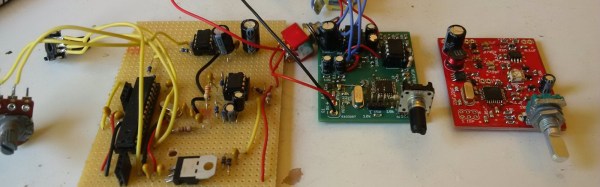
[Jan] is the Internet’s expert in doing synths on single chips, and now he has something pretty cool. It’s a breadboard synth with MIDI and CV input. Basically, what we’re looking at is [Jan]’s CVS-01 chip for a DCO, DCF, and DCA), a KL5 chip for an LFO, and an envelope chip. Tie everything together with a two-octave captouch keyboard, and you have a complete synthesizer on a breadboard.

As an aside relating to the above, does anyone know what the cool kids are using for a CV/Gate keyboard controller these days? Modular synths are making a comeback, but it looks like everyone is running a MIDI keyboard into a MIDI-CV converter. It seems like there should be a –simple, cheap– controller with quarter-inch jacks labeled CV and Gate. Any suggestions?

World leaders are tweeting. The Canadian PM is awesome and likes Dark Castle.

Way back in July, Square, the ‘POS terminal on an iPad’ company posted some data on Twitter. Apparently, fidget spinner sales peaked during the last week of May, and were declining through the first few weeks of summer. Is this proof the fidget spinner fad was dead by August? I have an alternate hypothesis: fidget spinner sales are tied to middle schoolers, and sales started dropping at the beginning of summer vacation. We need more data, so if some of you could retweet this, that would be awesome.

Remember [Peter Sripol], the guy building an ultralight in his basement? This is going to be a five- or six-part video build log, and part three came out this week. This video features the installation of the control surfaces, the application of turnbuckles, and hardware that is far too expensive for what it actually is.

Hackaday Prize Entry: You Can Tune A Guitar, But Can You Reference REO Speedwagon?

Just for a second, let’s perform a little engineering-based thought experiment. Let’s design a guitar tuner. First up, you’ll need a 1/4″ input, and some op-amps to get that signal into a microcontroller. In the microcontroller, you’re going to be doing some FFT. If you’re really fancy, you’ll have some lookup tables and an interface to switch between A440, maybe A430, and if you’re a huge nerd, C256. The interface is simple enough — just use a seven-segment display and a few LEDs to tell the user what note they’re on and how on-pitch they are. All in all, the design isn’t that hard.

Now let’s design a tuner for blind musicians. This makes things a bit more interesting. That LED interface isn’t going to work, and you’ve got to figure out a better way of telling the musician they’re on-pitch. This is the idea of [Pepijn]’s Accessible Guitar Tuner. It’s a finalist in The Hackaday Prize Assistive Technology round, and a really interesting problem to solve.

Most of [Pepijn]’s tuner is what you would expect — microcontrollers and FFT. The microcontroller is an ATMega, which is sufficient enough for a simple guitar tuner. The real trick here is the interface. [Pepijn] modulating the input from the guitar against a reference frequency. The difference between the guitar and this reference frequency is then turned into clicks and played through headphones. Fewer clicks mean the guitar is closer to being in tune.

This is one of those projects that’s a perfect fit for the Hackaday Prize Assistive Technology round. It’s an extremely simple problem to define, somewhat easy to build, and very useful. That doesn’t mean [Pepijn] isn’t having problems — he’s having a lot of trouble with the signal levels from a guitar. He’s looking for some help, so if you have some insights in reading signals that range from tiny piezos to active humbuckers, give him a few words of advice.

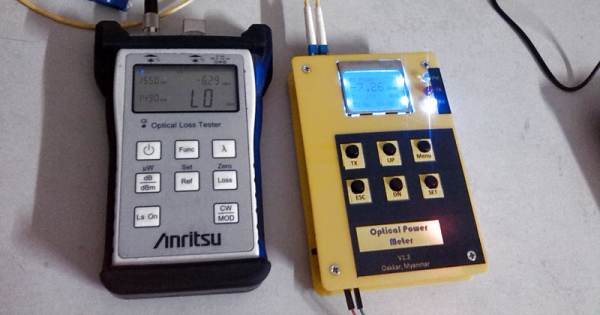
Hackaday Prize Entry: An Optical Power Meter

This is the type of crowd that’s famous for building their own test equipment. If you need a way to program a flash chip, don’t go out and buy one — you can just build one. Need a spectrum analyzer? You can build that out of copper clad board. For his Hackaday Prize entry, [oakkar7] is building an optical power meter, capable enough to do futzy fiber work, but still completely DIY.

When you get into networking and telecom connections that don’t begin with the letters ‘RJ’, you start to stumble upon SPF transceivers. These ‘small form factor pluggable’ devices are little modular transceivers capable of handling fiber, Gigabit Ethernet, and other slightly weirder bit pipes. When used with fiber, they can measure optical power in dBm and watts, and can be debugged by a UART.

[oakkar]’s optical power meter uses these SPF transceivers, tied together with a fairly simple circuit consisting of an Arduino, a few tact switches, a Nokia LCD, and an FTDI UART. The key in tying all of this together is an Arduino library for SPF and DDM (Digital Diagnostics Monitoring), giving the user access to all the configuration bits in these transceivers.

While the circuit is simple enough to be built on a piece of perfboard, [oakkar] really knocked it out of the park with the enclosure on this one. With just a little bit of laser cut acrylic and a few standoffs, [oakkar] has a device that actually looks professional, and has most of the capabilities of fancier, more expensive tools.

Friday Hack Chat: Open Source Startups

If you want to found a company, you’ll find pages and pages of advice scattered around the Internet telling you exactly how to do that. What if you want to found an Open Source hardware company? That’s a bit harder — you can’t do hardware as a service, and that Open Source moniker will drive away investors.

[Zach Fredin] is one of the rare founders that are making an Open Source hardware company work. In 2015, he developed NeuroBytes, a system of electric neurons designed in such a way that if you get two hundred or so, you can replicate the brain of a flatworm. NeuroBytes was a finalist in the 2015 Hackaday Prize, the team received an NHS grant, and now these PCB neurons will be on the market late this year.

For this week’s Hack Chat, we’re going to be talking to [Zach] about the challenges about creating a company from nothing and doing it the Open Source way. Topics for this Friday’s Hack Chat will include the experience of building an Open Source hardware company, manufacturing, building a community around a product, and business spelled with dollar signs.

This Hack Chat will be Friday, noon, PDT. If you have a question for [Zach]. here’s a spreadsheet we’ll be drawing questions from. Continue reading “Friday Hack Chat: Open Source Startups”

Hackaday Prize Entry: Retrofit A Nokia

The Nokia 3210 is the greatest cell phone ever made. The battery lasted for days, custom color covers were available at every mall kiosk, it had the Snake game, and the chassis for this phone was finely crafted out of the crust of neutron stars. It was indestructible; it is the reason we now appreciate technology over more impermanent concepts like relationships and love.

For his Hackaday Prize entry, [Bastian] is bringing the Nokia 3210 into this century. He’s designing a circuit board with the same footprint, the same button layout, and a better screen that drops right into the lovely plastic enclosure of the 3210.

Also known as, ‘a fun time’

The current BOM for the upgraded 3210 includes an STM32 F7 microcontroller, which is more or less the current top of the line ARM micro you can get. For wireless, [Bastian] is using an A7 GSM/GPRS module and an ESP8266 for a little bit of WiFi. For a dumbphone, this is ludicrously overpowered. Provided [Bastian] gets a prototype up and running, there will be some interesting applications for a device this powerful in a package this indestructible.

One of the things [Bastian] has been butting his head against with this project is KiCad. Microvias don’t work like they should in KiCad — they’re restricted to the outer layers only. This is a problem for routing a complex board like this, so [Bastian] wrote a patch that gives KiCad an ‘I know what I’m doing mode’ for microvias everywhere.

This is truly the spirit of The Hackaday Prize: not only is [Bastian] building something ridiculous, he’s also creating the tools to do it.

These Twenty Assistive Technologies Projects Won $1000 In The Hackaday Prize

Today, we’re excited to announce the winners of the Assistive Technologies portion of The Hackaday Prize. In this round, we’re looking for projects that will help ensure a better quality of life for the disabled. Whether this is something that enhances learning, working, or daily living. These are the projects that turn ‘disability’ into ‘this ability’.

Hackaday is currently hosting the greatest hardware competition on Earth. We’re giving away hundreds of thousands of dollars to hardware creators to build the next great thing. Last week, we wrapped up the fourth of five challenges. It was all about showing a design to Build Something That Matters. Hundreds entered and began their quest to build a device to change the world.

There’s still one entry challenge remaining in The Hackaday Prize. Anything Goes is on right now and open to every idea imaginable. If you’re building a computer made of sand, awesome. Quadcopter hammock? Neat. This is the portion of the Hackaday Prize that’s open to the best ideas out there. It’s up to you to explain how your creation makes the world a little bit better place.

The winners of the Assistive Technologies challenge are, in no particular order:

Assistive Technologies Hackaday Prize Finalists:

Continue reading “These Twenty Assistive Technologies Projects Won $1000 In The Hackaday Prize”