A Universal USB To Quadrature Encoder

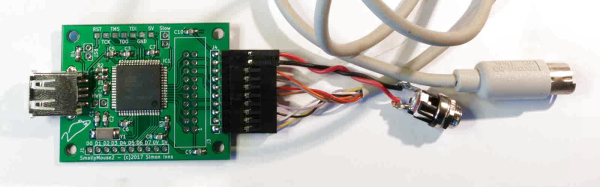
Computer mice existed long before the Mac, and most of the old 8-bit computers had some software that could use a mouse. These mice had balls and quadrature encoders. While converters to turn these old mice into USB devices exist, going the other way isn’t so common. [Simon] has developed the answer to that problem in the form of SmallyMouse2. It turns a USB mouse into something that can be used with the BBC Micro, Acorn Master, Acorn Archimedes, Amiga, Atari ST and more.

The design of the SmallyMouse2 uses an AT90USB microcontroller that supports USB device and host mode, and allows for a few GPIOs. This microcontroller effectively converts a USB mouse into a BBC Micro user port AMX mouse, generic quadrature mouse, and a 10-pin expansion header. The firmware uses the LUFA USB stack, a common choice for these weird USB to retrocomputer projects.

The project is completely Open Source, and all the files to replicate this project from the KiCad project to the firmware are available on [Simon]’s GitHub. If you have one of these classic retrocomputers sitting in your attic, it might be a good time to check if you still have the mouse. If not, this is the perfect project to delve into to the classic GUIs of yesteryear.

Hackaday Prize Entry: Compact Braille Printing Press

For the last few years of the Hackaday Prize, we’ve seen a few projects that aim to bring Braille to the masses in a cheap, easy to use electronic device. Aside from the interesting technology that would go into such a device like tiny motors moving even tinier bumps, these projects are a great example of an enabling technology.

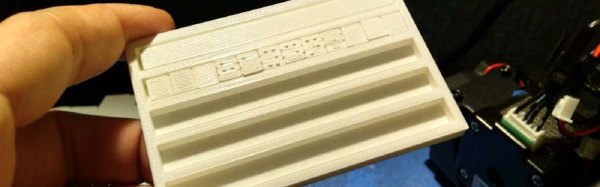
For his Hackaday Prize project, [haydn jones] is building something that makes Braille more accessible, but without all that messy technology. It’s 3D printed movable type for Braille. It’s a Braille printing press for nurses, teachers, and anyone else who would like to leave small notes for people who read Braille.

This Hackaday Prize project is the answer to the question, ‘how do you leave a note for a blind person’. Yes, digital voice recorders exist, but movable type is a technology that’s thousands of years old and doesn’t require batteries or any of the other failings of modern electronics. To use this device, all you need to do is assemble a message — a handy Braille cheat sheet is coming soon — and emboss a piece of paper. Keep in mind Braille embossers cost a small fortune, and this project is simple and cheap bits of plastic.

It’s a great idea, and one we’re surprised we haven’t seen before. All in all, a great entry for The Hackaday Prize.

PrusaControl: The Beginner’s Slicer

There are two main applications for managing 3D prints and G-Code generation. Cura is a fantastic application that is seeing a lot of development from the heavy hitters in the industry. Initially developed by Ultimaker,  Lulzbot has their own edition of Cura, It’s the default software packaged with thousands of different printers. Slic3r, as well, has seen a lot of development over the years and some interesting hacks. Do you want to print non-planar surfaces? Slic3r can do that. Slic3r and Cura are two sides of the CAM part of the 3D printing coin, although Cura is decidedly the prettier side.

The ability to combine the extensibility of Slic3r with the user interface of Cura has been on our wish list for a while now. It’s finally time. [Josef Prusa] has released PrusaControl, a 3D printing CAM solution that combines the best of Slic3r into a fantastic, great looking package. What are the benefits? What’s it like? Check that out below.

Continue reading “PrusaControl: The Beginner’s Slicer”

Hackaday Links Column Banner

Hackaday Links: June 11, 2017

PCB art is getting better and better every year. This year, though, is knocking it out of the park. In March, [Andrew Sowa] turned me into money. More recently, [Trammell Hudson] has explored the layers of OSH Park soldermask and silk to create a masterpiece. Now, we’re moving up to full-blown art. [Blake Ramsdell] worked with OSH Park to create a full panel of art in gold, fiberglass, soldermask, and silkscreen. It’s 22×16 inches, and it’s fantastic.

There’s an independent Hackaday meetup going down in Hong Kong this week. The subject of the meetup will be vacuum systems for electron beam melting, mass spectrometry, and building Nixie tubes.

Why does my circuit still work when I remove some caps? This question was posed to the EEVBlog forums, with a picture attached of  the worst mess of wires I’ve ever seen. This is — supposedly — not a joke, and a complete, functional CPU built out of 74HC series logic on thirty or so solderless breadboards. A weird bonus of access to the tip line at Hackaday means everyone here becomes experts in the field of absurdly constructed electronics. Want to see the worst PCB ever? We’ve seen it. This is, without question, the most rats nest electronic project anyone has ever built.

[Adam West] died this weekend at the age of 88. [West] is perhaps best known for his performance in Lookwell as a crime-solving, washed-up TV action hero. He is survived by his wife, Marcelle, and six children.

There’s a new documentary on [Nolan Bushnell] and the early days of Atari. Documentarian [Bruno Grampa] will be showing his latest, Easy to Learn, Hard to Master at the Computer History Museum in Mountain View on June 23rd. It’s narrated by [Bil Herd], so we’re a bit prejudiced, but check out the trailer.

Hackaday Prize Entry: Earthquake Warnings Via Tweets

Seismic waves travel through the Earth’s crust at about four kilometers a second. Light travels through fiber at about 200,000 kilometers per second. Taking network lag into account, it’s possible to read a Tweet about an earthquake a few seconds before the shaking starts. This is the concept behind an XKCD strip and a project for the Hackaday Prize.

[Zalmotek]’s Earthquake Validation Gadget is an Internet-connected box designed for those few seconds between asking yourself, ‘is this an earthquake’ and saying, ‘yeah, this is totally an earthquake’. Inside this wall-mounted box is both a sensitive vibration sensor and a microcontroller connected to the Internet. If the vibration sensor goes off, it checks the Internet — the USGS website is a great start, by the way — for any large, local earthquakes. If there’s a possibility that shaking is an earthquake, lights and sirens go off, telling you to take cover.

The idea of an ‘earthquake warning device’ isn’t new. The USGS has a system in place for just this sort of thing. It’s good to see independent researchers working on this, though, and it makes for a great entry to the Hackaday Prize.

Casting Cylinder Heads Out Of JB Weld

Like friendship, JB Weld is magic. Rumors persist of shade tree mechanics in the Yukon repairing cracked engine blocks with JB Weld, and last month this theory was proved correct. [Project Farm] over on YouTube took a grinder to the head of a lawnmower engine, filled the gouge with JB Weld, and ran the engine for twenty minutes.

However, as with anything mechanical that doesn’t have a foul-mouthed Canadian in it, arguments ensued. ‘This was not a true test of JB Weld repairing a cracked engine block’, claimed Internet commenters, ‘I won’t even watch the video because the idea alone is click bait.’

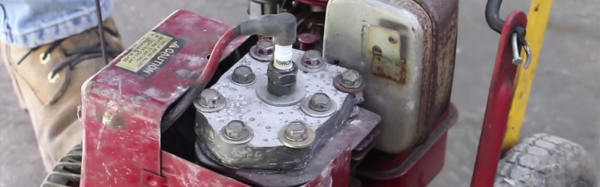
Now, [Project Farm] is back at it. Is it possible to use JB Weld to cast an entire cylinder head for a lawnmower? It sure is. With a cast epoxy cylinder head, this engine will run for just long enough for a proof of concept.

This experiment began by casting a single monolithic block of JB Weld that’s a bit larger than the cylinder head for a lawnmower. After curing, this JB Brick was surfaced on both sides with a belt sander. No, there was no vacuum chamber or any other techniques used by people who work with epoxies for a living. With the brick surfaced, the head gasket was used to place the bolt holes, the brick was tapped for a spark plug, and a bit of the inside was Dremeled out for the valves.

After attaching the JB Weld cylinder head to a lawnmower, [Project Farm] ran the lawnmower for about a minute. Is this a proof of concept? Yes. Did it work? Absolutely. Is it the ultimate test of JB Weld and the myth of the cracked engine block? Unfortunately, no. For that, someone will have to build a real engine entirely out of JB Weld. Until then, just check out the video below.

Continue reading “Casting Cylinder Heads Out Of JB Weld”

Hackaday Prize Entry: Printing Bones

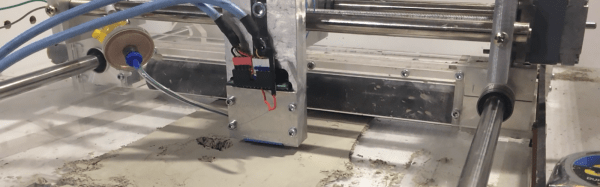
You would be forgiven to think that 3D printing is only about rolls of filament and tubs of resin. The fact is, there are many more 3D printing technologies out there. Everything from powders to paper can be used to manufacture a 3D model. [Jure]’s Hackaday Prize entry is meant to explore those weirder 3D manufacturing techniques. This is a printer that lays down binder over a reservoir of powder, slowly building up objects made out of minerals.

The key question with a powder printer is exactly what material this printer will use. For this project, [Jure] is planning on printing with hydroxyapatite, a mineral that makes up about 70% of bones by weight. Printing bones — yes, they do that — is quite expensive and has diverse applications.

The design of this printer is about what you would expect. It’s a Cartesian design with a roller to distribute powder, a piston to drop the part down into the frame, and an industrial inkjet printhead designed for wide format printers. It’s a fantastic piece of work and one of the better powder printers we’ve seen, and we can’t wait to see what [Jure] is able to produce with this.