Hackaday Invades Toronto

Next Wednesday, April 20th, Hackaday will invade Toronto.

[Sophi Kravitz] and [Michael Guilfoil] are heading north of the border to meet up with our friends at HacklabTO. They’ll be hosting a Bring A Hack meetup with drinks, snacks, and swag.

Since this is a Bring A Hack, attendees are encouraged to bring whatever project you’re working on and show it off, give a lightning talk, and pitch it to the community. [Sophi]’s last visit to Toronto brought some crazy hardware to the meetup, including a gaming glove for a Commodore 64, a demonstration of Ontario’s power plants, testing hamburgers for anything that is not beef with PCR, and analog synthesizers.

Since the Hackaday Prize is in full swing, this is an excellent opportunity to team up with fellow Torontonians for a great Prize entry, or just bounce a few ideas off people to see if your idea is feasible.

The meet and greet at the Hacklab is free, but we would request that you RSVP for the event. The event is also on Hackaday.io, just in case you’d like to chat with [Sophi] or other attendees.

The HackadayPrize2016 is Sponsored by:

Powering A Lot Of Nixie Tubes

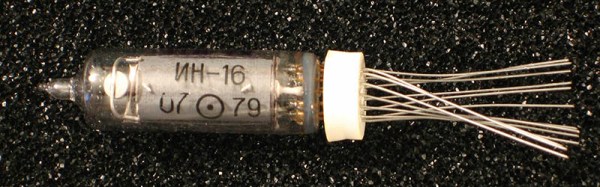
[Limpkin] has an idea for a project that uses a lot of IN-9 Nixie tubes. Where a Nixie tube clock would only use four or six tubes, [Limpkin] is looking at fifty IN-9 bar graph Nixie tubes. These tubes only light up above 100 Volts and draw about half an amp. That’s 64 Watts, according to the math on the project page, so how does [Limpkin] plan on powering these tubes? With a big high voltage power supply.

The power supply [Limpkin] designed is more or less what you would expect to find in any power supply. There’s a transformer, a bunch of caps, and a rectifier. Going with a standard laminated core transformer would mean this power supply would be huge and heavy, but once again eBay comes to the rescue with a small, 150 Watt toroidal transformer. The largest output on the transformer was two 24 V outputs. Combining those outputs gets [Limpkin] to 48V AC, or 68V peak to peak. A full wave voltage doubler with two caps and two diodes gives [Limpkin] the 136V DC that will power the tubes.

Combine the high voltage circuit with a 9V AC tap, a small bridge rectifier, and a few more caps, and [Limpkin] had a supply that would power the tubes and the rest of the electronics in his multiple Nixie tube project. A few passes with a CNC mill gave the power supply a nice case topped off with a foreboding toroidal transformer ready to power a beautiful neon project.

Arduino Comes To The Raspberry Pi, Linux ARM Devices

Arduino is the perfect introduction to microcontrollers and electronics. The recent trend of powerful, cheap, ARM-based single board Linux computers is the perfect introduction to computer science, programming, and general Linux wizardry. Until now, though, Arduino and these tiny ARM computers have been in two different worlds. Now, finally, there are nightly builds of Arduino IDE on the Raspberry Pi and other single board Linux computers.

The latest Arduino build for ARM Linux popped up on the arduino.cc downloads page early this week. This is the result of an incredible amount of work from dozens of open source developers across the Arduino project. Now, with just a simple download and typing ‘install’ into a terminal, the Arduino IDE is available on just about every single board Linux computer without having to build the IDE from source. Of course, Arduino has been available on the Raspberry Pi for a very long time with sudo apt-get install arduino, but this was an older version that cannot work with newer Arduino boards.

Is this distribution of the Arduino IDE the same you would find on OS X and Windows? Yep, everything is the same:

While this is really just arduino.cc improving their automated build process and putting a link up on their downloads page, it does make it exceptionally easy for anyone to set up a high school electronics lab. The Raspberry Pi is almost a disposable computing device, and combining it with Arduino makes for a great portable electronics lab.

Flying The Infinite Improbability Drive

Not since the cold fusion confusion of 1989 has the pop science media industry had a story like the EmDrive. The EmDrive is a propellantless thruster – a device that turns RF energy into force. If it works, it will revolutionize any technology that moves. Unlike rocket motors that use chemicals, cold gas, ions, or plasma, a spacecraft equipped with an EmDrive can cruise around the solar system using only solar panels. If it works, it will violate the known laws of physics.

After being tested in several laboratories around the world, including Eagleworks, NASA’s Advanced Propulsion Physics Laboratory, the concept of a device that produces thrust from only electricity is still not disproven, ridiculed, and ignored. For a device that violates the law of conservation of momentum, this is remarkable. Peer review of several experiments are ongoing, but [Paul] has a much more sensational idea: he’s building an EmDrive that will propel a cubesat.

Make no mistake, our current understanding of the universe is completely incompatible with the EmDrive. The idea of an engine that dumps microwave energy into a metal cone and somehow produce thrust is on the fringes of science. No sane academic physicist would pursue this line of research, and the mere supposition that the EmDrive might work is irresponsible. Until further peer-reviewed experiments are published, the EmDrive is the fanciful dream of a madman. That said, if it does work, we get helicarriers. Four EmDrives mounted to a Tesla Roadster would make a hovercar. Your grandchildren would only see Earth’s sun as a tiny speck in the night sky.

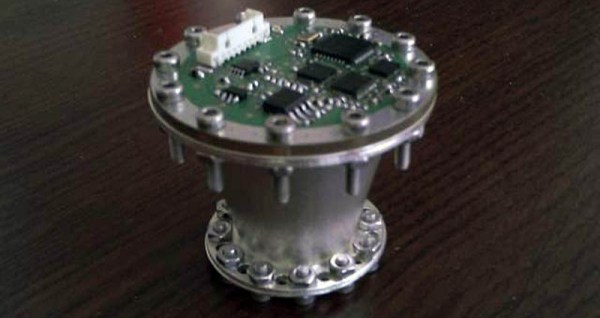
This isn’t [Paul]’s first attempt to create a working propellantless thruster. For last year’s Hackaday Prize, [Paul] built a baby EmDrive. Unlike every other EmDrive experiment that used 2.4GHz microwaves, [Paul] designed his engine to operate on 22 to 26 GHz. This means [Paul]’s is significantly smaller and can easily fit into a cubesat. If it works, this cubesat will be able to maintain its orbit indefinitely, fly to the moon and back, or go anywhere in the solar system provided the solar panels get enough light.

While [Paul]’s motivations in creating a citizen science version of the EmDrive are laudable, Hackaday.io’s own baby EmDrive does not display the requisite scientific rigor for a project of this magnitude. Experimental setups are ill-defined, graph axes are unlabeled, and there is not enough information to properly critique [Paul]’s baby EmDrive experiments.

That said, we can’t blame a guy for trying, and the EmDrive is still an active area of research with several papers under peer review. [Paul]’s plan of putting an EmDrive into orbit is putting the cart several miles ahead of the horse, but it is still a very cool project for this year’s Hackaday Prize.


The HackadayPrize2016 is Sponsored by:

A Low-Cost Mini PCB Printer

The next great advancement in homebrew electronics is an easy way to turn copper clad board into functional circuit boards. This has been done since the 60s with etch resist pens, sheets of etch resist rub-on transfers, the ever-popular photocopy and clothes iron, and now with small CNC mills. It’s still a messy, slow, and expensive process. [johnowhitaker] and [esot.eric] are trying to solve the latter of these problems with a mini PCB printer made out of DVD drives.

Playing around with the guts of a DVD drive is something [john] and [eric] have been doing for a while now, and for good reason. There’s a lot of interesting tech in DVD drives, with motors, steppers, and gears able to make very, very accurate and precise movements. Most PCBs aren’t very big, either, so a laser cutter that can only traverse an area a few inches square isn’t that much of a downside in this case.

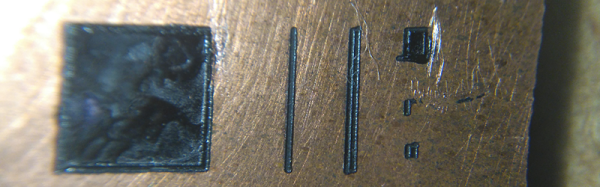
With a small diode laser mounted to a CNC gantry constructed out of DVD drives, the process of making a PCB is actually pretty simple. First, a slurry of laser printer toner and alcohol is applied to the board. Next, the laser on this PCB printer lases over the traces and copper fills, melting the toner. The board is removed, the excess toner wiped off, and the unwanted copper is melted away. Simple, even if it is a little messy.

Of course this method cannot do plated traces like your favorite Internet-based board house, but this does have a few advantages over any other traditional homebrew method. It’s cheap, since CD and DVD drive mechanisms are pretty much standardized between manufacturers. It’s also easy to add soldermask printing to this build, given that soldermasks can be cured with light. It’s a very cool build, and one that would find a home in thousands of garages and hackerspaces around the world.

The HackadayPrize2016 is Sponsored by:

Hackaday Links: April 10, 2016

Spot the mirrored mac
Spot the mirrored Mac

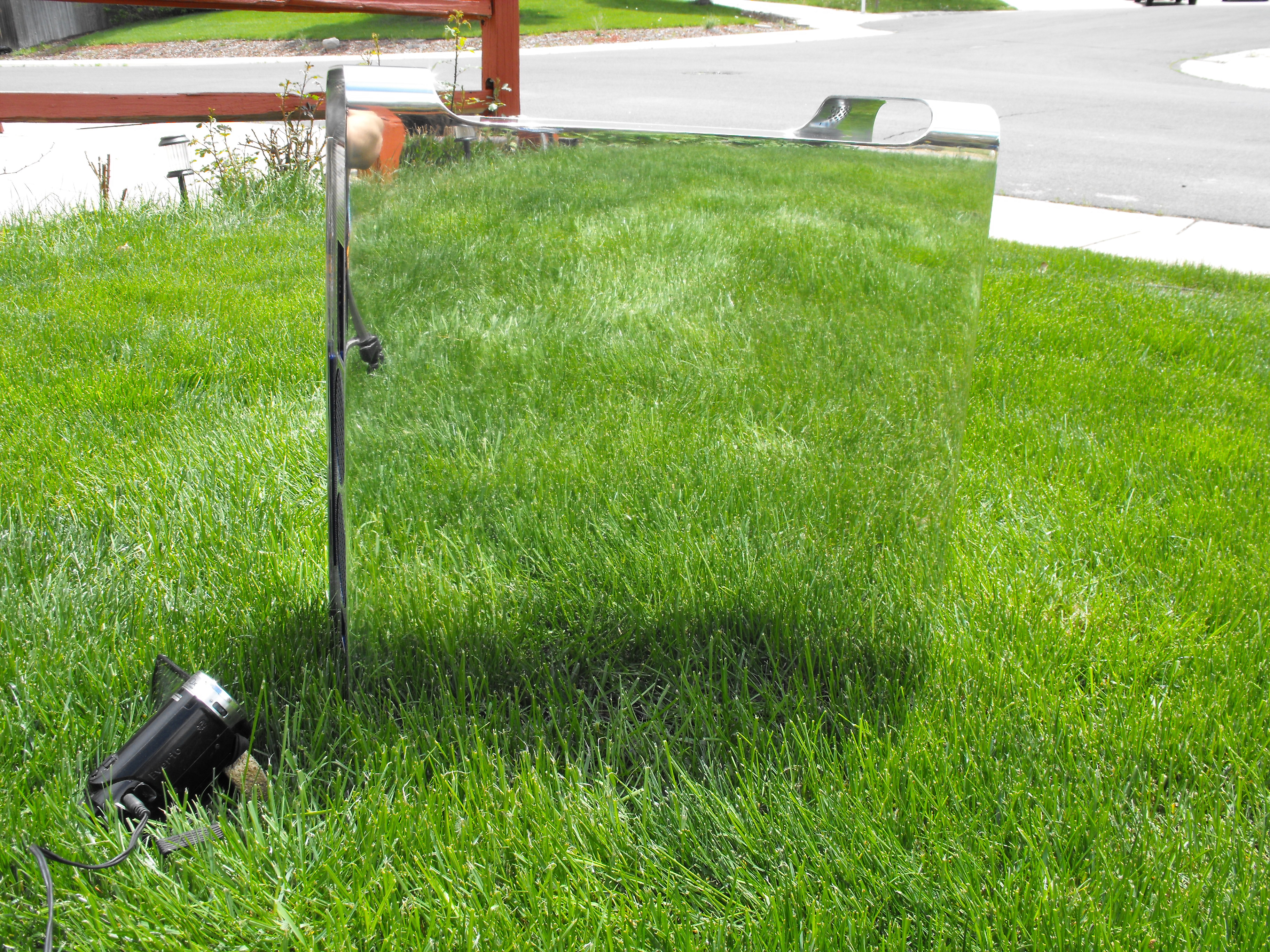
Here is the best Mac mod we’ve ever seen. [Doogie] decided to take an Apple G5 Quad to the max. This means maintaining the liquid cooling setup, adding the max amount of RAM (16 GB), adding a Sonnet Tempo 6.0Gb PCI-e card and two Samsung 840 Pro SSDs, and an Nvidia Geforce 6600GT. The best part about this Mac? Instead of the classic anodized aluminum, [Doogie] polished the case to a mirror finish. Here’s a video of the entire build. The computer is currently serving up his webpage, and if you want to see how the server load test is going, you can check out the stats page here.

Hackaday links posts are where we put interesting kickstarters and crowdfunding projects, and this one is near the top. It’s a crowdfunding campaign for a glassblowing workshop in England. If this project is funded, people can come repair their scientific glassware, make new tubes, or take a glassblowing workshop. It’s not quite a crowdfunding campaign for a business (perhaps it should be?), but maybe someone out there has a glass lathe they can donate.

A few months ago, Microchip acquired Atmel for $3.56 Billion. There’s a lot of overlap in both company’s portfolios, leading many to wonder which products would be EOL’ed and removed from the market. This week, Microchip released a statement on the acquisition (PDF), and spelled out what to expect from the product line. It’s good news:

We know that stability and growth in manufacturing is an important consideration from a supply base, and it has been one of the key elements that Microchip has executed well throughout its 25+ year life. We will honor that concept in this integration activity as well. We also recognize that product End-of-Life may be one of your concerns in any acquisition, including this one. Microchip has a practice and track record of not putting products on End-of-Life, and it is our intent to continue to offer the complete portfolio of products from both companies.

On April 5th, Makerbot announced it has sold more than 100,000 3D printers worldwide. Sounds like quite an accomplishment, right? Wrong. From December 31, 2014 to April 5, 2016 – fifteen months – Makerbot has sold only 20,094 printers. Sales figures are hard to come by (I’m working on this), but Lulzbot is outselling Makerbot given one of their latest press releases and basic math. There will be more on this after Stratasys releases their 2015 yearly report (on May 9), but I’m calling this the beginning of the end for Makerbot.

Here’s a Kickstarter for a laser cutter. The first reward that will get you a laser cutter is €1.300, “a special 50% early bird Kickstarter discount off the estimated retail price.” That means this is a $3000 laser cutter. What does that get you? A five watt ‘shortwave’ laser, 20×16″ working area, and a software interface that actually looks rather good.

Everyman’s Turbomolecular Pump

What can you do with a very good vacuum pump? You can build an electron microscope, x-ray tubes, particle accelerators, thin films, and it can keep your coffee warm. Of course getting your hands on a good vacuum pump involves expert-level scrounging or a lot of money, leading [DeepSOIC] and [Keegan] to a great entry for this year’s Hackaday Prize. It’s the Everyman’s Turbomolecular Pump, a pump based on one of [Nikola Tesla]’s patents. It sucks, and that’s a good thing.

The usual way of sucking the atmosphere out of electron microscopes and vacuum tubes begins with a piston or diaphragm pump. This gets most of the atmosphere out, but there’s still a little bit left. To get the pressure down even lower, an oil diffusion pump (messy, but somewhat cheap) or a turbomolecular pump (clean, awesome, and expensive) is used to suck the last few molecules of atmosphere out.

The turbomolecular pump [DeepSOIC] and [Keegan] are building use multiple spinning discs just like [Tesla]’s 1909 patent. The problem, it seems, is finding a material that can be made into a disc and can survive tens of thousand of rotations per minute. It’s a very, very difficult build, and a mistake in fabricating any of the parts will result in a spectacular rapid disassembly of this turbomolecular pump. The reward, though, would be great. A cheap turbomolecular pump would be a very useful device in any hackerspace, fab lab, or workshop garage.

The HackadayPrize2016 is Sponsored by: