Hackaday Prize Entry: A Better DIY CT Scanner

If you’re entering something in The Hackaday Prize this year, [Peter Jansen] is a guy you need to watch out for. Last year, he won 4th place with the Open Source Science Tricorder, and this year he’s entering a homebrew MRI machine. Both are incredible examples of what can be built with just enough tools to fit on a workbench, but even these builds don’t cover everything [Peter] has built. A few years ago, [Peter] built a desktop CT scanner. The CT scanner worked, but not very well; the machine takes nine hours to acquire a single slice of a bell pepper. At that rate, any vegetable or fruit would begin to decompose before a full scan could be completed.

This didn’t stop a deluge of emails from radiology professors and biomedical folk from hitting [Peter]’s inbox. There are a lot of people who are waiting for back alley CT scans, but the CT scanner, right now, just isn’t up to the task. The solution is iteration, and in the radiology department of hackaday.io, [Peter] is starting a new project: an improved desktop CT scanner.

The previous version of this CT scanner used a barium check source – the hottest radioisotope source that’s available without a license – and a photodiode detector found in the Radiation Watch to scan small objects. This source is not matched to the detector, there’s surely data buried below the noise floor, but somehow it works.

For this revision of a desktop CT scanner, [Peter] is looking at his options to improve scanning speed. He’s come up with three techniques that should allow him to take faster, higher resolution scans. The first is decreasing the scanning volume: the closer a detector is to the source, the higher the number of counts. The second is multiple detectors, followed up by better detectors than what’s found in the Radiation Watch.

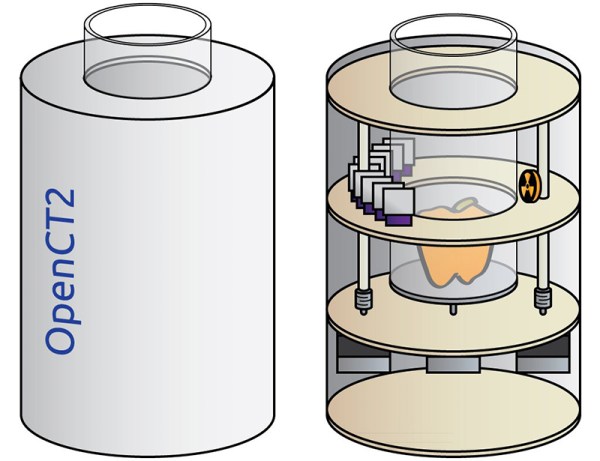
The solution [Peter] came up with still uses the barium check source, but replaces the large photodiode with multiple PIN photodiodes. There will be a dozen or so sensors in the CT scanner, all based on a Maxim app note, and the mechanical design of this CT scanner greatly simplifies the build.

Compared to the Stargate-like confabulation of [Peter]’s first CT scanner, the new one is dead simple, and should be much faster, too. Whether those radiology professors and biomed folk will be heading out to [Dr. Jansen]’s back alley CT scan shop is another question entirely, but it’s still an amazing example of what can be done with a laser cutter and an order from Mouser.



The 2015 Hackaday Prize is sponsored by:

Hackerspace Happenings: Santa Barbara Hackerspace Moving

Occasionally we get a few tips on our hotline telling us of hackerspace happenings. Either a space is moving, they need some help to install a moat around the space, or there’s a mini-conference of weird and esoteric technology happening sometime soon. The latest such tip is from the Santa Barbara Hackerspace. They’re moving, the new space doesn’t have a leaky roof, and they’re looking for some people to help out.

The new space features necessary hackerspace upgrades like no carpet, 120, 220, and 440 Volt outlets, actual parking, and a non-leaky roof. You can get by with a leaky roof in Santa Barbara, but having a roof that doesn’t have holes in it is always a bonus.

Add this to the space’s existing battery of equipment – everything from laser cutters, bandsaws, and welders to oscilloscopes, an amateur radio station, and a forge and anvil, there’s a lot anyone can do in this space.

An Open Source Toolchain For ICE40 FPGAs

FPGAs are great, but open source they are not. All the players in FPGA land have their own proprietary tools for creating bitstream files, and synthesizing the HDL of your choice for any FPGA usually means agreeing to terms and conditions that nobody reads.

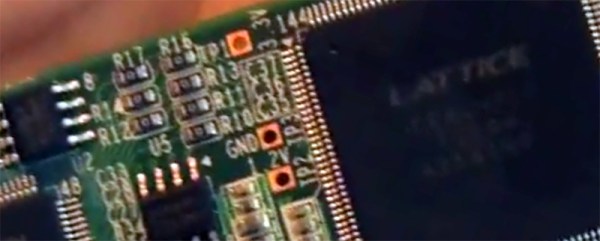
After months of work, and based on the previous work of [Clifford Wolf] and [Mathias Lasser], [Cotton Seed] has released a fully open source Verilog to bitstream development tool chain for the Lattice iCE40LP with support for more devices in the works.

Last March, we saw the reverse engineering of the Lattice ICE40 bitstream, but this is a far cry from a robust, mature development platform. Along with Yosys, also written by [Clifford Wolf] it’s relatively simple to go from Verilog to an FPGA that runs your own code.

Video demo below, and there’s a ton of documentation over on the Project IceStorm project page. You can pick up the relevant dev board for about $22 as well.

Continue reading “An Open Source Toolchain For ICE40 FPGAs”

Hackaday Prize Entry: A 3D Mapping Drone

Quadcopters show a world of promise, and not just in the mediums of advertising and flying Phantoms over very large crowds. They can also be used for useful things, and [Sagar]’s entry for The Hackaday Prize does just that. He’s developing a 3D mapping drone for farmers, miners, students, and anyone else who would like high-resolution 3D maps of their local terrain.

Most high-end mapping and photography work done with quadcopters these days uses heavy DSLRs to record the images that are brought back to the base station to be stitched into a 3D image. While this works, those GoPros are getting really, really good these days, and with 4k resolution, too. [Sagar] is mounting one of these to a custom quad and flying around an area to get images of an area from every angle.

To stitch the images together [Sagar] will be using the Pix4D mapping software, an impressive bit of software that will convert a multitude of still images to a 3D scene. It’s an expensive piece of software – $8500 for a perpetual license, but the software can be rented for $350/month until a FOSS alternative can be developed.


The 2015 Hackaday Prize is sponsored by:

Avago Buys Broadcom For $37 Billion

The economy is doing well, and that means companies are spending money. Companies in the chip business are in fact businesses, and spending money to them means acquisitions and mergers. The latest such deal is Avago Technologies buying Broadcom for $37 Billion USD – the largest deal ever made in the semiconductor industry.

The products made by these two companies aren’t usually found in stock at Adafruit, Sparkfun, or in the BOMs on Hackaday.io, but that doesn’t mean these chips aren’t extremely popular in the industry. Avago has a huge catalog of RF goodies and a surprising number of LED products. Broadcom, outside of the SoC found in the Raspberry Pi, likewise isn’t seen very often on workbenches, but their chips are found in everything from set-top boxes to Ethernet and broadband equipment.

Just a few months ago, a merger between NXP and Freescale struck a little bit closer to our hearts, but there is an opportunity for this acquisition to be much more interesting. The company that emerges from the NXP and Freescale merger will be saddled with hundreds of chip lines that all compete with each other – a cornucopia of ARMs, 8051s, Kinetis,  iMX.6, and ColdFires, and that’s just microcontrollers. Avago and Broadcom don’t have a catalog that overlaps nearly as much, and it will be very interesting to see what they can come up with.

Hackaday Prize Entry: An Electric Vehicle From Recycled Parts

In the future, just about everyone will be driving an electric car. We’re seeing the beginnings of this, and that means electrics and hybrids are showing up in junk yards. What does that mean? Tons of big batteries and powerful motors to build an electric vehicle from recycled parts.

A few years ago, someone exceptionally smart did the math on the environmental friendliness of different makes of vehicles from cradle to grave. The most environmentally friendly car to buy wasn’t a Prius, Leaf, or Tesla, but a used car; an old Civic or Rabbit. The logic makes sense – after two or three hundred thousand miles under its timing belt, the Civic or Rabbit has already paid the cost of forging the body and refining the plastic. Obviously, then, the most environmentally friendly car would be reusing the batteries and motor out of a newer hybrid.

For his Hackaday Prize build, [mauswerkz] is taking a 2001 BMW 330ci coupe and replacing the motor and transmission with some salvaged EV equipment. In this case, it’s the transmission and inverter from a Lexus GS450h and the batteries from a Chevy Volt ‘Extended Range’. Where the magical junkyard [mauswerkz] is pulling this equipment out of is anyone’s guess, but he did it. Maybe you can too.

So far, [mauswerkz] has the charger out of the Chevy Volt hooked up to the inverter and transmission from the Lexus and is making stuff turn. It’s only running at 200V instead of the final voltage of 650, but it’s enough for a proof of concept. Now it’s just a matter of stuffing everything inside the BMW.

Of course going to a junk yard isn’t the only way to get an EV. The more enterprising builder might want to build their own EV completely from scratch, starting with a block of foam. Yes, it even looks better than the BMW.


The 2015 Hackaday Prize is sponsored by:

Hackaday Prize Entry: Telling Dad The Stove Is Off

A month ago, Hackaday landed at the NYC TechCrunch Disrupt, a bastion of people up all night on MacBooks and immense amounts of caffeine and vitamin B12. For 20 hours, everyone was typing away trying to build the next great service that would be bought by Google or Amazon or Facebook. Tucked away in one small corner of the room was the Hackaday crew, giving out dev boards, components, and advice to the few dozen hardware hackers at Disrupt. [David], one of these Hackaday enthusiasts won the Twilio Sponsorship Prize at Disrupt, and now it’s a Hackaday Prize entry.

[David]’s dad has a little bit of paranoia of accidentally leaving the stove on. This usually manifests itself a few minutes after leaving the house, which means turning the car around just to make sure the stove was off. At the TechCrunch hackathon, [David] built a small IoT device to automatically read the temperature of the stove, send that off to the Internet, and finally as an SMS via Twilio.

The hardware [David] is using is extremely minimal – a thermopile, a gas sensor, a WiFi module, and a microcontroller. There’s a lot of iterations in this project, with [David] looking at everything from TI MSP430s to Teensys to Arduinos to ESP8266 modules. Still, rough prototype thrown together in 20 hours is all you need to win the Twilio prize at Disrupt, and that’s more than enough for a very good Hackaday Prize entry.


The 2015 Hackaday Prize is sponsored by: