Live Now: 2015 Hackaday Prize Worldwide: LA

Right now we’re throwing a huge workshop, meetup, and hackathon in Pasadena.

Events include a ‘Zero to Product’ workshop that will take everyone through PCB design, manufacturing techniques, CAM, soldering, testing, and blowing up caps and releasing blue smoke. You can check out the live stream of that here (or below).

Later on this evening, we’ll be having a few short talks from some LA-area hackers, builders and engineers.

Tomorrow is Open Hack Day, where the Hackaday Design Lab will have tables filled with components, dev boards, soldering irons, and enough blinkey stuff to blind someone. Live stream below.

Continue reading “Live Now: 2015 Hackaday Prize Worldwide: LA”

Hardware You Might See In A Bar In New York

Our New York City trip for the TechCrunch hackathon is just about wrapped up, and this weekend we’re hosting a hardware hackathon at the Hackaday Design Lab in Pasadena, but there’s still one more event from NYC left to cover: our drink-up in the city.

Our drink-up took over about 90% of the Antler Beer and Wine Dispensary, with the usual, not electronically enabled patrons sufficiently annoyed.
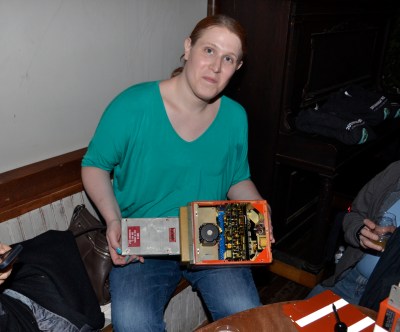
datarecorderWhile this meetup was really just a meet-and-greet pregame for the TechCrunch hackathon, and not a proper ‘bring a hack’, that didn’t stop a few people from toting out some very cool hardware. [Katie Fortunato] trucked out a flight data recorder (or an airplane’s black box, painted orange for visibility) that is supposedly from a 747.

This flight data recorder keeps relevant data on a loop of mylar tape. We didn’t crack into that part of the black box, but we did manage to dig into the electronics. Very weird stuff in there; the control electronics have a backplane design, where each card has a connector that’s basically 2 rows of 50 or 75 female pin sockets. These cards aren’t keyed in any way, and they must be placed in the backplane in a certain order. The circuits are extremely simple; just a mix of op-amps, 74- and 54-series logic (no, we can’t figure that one out, either), buffers, and inverters. The latest date code was some time in the early 80s, and all the boards had a conformal coating on them. There’s a weird connector on the outside of the black box [Katie] promises to document on her hackaday.io profile.

Also at the event were a few folks from NYC Resistor, a few people from the IoTGotham meetup, some of the crew from littleBits. Somewhere in the pictures below is a Ms. PacMan/Galaga cabinet. Yes, I tested the bee overflow cheat, it works, but the high score was above 500,000.

Continue reading “Hardware You Might See In A Bar In New York”

Hackaday Prize Entry: An EM Drive

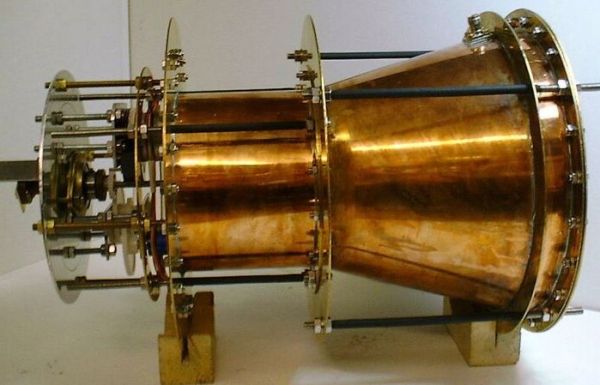
As far as engineering feats of the 21st century go (as long as they turn out to be real), we’re looking at two things. Lockheed Martin might build a working, power generating fusion reactor in the next decade. That will solve every problem on the planet. The second is even more spectacular. It’s called the EM drive, and it will take humans to the stars. It violates the laws of physics, but it somehow works, and there’s a project on hackaday.io to replicate it.

The first thing to know about the EM drive is that it doesn’t use propellent. Instead, it simply dumps microwaves into a cavity and somehow produces thrust. This violates [Newton]’s third law of motion, “for every action there is an equal and opposite reaction.” Every rocket engine ever, from the Saturn V to ion thrusters on spacecraft now cruising around the solar system, use some sort of propellent. The EM drive does not; it simply dumps microwaves into a closed cavity. It breaks the tyranny of the rocket equation. If you strap a nuclear reactor to an EM drive, you’ll be seeing attack ships on fire off the shoulder of Orion, and C-beams glitter in the dark near the Tanhauser Gate.

Despite violating the laws of physics, Chinese researchers found this device produces thrust, and these experiments were replicated at Eagleworks at Johnson Space Center. No one can tell you why it works, but somehow it does, at least in the few tests completed so far.

If the EM drive isn’t just an experimental aberration, this is how we’re going to get to Alpha Centauri. Whoever explains how the EM drive works will get the Nobel, and [movax] over on hackaday.io is building one out of a broken microwave oven. It’s a fantastic project for the Hackaday Prize, and even if it doesn’t work, it makes for a great story for the grandkids.


The 2015 Hackaday Prize is sponsored by:

The Simplest Quadrupedal Robot Ever

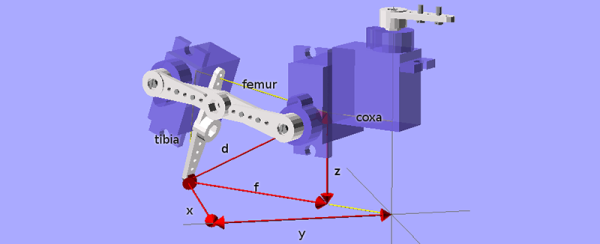
Wheeled and tracked robots are easy mode, and thanks to some helpful online tutorials for inverse kinematics, building quadruped, hexapod, and octopod robots is getting easier and easier. [deshipu] came up with what is probably the simplest quadruped robot ever. It’s designed to be a walking robot that’s as cheap and as simple to build as possible.

The biggest problem with walking robots is simply the frame. Where a wheeled robot is basically a model car, a walking robot needs legs, joints, and a sturdy frame to attach everything to. While there are laser cut hexapod frames out there, [deshipu]’s Tote robot uses servos for most of the skeleton. The servos are connected to each other by servo horns and screws.

The electronics are based on an Arduino Pro Mini, with a PCB for turning the Arduino’s pins into servo headers. Other than that, a 1000uF cap keeps brownouts from happening, and a 1S LiPo cell provides the power.

Electronics are easy, and the inverse kinematics and walking algorithms aren’t. For that, [deshipu] has a few tutorials for these topics. It’s a very complete guide to building a quadruped robot, but it’s still a work in progress. That’s okay, because [deshipu] says it will probably remain a work in progress until every kid on Earth builds one.

Hackaday Prize Entry: Aspirin For Everyone

When it comes to the history of medicine and drugs, Aspirin, or more properly acetyl-salicylic acid, is one of the more interesting stories. Plants rich in salicalates were used as medicines more than four thousand years ago, and in the fourth century BC, [Hippocrates] noted a powder made from willow bark was an excellent analgesic. It was only in the 1800s that acetylated salicylic acid was first synthesized. In 1897, chemists at Bayer gave this ancient remedy a new name: Aspirin. It’s on the WHO List of Essential Medicines, but somehow millions of people don’t have access to this pill found in every pharmacy.

[M. Bindhammer] is working to make Aspirin for Everyone for his entry to the Hackaday Prize, using a small portable lab designed around chemicals that can be easily obtained.

The most common synthesis of Aspirin is salicylic acid treated with acetic anhydrate. Acetic anhydrate is used for the synthesis of heroin, and of course the availability of this heavily restricted by the DEA. Instead, [M. Bindhammer] will use a different method using salicylic acid and acetic acid. If you’re keeping track, that’s replacing a chemical on a DEA list of precursors with very strong vinegar.

[M. Bindhammer] even has a design for the lab that will produce the Aspirin, and it’s small enough to fit in a very large pocket. Everything that is needed for the production of acetyl-salicylic acid is there, including a reaction vessel with a heating element, a water/oil bath, flask, an Allihn condenser, and a vacuum filtering flask. Even if shipping millions of pills to far-flung reaches of the planet were easy, it’s still an exceptional Hackaday Prize entry.


The 2015 Hackaday Prize is sponsored by:

A Simple Programmable 555

“Instead of an Arduino, he could have done that with a 555 timer.” “Instead of a 555 he could have done that with two transistors.” “Instead of a few transistors, he could have done that with butterflies.” These are quotes from various Hackaday comment threads throughout the years. It seems simplicity is the name of the game here, and if you need a timer chip, how about an 8-pin DIP? This, of course, means an I2C programmable oscillator in the form of an LPC810.

[kodera2t] built this circuit after reaching for a 555 timer a few too many times. It’s a one-chip solution with an ARM core that’s able to generate square waves with 1Hz resolution up to 65536Hz.

The source for this chip is a lot of C, but once it’s in the Flash of the LPC810, this chip becomes a programmable oscillator with an I2C interface. Yes, it’s a one-component solution, no, it’s not a twenty cent chip, but try programming a 555 over I2C.

The videos below show [kodera] playing around with this I2C oscillator, sweeping the frequency from zero to inaudible teenage angst.

Continue reading “A Simple Programmable 555”

Bitten By PCB Defects

If you’ve ordered PCBs from Seeed Studio, ITead, DirtyPCB, or another board house in China, you’ve probably noticed that neat little 100% e-test option available on the order form. If you select this, the board house will throw your PCBs in a machine that will poke a pin in every pad to make sure all the connections are good. Less work for you, right? As [Andy] found out, not always. He was bitten by a manufacturing defect that sheds some light on what that e-test actually is, and the capabilities of what these Chinese board houses can do.

Most of [Andy]’s project have a lot of surface mount components, and when he receives his boards, he notices a few pin pricks on each and every pad. This is from a flying lead machine; a robotic continuity checker that makes sure all the relevant pads are electrically isolated from each other.

One of [Andy]’s recent projects is an entirely through-hole design. Apparently these robotic meters don’t test through-hole pads; it’s significantly harder to measure the continuity of a hole rather than a pad, apparently. After assembling one of these boards, he noticed a problem where one of the GPIOs was permanently high. The offending trace was found underneath a DIP socket, in precisely the worst possible place it could be.

If [Andy] had inspected the board beforehand, this problem would have been avoided. He says it was a relatively simple board with big traces and wide spaces and he didn’t think a manufacturing defect was possible. He was wrong, and now we have a warning. We thank him for that.