Writing A Virtual Machine In Excel

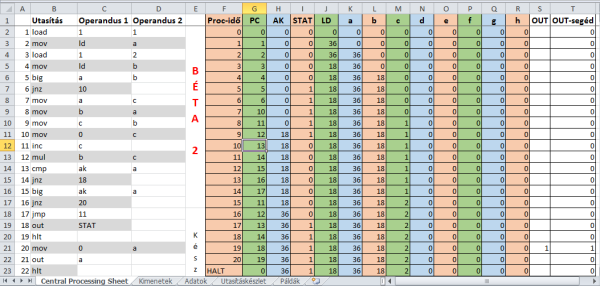
[Ádám] participates in a competition called KöMaL. It’s a 9-times-a-month journal for junior high and high school students featuring math and physics problems. [Paul Erdős], one of the most published mathematicians of all time, was a huge participant and by far the most notable student to crack open a copy of KöMaL in its hundred-year history. [Ádám] was trying his hand at a problem in Excel, but the official rules prohibit the use of Excel macros. In a daze, he came up with one of the most clever uses of Excel: building an assembly interpreter with the most popular spreadsheet program.

This is a virtual Harvard architecture machine without writable RAM; the stack is only lots and lots of IFs.  The instructions – mostly load, MOV, JNZ, INC, and CMP solves this problem, examining two inputs to see if they multiples of each other. If you’re wondering, an example cell from [Ádám]’s Excel sheet looks like this:

=F6
   INDEX($C$2:$C99999,$G2,1),
   IF(AND(INDEX($B$2:$B99999,$G2,1)="JZ",$I2=0),
      INDEX($C$2:$C99999,$G2,1),
         IF(AND(INDEX($B$2:$B99999,$G2,1)="JNZ",$I2<>0),
         INDEX($C$2:$C99999,$G2,1),
         G2+1
         )
      )
   )
)

[Ádám] has provided his Excel solution to the problem, available on the hackaday.io. It’s in Hungarian which really shouldn’t matter since it’s basically Excel and a pseudo-x86 instruction set. but the column labels will require a bit of Google Translate.

Home Automation With The Amazon Echo

The Amazon Echo is the answer to Apple’s Siri, Microsoft’s Cortana, and [Orwell]’s Telescreen – a device that sits in your home, listens to everything you say, and will gladly oblige if you want to buy something on Amazon. Brilliant. Despite being a pretty cheap device, there’s not really a whole lot it can do; sure, Echo, or more accurately Alexa, the personality in the Echo, can tell you the weather, queue up a playlist, or read a Wikipedia entry, but there’s a definite lack of imagination when it comes to the Echo.

Now, thanks to some clever API hacks, you can do far more with the Echo. [Noel] is using the Echo to turn lights in his house on and off, ring his home phone, and basically everything else you can do with some wire and a bit of code.

[Noel] got his idea from [Owen Piette] who recently investigated the Echo API. It’s all unpublished by Amazon, but it is possible to poll the todo list for random key phrases. By polling this API and getting new results, it’s pretty easy to set up some logic to do arbitrary actions.

Right now [Noel] can turn a light on and off and call his phone, but the sky really is the limit here. If you have a web-enabled thermostat, Alexa can turn the heat on or off. Want to text yourself something? That’s easy too. Anything that can be put in a todo list can be done with the Echo, the only obstacle is doing all the programming and electronics.

Website Response Speedometer

Here’s something that will probably make it to a wall right next to the people responsible for the Hackaday servers sometime soon, and should be something every web dev should build at some point: a website response meter, an analog gauge that will tell you how long it takes to reach your website.

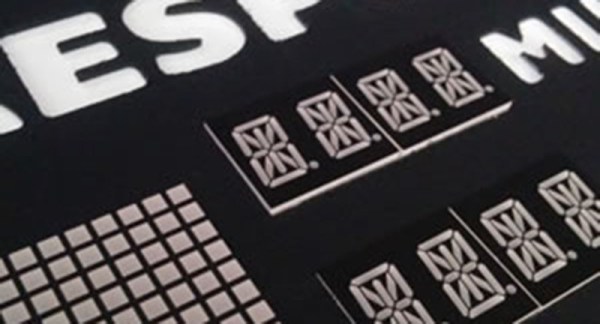
The build is simple enough, with a micro servo working as a gigantic analog gauge. There are also a pair of four-digit, seven-segment displays for displaying a digital number and the number of website requests per second. There’s also an 8×8 matrix of bi-color LEDs for showing a green happy face or a red frowny face, just in case all that data wasn’t self-evident to the uninitiated.

All the electronics are handled by an Arduino, but what really makes this build useful, or even possible, is the bit of code that runs on a computer. The computer uses an API from New Relic, a software analytics company, to come up with the response time and requests per second. That data is pulled down and piped up to the Arduino that displays everything on a beautifully milled acrylic sheet.

An OLED Ring For Bluetooth Notifications

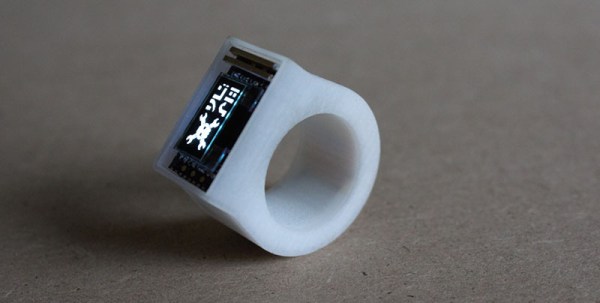
Wearables are the next frontier of amateur electronics, and [Kevin]’s Arduboy ring (link dead, try Internet Archive) is one of the best examples we’ve seen yet.

Inside the Arduboy is an nRF51822 – a chipset with Bluetooth Low Energy, an ARM Cortex M0,256k of Flash, and 16k of RAM. There’s also a an OLED and a touch button for displaying notifications from a phone, with the ability to reply to these notifications.

The enclosure for the ring is rather interesting. It’s a bit thick, but that’s for a reason – there’s a 40mAh battery stuffed along the sides of the ring. The enclosure itself is 3D printed to spec, and contrary to some beliefs, there’s nothing wrong with bending a LiPo cell once. Sure, it only has four hours of battery life with the display on, but it has a 24 hour battery life in standby mode, making it almost useful as an everyday wearable.

This is [Kevin]’s second wearable, the first being the Ardubracelet, an extremely interesting OLED bracelet with three different displays.  The Arduboy is much more compact and comes extremely close to looking like a product. You can check out the video of it below.

Continue reading “An OLED Ring For Bluetooth Notifications”

Rewritable ROM For The Mac Plus

The Macintosh Classic – a small all-in-one computer with a 9″ monochrome screen –  was one of the more interesting machines ever released by Apple. It was the company’s first venture into a cost-reduced computer, and the first Macintosh to sell for less than $1000. Released in 1990, its list of features were nearly identical to the Macintosh Plus, released four years earlier. The Classic also had an interesting feature not found in any other Mac. It could boot a full OS, in this case System 6.0.3, by holding down a series of keys during boot. This made it an exceptional diskless workstation. It was cheap, and all you really needed was a word processor or spreadsheet program on a 1.44 MB floppy to do real work.

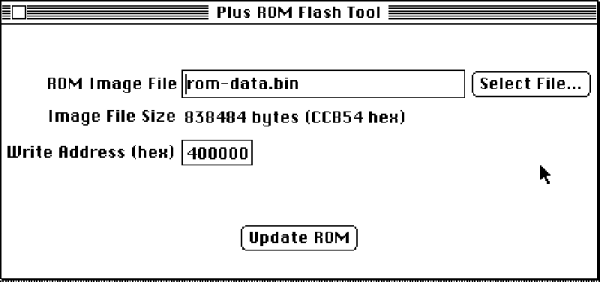
[Steve] over at Big Mess O’ Wires had the same idea as the Apple engineers back in the late 80s. Take a Macintosh Plus, give it a bit more ROM, and put an OS in there. [Steve] is going a bit farther than those Apple engineers could have dreamed. He’s built a rewritable ROM disk for the Mac Plus, turning this ancient computer into a completely configurable diskless workstation.

The build replaces the two stock ROM chips with an adapter board filled with 29F040B Flash chips. They’re exactly what you would expect – huge, old PDIPs loaded up with Flash instead of the slightly more difficult to reprogram EEPROM. Because of the additional space, two additional wires needed to connected to the CPU.  The result is a full Megabyte of Flash available to the Macintosh at boot, in a computer where the normal removable disk drive capacity was only 800kB.

The hardware adapter for stuffing these flash chips inside a Mac Plus was made by [Rob Braun], while the software part of this build came from [Rob] and [Doug Brown]. They studied how the Macintosh Classic’s ROM disk driver worked, and [Rob Braun] developed a stand-alone ROM disk driver with a new pirate-themed startup icon. [Steve] then dug in and created an old-school Mac app in Metrowerks Codewarrior to write new values to the ROM. Anything from Shufflepuck to Glider, to a copy of System 7.1  can be placed on this ROM disk.

This isn’t the first time we’ve seen ROM boot disks for old Macs. There was a lot of spare address space floating around in the old Mac II-series computers, and [Doug Brown] found a good use for it. Some of these old computers had optional ROM SIMM. You can put up to 8 Megabytes  in the address space reserved for the ROM, and using a similar ROM disk driver, [Doug] can put an entire system in ROM, or make the startup chime exceptionally long.

Developing Film With Lego

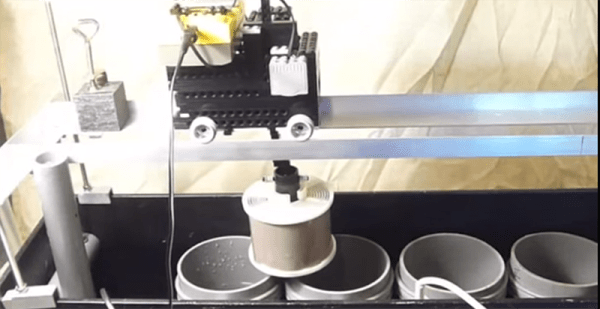
Developing film at home is most certainly a nearly forgotten art nowadays, but there are still a few very dedicated people who care enough to put in the time and study to this craft. [Jan] is one of the exceptional ones. He’s developing 35mm film with Lego (Dutch, Google translate).

For the build, [Jan] is using the Lego RCX 1.0, the first gen of the Lego Mindstorms, released in the late 90s. According to eBay, this is a significantly cheaper option for programmable Lego. The mechanics of the Lego film developer consisted of multiple tanks of chemicals. The film was loaded on a reel, suspended from a Lego gantry, and dunked into each tank for a specific amount of time.

A second revision of the hardware (translate) was designed, with the film loaded into a rotating cylinder. A series of chemicals would then be pumped into this unit with the hope of reducing the amount of chemicals required. This system was eventually built using the wiper fluid pump from a car. Apparently, the system worked well, judging from the pictures developed with this system. Whether it was easy or efficient is another matter entirely.

You can check out a video of the first revision of the Lego film developing system below.

Thanks [Andrew] for sending this in.

Continue reading “Developing Film With Lego”

The Heathkit Mystery

Heathkit is a company that requires no introduction. From the mid-40s until the 90s, Heathkit was the brand for electronic kits ranging from test equipment, HiFis, amateur radio equipment, computers, to freakin’ robots. Their departure was a tragic loss for generations of engineers, electronic tinkerers and hobbyists who grew up with these excellent and useful kits.

Although Heathkit is dead, 2013 brought an announcement that Heathkit was back in the biz. A Facebook page was launched, a Reddit AMA was held, and the news was that Heathkit would rise from the dead in the first half of 2014. It’s now Christmas, 2014, and there’s no sign of Heathkit anywhere. Adafruit has been keeping a watchful eye on the on the (lack of) developments, and the only surprising thing to report is that there is nothing to report. There has been no new announcement, there are no new products, the “official” Heathkit website hasn’t been updated in a year, and no one knows what’s going on.

Adafruit has decided to dig into the matter, and while they’ve come up with a few items of note, there’s not much to report. A trademark for ‘HEATHKIT’ was filed October 27, 2014 – two months ago. An email was sent to the attorney of record and there has been no response.

This trademark was granted to Heathkit Company, Inc., incorporated in Delaware. Searching for any companies in Delaware using the Heathkit name returns exactly two results: Heathkit Company, Inc., and Heathkit Holdings, Inc.. Adafruit is probably going to pay the $20 to the Delaware Department of State to get the detailed information that includes Heathkit’s tax assessment and tax filing history.

The last bit of information comes from a whois on the heathkit.com domain. The relevant contacts have been emailed, and there are no further details. The Heathkit virtual museum was contacted for information, as was the news editor for ARRL.org. Nobody knows anything, or at least nobody is telling anybody anything.

To date, the only physical evidence of Heathkit’s rebirth is a geocache that was left at Brooklyn Bridge Park, announced during the Reddit AMA. This geocache was recovered by reddit user IFoundTheHeathKit, a throwaway account that had no posts before or since finding the cache. We have no idea what was in that geocache, what the ‘secret passphrase’ or set of instructions was, or if anything ever came of the promise to send one of the first new kits.

So there ‘ya go. A lot of words but no information. If you have any info, the Adafruit crew would like to have a word with you.

Update

The person who found the Heathkit geocache has been found:



The full comment referred to below is,

Hey, person who found the Heathkit geocache here. The secret passcode was an Einstein quote about radio vs wired communication (invisible cats), and they said they’d send me something in early 2014. Never had any communication except through FB, and they haven’t replied to any of my recent messages.

IFoundTheHeathKit might want to email Adafruit with a copy of all the emails.