A Year Long Time Lapse Camera

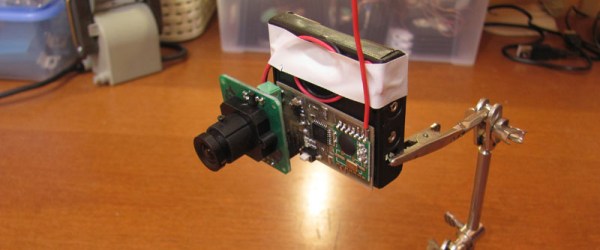
All [val3tra] wanted was an RF-accessible camera. A camera that would take pictures, save them to an SD card, and occasionally send them over an RF link to a computer. This project has grown out of control, and now it has become an open-source camera that’s able to take year-long time-lapse movies.

The build started as a low power camera using an eBay JPEG camera modified for 3.3V. That’s only 640×480, but each frame averages only 48kb – small enough to store a few thousand pictures on a FAT16 formatted SD card. A $4 RF module, an ATMega, and an RTC make up the rest of the build that has a power draw of about 100 Joules per hour. A D-cell has about 60,000 Joules, and a pessimistic estimate of a battery of four in series, two in parallel gives a run time of 200 days.

This build was then improved, bringing the total battery consumption down to about 3.5-4 Joules per frame, or at one frame every 10 minutes, about 24 Joules an hour. That’s impressive, and getting this camera to run longer than a dozen or so months raises some interesting challenges. The self-discharge of the battery must be taken into account, and environmental concerns – especially when leaving this camera to run in a Moscow winter, seen in the video below – are significant.

If you don’t want to go equipment-lite you could seal your DSLR, Pi, and some serious batteries in a weatherproof enclosure.

Continue reading “A Year Long Time Lapse Camera”

Hackaday Links Column Banner

Hackaday Links: December 21, 2014

Most of the incredible flight simulator enthusiasts with 737 cockpits in their garage are from the US. What happens when they’re from Slovenia? They built an A320 cockpit. The majority of the build comes from an old Cyprus Airways aircraft, with most of the work being wiring up the switches, lights, and figuring out how to display the simulated world out of the cockpit.

Google Cardboard is the $4 answer to the Oculus Rift – a cardboard box and smartphone you strap to your head. [Frooxius] missed being able to interact with objects in these 3D virtual worlds, so he came up with this thing. He adapted a symbol tracking library for AR, and is now able to hold an object in his hands while looking at a virtual object in 3D.

Heat your house with candles! Yes, it’s the latest Indiegogo campaign that can be debunked with 7th grade math. This “igloo for candles” will heat a room up by 2 or 3 degrees, or a little bit less than a person with an average metabolism will.

Last week, we saw a post that gave the Samsung NX300 the ability to lock the pictures taken by the camera with public key cryptography. [g3gg0] wrote in to tell us he did the same thing with a Canon EOS camera.

The guys at Flite Test put up a video that should be handy for RC enthusiasts and BattleBot contenders alike. They’re tricking out transmitters, putting push buttons where toggle switches should go, on/off switches where pots should go, and generally making a transmitter more useful. It’s also a useful repair guide.

[Frank Zhao] made a mineral oil aquarium and put a computer in it. i7, GTX 970, 16GB RAM, and a 480GB SSD. It’s a little bigger than most of the other aquarium computers we’ve seen thanks to the microATX mobo, and of course there are NeoPixels and a bubbly treasure chest.

RISC, Tagged Memory, And Minion Cores

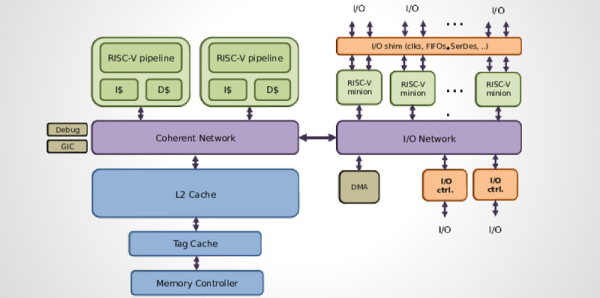
Buy a computing device nowadays, and you’re probably getting something that knows x86 or an ARM. There’s more than one architecture out there for general purpose computing with dual-core MIPS boards available and some very strange silicon that’s making its way into dev boards. lowRISC is the latest endeavour from a few notable silicon designers, able to run Linux ‘well’ and adding a few novel security features that haven’t yet been put together this way before.

There are two interesting features that make the lowRISC notable. The first is tagged memory. This has been used before in older, weirder computers as a sort of metadata for memory. Basically, a few bits of each memory address tag each memory address as executable/non-executable, serve as memory watchpoints, garbage collection, and a lock on every word. New instructions are added to the ISA, allowing these tags to be manipulated, watched, and monitored to prevent the most common single security problem: buffer overflows. It’s an extremely interesting application of tagged memory, and something that isn’t really found in a modern architecture.

The second neat feature of the lowRISC are the minions. These are programmable devices tied to the processor’s I/O that work a lot like a Zynq SOC or the PRU inside the BeagleBone. Basically, they’re used for programmable I/O, implementing SPI/I2C/I2S/SDIO in software, offloading work from the main core, and devices that require very precise timing.

The current goal of the lowRISC team is to develop the hardware on an FPGA, releasing some beta silicon in a year’s time. The first complete chip will be an embedded SOC, hopefully release sometime around late 2016 or early 2017. The ultimate goal is an SOC with a GPU that would be used in mobile phones, set-top boxes, and Raspi and BeagleBone-like dev boards. There are enough people on the team, including [Robert Mullins] and [Alex Bradbury] of the University of Cambridge and the Raspberry Pi, researchers at UC Berkeley, and [Bunnie Huang].

It’s a project still in its infancy, but the features these people are going after are very interesting, and something that just isn’t being done with other platforms.

[Alex Bardbury] gave a talk on lowRISC at ORConf last October. You can check out the presentation here.

Multiplexing Pi Cameras

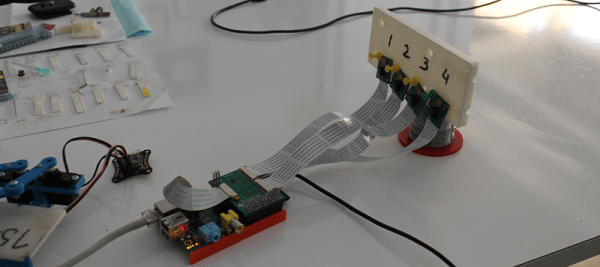
The Raspberry Pi and its cool camera add-on is a great way to send images and video up to the Intertubes, but what if you want to monitor more than one scene? The IVPort can multiplex up to sixteen of these Raspi camera modules, giving the Pi sixteen different views on the world and a ridiculously high stack of boards connected to the GPIO header.

The Raspberry Pi’s CSI interface uses high-speed data lines from the camera to the CPU to get a lot of image data quickly. Controlling the camera, on the other hand, uses regular old GPIOs, the same kind that are broken out on the header. We’ve seen builds that reuse these GPIOs to blink a LED, but with a breakout board with additional camera connectors, it’s possible to use normal GPIO lines in place of the camera port GPIOs.

The result is a stackable extension board that splits the camera port in twain, allowing four Raspi cameras to be connected. Stack another board on top and you can add four more cameras. A total of four of these boards can be stacked together, multiplexing sixteen Raspberry Pi cameras.

As far as the obvious, ‘why’ question goes, there are a few interesting things you can do with a dozen or so computer controlled cameras. The obvious choice would be a bullet time camera rig, something this board should be capable of, given its time to switch between channels is only 50ns. Videos below.

Continue reading “Multiplexing Pi Cameras”

Crypto Photography And Custom Firmware

Imagine a camera that took encrypted pictures. If your camera is stolen, the only thing on the memory card would be random data that can only be unlocked with a key. If you hire a photographer, those images cannot be copied without the key. At the very least, it’s an interesting idea made impressive because this actually exists.

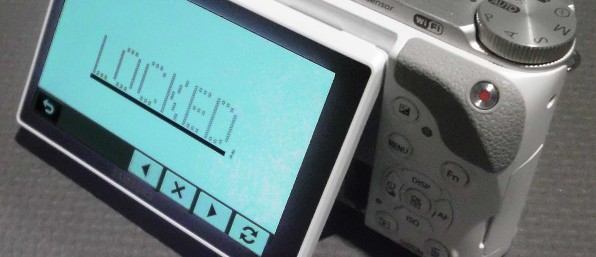
[Doug] recently got his hands on a Samsung NX300, a nice camera for the price that conveniently runs Linux and is kinda open-sourced by Samsung. With special firmware, [Doug] created public/private key encryption for this camera, giving only the person with the private key the ability to unlock the pictures taken with this camera.

[Doug] started his build by looking at the firmware for this camera, figuring out how to take everything apart and put it back together. With a few modifications that included encryption for all images taken with this camera, [Doug] repackaged the firmware and upgraded the camera.

The encryption firmware is available on the site, but considering how easily [Doug] was able to make this hack happen, and a great walkthrough of how to actually do it raises some interesting possibilities. The NX300 is a pretty nice camera that’s a little bit above the Canon PowerShot cameras supported by CHDK. It also runs Linux, so if you’re looking for something cool to do with a nice camera, [Doug] has a very good resource.

Counting Transistors In The Playstation

Over in Russia there are a few people doing extremely in-depth technical teardowns, and the latest is one of the most ambitious ever seen. The PSXDEV team is tearing into the heart of the original PlayStation (Google translatrix), looking at 300,000 transistors, and re-implementing the entire console in a logic level simulator.

While the CPU in the PSX is unique to that specific piece of hardware, a lot of this custom silicon can be found in other places. The core – a RISC LSI LR33300 – is documented in a few rare tomes that are somehow available for free on the Internet. Other parts of this chip are a little stranger. There is a bizarre register that isn’t documented anywhere, a Bus Unit that handles the access between various devices and peripherals, and a motion picture decompressor.

The reverse engineering process begins by de-encapsulating the CPU, GPU, sound processing unit, and CD-ROM controller, taking very high magnification photos of the dies, and slowly mapping out the semiconductors and metals to figure out what cells do what function, how they’re connected, and what the big picture is. It’s a painstaking process that requires combing through gigabytes of die shots and apparently highlight gates, wires, and busses with MS Paint.

The end result of all this squinting at a monitor is turning tracings of chips into logic elements with Logisim. From there, the function of the CPU can be understood, studied, and yes, eventually emulated down to the gate level. It’s an astonishing undertaking, really.

If this sort of thing sounds familiar, you’re right: the same team behind PSXDEV is also responsible for a similar effort focused on the Nintendo Entertainment System. There, the CPU inside the NES – the Ricoh 2A03 – was torn down, revealing the 6502 core, APU, DMA, and all the extra bits that made this a custom chip.

Thanks [Rasz] for the tip.

Towards More Interesting Instant Cameras

When [Ch00f] was getting jeans rung up at Nordstroms, he noticed how fast thermal receipt printers can put an image on a piece of paper. This observation isn’t unique to the circles [Ch00f] frequents – there are a few small receipt paper printers out there that connect to the Internet, iPhones, and a whole bunch of other Kickstarter-friendly keyword devices.

Nevertheless, a device that can make a hard copy of an image quickly and cheaply isn’t something you just stop thinking about. After rolling the concept around in his head for a few years, [Ch00f] finally came up with the perfect build – a camera.

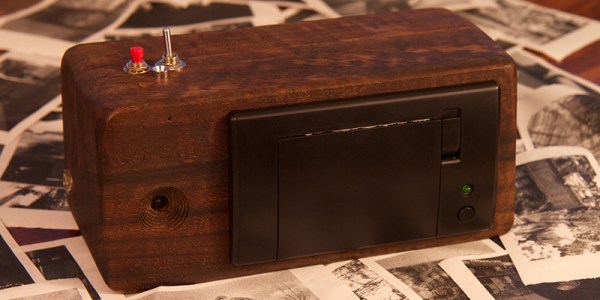
The hardware for the build is based around an STM32F4 Discovery board. It’s a bit overpowered for this sort of application, and this is one of [Ch00f]’s first adventures in ARM-land. The rest of the hardware consists of a thermal receipt printer and a JPEG camera, the latter of which replaced a cellphone CMOS camera module that was lost in a move.

A custom camera requires a custom enclosure, and for this [Ch00f] made something remarkable. The entire enclosure is CNC milled out of a beautiful piece of figured walnut. The end result looks far too good for a prototype, but it does polish up nicely with a bit of linseed oil.

Now [Ch00f] has an instant camera that takes the idea of a Polaroid and turns it into something that produces a print for tenths of a cent. There’s a time-lapse function – just a zip tie on the shutter button – filters with the help of highlighters, and the ability to record movies in flipbook format.

It’s a great project, and also something that will make for a great crowdfunding campaign. [Ch00f] has already started work on this. He already has a sleek, modern-looking website that requires far too much scrolling than should be necessary – the first step to a winning Kickstarter. [Ch00f] also learned a lot about ARMs, DMA, dithering, gamma correction, and the JPEG format, but that’s not going to get anyone to open up their wallet. You know what will? A slick video. You’ll find that below.

Continue reading “Towards More Interesting Instant Cameras”