ESP8266 Distance Testing

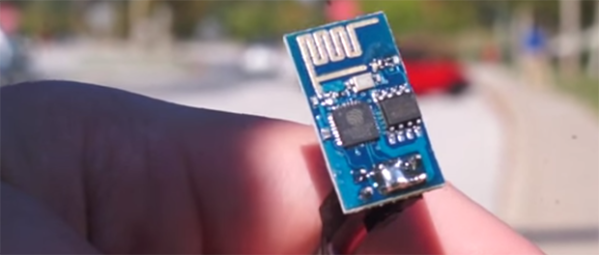
With progress slowly being made on turning the ESP8266 UART to WiFi module into something great, there is still the question of what the range is for the radio in this tiny IoT wonder. [CNLohr] has some test results for you, and the results are surprisingly good.

Connecting to the WiFi module through a TPLink WR841N router, [CN] as able to ping the module at 479 meters with a huge rubber duck antenna soldered on, or 366 meters with the PCB antenna. Wanting to test out the maximum range, [CN] and his friends dug out a Ubiquiti M2 dish and were able to drive 4.28 kilometers away from the module and still ping it.

Using a dish and a rubber duck antenna is an exercise in excess, though: no one is going to use a dish for an Internet of Things thing, but if you want to carry this experiment to its logical conclusion, there’s no reason to think an ESP8266 won’t connect, so long as you have line of sight and a huge antenna.

There’s still a lot of work to be done on this module. It’s capable of running custom code, and since you can pick this module up for less than $5 USD, it’s an interesting platform for whatever WiFi project you have in mind.

Starting To Wrap Up Maker Faire

It’s almost a week since the NYC Maker Faire, and it’s about time for us to start wrapping up all the posts we’re doing on everything we’ve seen.

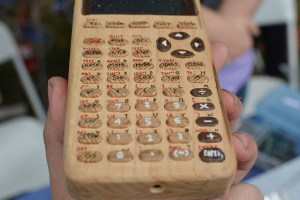
DSC_0216[Chris Mitchell], hackaday favorite from Cemetech did what he always does at Maker Faire: brought some stuff he’s doing with TI graphing calculators.
The TI-84 with GPS made a showing, as did the graphing calculator IRC client. By far the coolest looking calculator was the wooden casemod. It’s a TI-82 put into a (what feels and looks like) a maple enclosure. The buttons are painted on, and despite stuffing consumer electronics into a handmade case, it’s still reasonable portable.

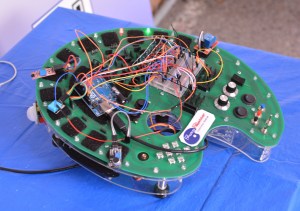
DSC_0201There were more Hackaday fans at the faire, but I’m not sure if anyone can beat the guys from Protopalette. Wait. One guy could. Find me in public sometime and I’ll tell you about that.
The Protopalette is a board with a bunch of lights, buttons, switches, sensors, knobs, servos, and buzzers for electronics prototyping. Think of it as a stylized version of the old ‘parts and springs and wire’ radio shack beginner electronic kits.

DSC_0160

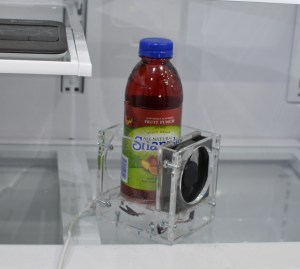
Some of the members of the hackerspace with the craziest group narrative, LVL1 in Louisville, made it to the faire. They’re working with GE to create a ‘maker module’ for appliances. It’s called Green Bean, and GE is actually building support for this into some of their fridges, washers, stoves and dishwashers.

There are a few modules already, like a scale that will send out a message when you’re out of milk. It’s an interesting system, and there are already a lot of appliances that support the system.

Pics below.

Continue reading “Starting To Wrap Up Maker Faire”

THP Semifinalist: NSA Away

Back when we started The Hackaday Prize, security, big brother, and the NSA were making headlines every day. Since that time, there has been enough bread and circuses in the news to wipe the consequences of these leaks out of the public consciousness, but work is still being done by hackers and tinkerers the world over to give you the tools to protect your data.

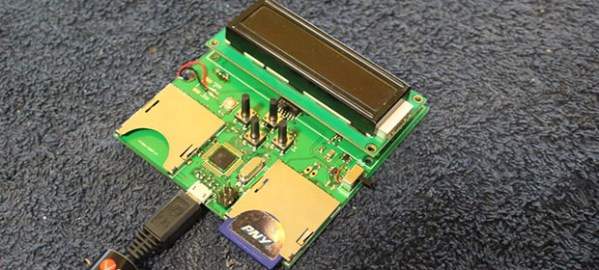
NSA Away is one of these tools. The first part of the project is a standalone key generator that writes the same random bits to a pair of SD cards simultaneously. With their random number generator, this is perfect encryption. The only way to crack the one time pad the team is using for encryption is to 1) use parts of the pad more than once, 2) have a terrible RNG, or 3) do something really stupid like sell the one time pad in a store.

The other part of the build is an Android-based encryption device with a camera, keyboard, SD card reader, and a USB port. This device reads the ‘OTP SD cards’ and reads data with the camera using OCR and decrypts it on the screen. Provided the OTP doesn’t fall into the wrong hands, this is a perfectly secure way to transmit data to anyone.

As far as progress goes, the members of the team have a fully functional pad generator, writing random data to SD cards. This device can also output random bits to a computer as a USB HID device, should you want to transmit your pad over unsecured mediums.

It’s an impressive bit of work, especially in the RNG department. The team is using eight avalanche noise generators in the circuit description. This part of the build isn’t quite working yet, but that’s really not needed for a proof of concept.


SpaceWrencherThe project featured in this post is a quarterfinalist in The Hackaday Prize.

A Wrist-Mounted Flamethrower? Sure, Why Not?

There are three types of booths at Maker Faire. The first is the strange corporate booth, like Pepsi ‘revolutionizing fluid intake’ or some such nonsense. That one had the longest line of any booth, in case you’re wondering. The second type of booth is the people you would expect to be there – Atmel, TI, and Makerbot all came out in full force.

The third type of booth were a little hard to find. They’re the ‘show and tell’ spirit of Maker Faire, and [Stephen Hawes] was one of the best. Why? Wrist-mounted flamethrower, that’s why.

The flamethrower is fueled with a propane bottle originally meant for a camping stove, with a microcontroller and pot setup taking care of the height of the flame. Buttons underneath [Stephen]’s thumb takes care of the propane flow and tazer-based ignitor. The wrist measurement sensor can rescale to adjust the height of the flame to how far the wearer can move their wrist.

All in all, a great project for the Faire, although we did feel a little sorry for the NYC fire marshal that was assigned to [Stephen] for the entire faire. As an aside, we’re applauding [Stephen] for not referencing whatever comic book character has fire shooting out of his hand.

THP Semifinalist: B10N1C Yourself

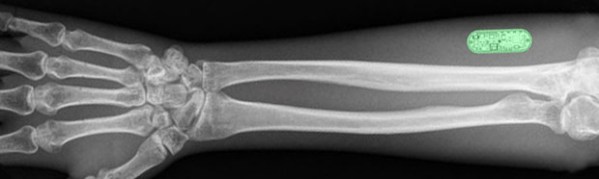
The Hackaday Prize has had a few medical devices make the semifinalist cut, and of course wearables are on the list. How about implantables? That’s what Bionic Yourself 2.0 (or B10N1C) is doing with an implantable microcontroller, battery, and sensor system.

The hardware in B10N1C includes a electromyography sensor for measuring muscle activity, an accelerometer, a vibration motor, RFID reader/writer, temperature sensor, and – get this – a LED bar graph that will shine a light through the skin. That’s something we’ve never seen before, and if you’re becoming a cyborg, it’s a nice feature to have.

As with anything you would implant in your body, safety is a prime consideration for Bionic.the Lithium battery can be overcharged (yes, through a wireless charging setup) to 10V without a risk of fire or explosion, can be hit with a hammer, and can even be punctured. The enclosure is medical grade silicone, the contacts are medical grade stainless steel, and there’s a humidity sensor inside that will radio a message saying its time to remove the device if the moisture level in the enclosure increases.

Because the device is implanted under the skin, being able to recharge and update the code without a physical connection is the name of the game. There’s a coil for wireless charging, and a lot of work is going into over the air firmware updating. It’s an astonishing project, and while most people probably won’t opt for a cyborg implant, it will look really cool.


SpaceWrencherThe project featured in this post is a quarterfinalist in The Hackaday Prize.

THP Semifinalist: A Continuous Wave Radar

There aren’t many Hackaday Prize entries playing around in RF, save for the handful of projects using off the shelf radio modules. That’s a little surprising to us, considering radio is one of the domains where garage-based tinkerers have always been very active. [Luke] is bucking the trend with a FM continuous wave radar, to be used in experiments with autonomous aircraft, altitude finding, and synthetic aperture radar imaging.

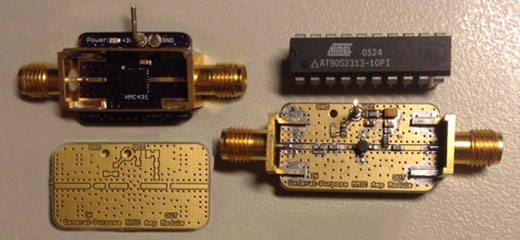
[Luke]’s radar operates around 5.8-6 GHz, and is supposed to be an introduction to microwave electronics. It’s an extremely modular system built around a few VCOs, mixers, and amplifiers from Hittite, all connected with coax.

So far, [Luke] has all his modules put together, a great pair of cans for the antennas, everything confirmed as working on his scope, and a lot of commits to his git repo.

You can check out [Luke]’s demo video is available below.


SpaceWrencherThe project featured in this post is a quarterfinalist in The Hackaday Prize.

Continue reading “THP Semifinalist: A Continuous Wave Radar”

Apollo, The Everything Board

The best projects have a great story behind them, and the Apollo from Carbon Origins is no exception. A few years ago, the people at Carbon Origins were in school, working on a high power rocketry project.

Rocketry, of course, requires a ton of sensors in a very small and light package. The team built the precursor to Apollo, a board with a 9-axis IMU, GPS, temperature, pressure, humidity, light (UV and IR) sensors, WiFi, Bluetooth, SD card logging, a microphone, an OLED, and a trackball. This board understandably turned out to be really cool, and now it’s become the main focus of Carbon Origins.

There are more than a few ways to put together an ARM board with a bunch of sensors, and the Apollo is extremely well designed; all the LEDs are on PWM pins, as they should be, and there was a significant amount of time spent with thermal design. See that plated edge on the board? That’s for keeping the sensors cool.

The Apollo will eventually make its way to one of the crowdfunding sites, but we have no idea when that will happen. Carbon Origins is presenting at CES at the beginning of the year, so it’ll probably hit the Internet sometime around the beginning of next year. The retail price is expected to be somewhere around $200 – a little expensive, but not for what you’re getting.