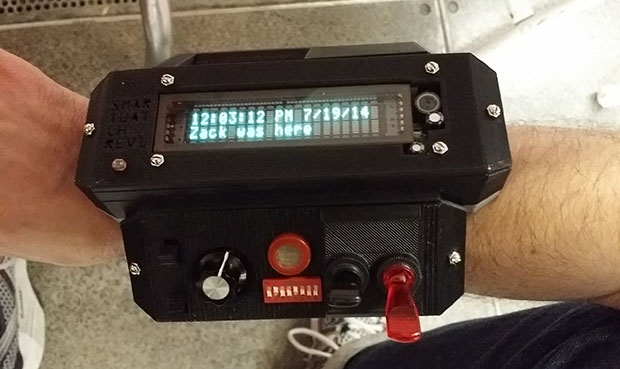
With any con, you’re going to have people walking around with things they’ve built. It’s the perfect venue for wearable tech, and the cream of the crop for HOPE X is [Zack]’s SmarTwatCh. Billed as a 3D printed big ass smart watch, it’s anything but subtle and has enough gadgets and gizmos to make even the biggest tech aficionado blush
The front of the SmarTwatCh is an authentic 2×20 glass encapsulated VFD running at 160 Volts, chosen for its danger and character. Inside the 3D printed enclosure is a Teensy 3.0, pots, knobs, and switches, a laser, LEDs, and an alcohol sensor because, “the future is quantified drinking”.
‘Apps’ for this smart watch include a TV-B-Gone, laser pointer, breathalyzer, flashlight, and just about anything else [Zack] can think of that would involve a Bluetooth adapter and a text display. Video of [Zack] demoing the watch at HOPE below.
For the next three days, Hackaday will be live, in the flesh, at Hotel Pennsylvania in NYC. It’s HOPE X, the biennial conference for hackers, code crackers, and slackers put on by the awesome folks at 2600.
[Greg Gage] and some of the other crew at Backyard Brains have done a TED talk, had a few successful Kickstarters, and most surprisingly given that pedigree, are actually doing something interesting, fun, and educational. They’re bringing neuroscience to everyone with a series of projects and kits that mutilate cockroaches and send PETA into a tizzy.
[Greg] demonstrated some of his highly modified cockroaches by putting a small Bluetooth backpack on one. The roach had previously been ‘prepared’ by attaching small electrodes to each of its two front antennas. The backpack sends a small electrical signal to the antennae every time I swiped the screen of an iPhone. The roach thinks it’s hitting a wall and turns in the direction I’m swiping, turning it into a roboroach. We seen something like this before but it never gets old.
Far from being your one stop shop for cockroach torture devices, Backyard Brains also has a fairly impressive lab in the basement of their building filled with grad students and genetically modified organisms. [Cort Thompson] is working with fruit flies genetically modified so a neuron will activate when they’re exposed to a specific pulse of light. It’s called optogenetics, and [Cort] has a few of these guys who have an ‘I’m tasting something sweet’ neuron activated when exposed to a pulse of red light.
Of course controlling cockroaches is one thing, and genetically engineering fruit flies is a little more impressive. How about controlling other people? After being hooked up to an EMG box to turn muscle actuation in my arm into static on a speaker, [Greg] asked for a volunteer. [Jason Kridner], the guy behind the BeagleBone, was tagging along with us, and stepped up to have two electrodes attached to his ulnar nerve. With a little bit of circuitry that is available in the Backyard Brains store, I was able to control [Jason]’s wrist with my mind. Extraordinarily cool stuff.
There was far too much awesome stuff at Backyard Brains for a video of reasonable length. Not shown includes projects with scorpions, and an improved version of the roboroach that gives a roach a little bit of encouragement to move forward. We’ll put up a ‘cutting room floor’ video of that a bit later.
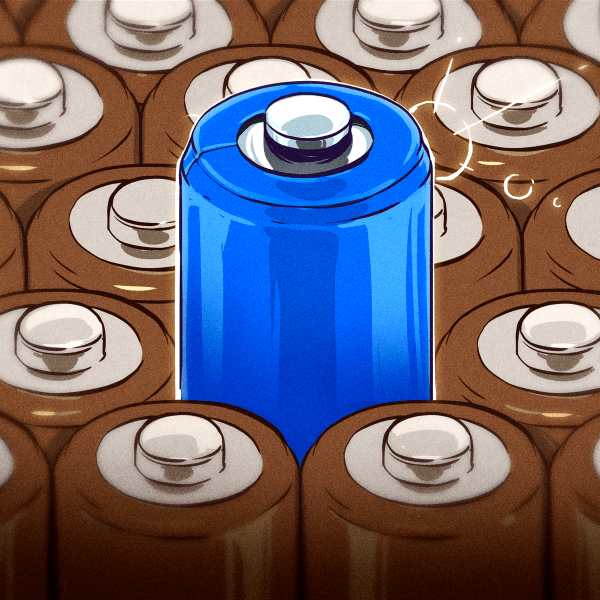
Lithium ion supercapacitors. No, not lithium ion batteries, and yes, they’re a real thing. While they’re astonishingly expensive per Farad, they are extremely small and used as the first line of defense in some seriously expensive heavy-duty UPS installations. Here’s a Kickstarter using these supercaps to replace the common AA, C, and D cell batteries. Even better, they can be recharged in seconds.
For each size battery, the caps used actually have a slightly higher energy density than a similarly sized dollar store battery. By adding a little bit of circuitry to drop the 3.8 Volts out of the cap down to the 1.5 V you expect from a battery, this supercap becomes a very expensive rechargeable battery, but one that can be recharged in seconds.
This is one of those crowdfunding campaigns we really like: an interesting tool, but something we just can’t figure out what the use case would be. These lithium ion supercaps are too expensive to be practical in anything we would build (save for a Gauss pistol), but the tech is just too cool to ignore. If you have a use case for these caps in mind, please leave a note in the comments.
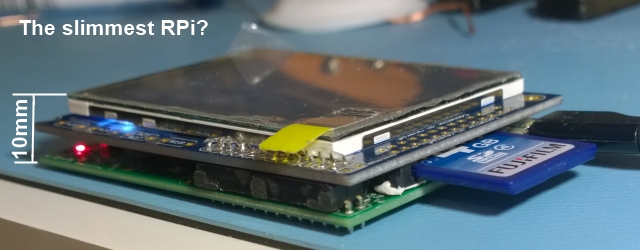
[Colin], AKA [Domipheus], was working on a project to monitor a thermostat with a wall mounted Raspberry Pi and a touchscreen. Simple enough, but the Pi has a problem: The plugs are all around the perimeter of the board, and with a TFT touch screen shield, it’s a bit too thick to be wall mounted. What followed is a hack in the purest sense: [Domipheus] removed and relocated components on the Pi until the entire Pi/display stack was just a hair over 10mm tall.
A Raspberry Pi Model A was used for this build, meaning the Ethernet jack was gone, and there was only a single USB port to deal with. Still, the highest components – the RCA and audio jacks – were too tall and needed to be removed; they weren’t going to be used anyway.
After these components were gone, [Domipheus] turned his attention to the next tallest parts on the board: fuses, caps, and the HDMI port. For fear of damaging the surrounding components when removing the HDMI connector the right way, this part was simply hacked off. The large tantalum cap near the USB power connector was removed (it’s just a filter cap) and the large protection diode was moved elsewhere.
Slimming down a Pi is no good without a display, and for that [Domipheus] used this touchscreen thing from Adafruit. Things got a little complicated when the project required the ability to remove the LCD, but you can do amazing things with a DIP socket and a file.
The end result is a Raspberry Pi with touchscreen display that’s just a smidgen thicker than a CD case. It’ll fit right up against a wall in its repurposed enclosure, and the end result looks very professional.
While most of the teams in this year’s Red Bull Creation didn’t really pay attention to the theme of ‘reinventing the wheel’, 1.21 Jiggawatts did. Their creation, a giant typewriter that can be suspended along the side of a building, takes its inspiration directly from 1970s typewriters and printers. Yes, it’s a giant daisy wheel typewriter.
The basic idea of a daisy wheel typewriter is a wheel with a few dozen petals, on the end of which is a single letter. To print a letter, the wheel spins around, and a solenoid mechanism strikes the letter against a piece of paper. This was cutting edge tech in the 70s, and was a fast (and cheap) way for computers to print out letter-quality reports.
1.21 Jiggawatts used a ladder as the rail to move down a line of text. The movement from line to line was supposed to be done by dangling the ladder off a chain with a few sprockets attached to motors. Unfortunately, the team couldn’t quite get the machine working for the competition and live event, but the build does show an amazing amount of creativity and respect for classic, forgotten technology.
If there’s one thing I learned about Detroit last weekend, it’s that it is freaking huge. It’s an unbelievably large city, and looking at the population numbers, you can really start to see the problem of providing city services to such a large area. With such a sparse population, it’s the ideal environment for experimentations in urban farming, after a few seasons of planting crops that will leech everything out of the soil of course.
If you have a farm, you’re going to need some means of irrigation, and you might as well throw a scarecrow in there as well, giving i3 Detroit the idea for RoboCrop, the perfect project for an urban farm or anyone who is putting on a production of The Wizard Of Oz but is a little shorthanded for a full cast.
RoboCrop is an all-in-one irrigation and bird and small mammal scaring device, controllable with webcam video streamed right to the remote. It’s a fun project, and fits right into the apparent unofficial “urban gardening” theme of this year’s Red Bull Creation.
i3 is also the largest and arguably the best equipped hackerspace in the Detroit region. They were kind enough to let us throw a little get together there last weekend where we gave away a 3D printer for The Hackaday Prize. Good times all around. We’ll have a video tour of i3 up a little bit later.
Cracked windshields ready for greenhouse
Windshields added to greenhouse.
Robocrop dressed with face and hands
Face worthy of Robocop; spits water while camera watches you




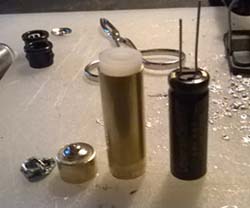 Lithium ion supercapacitors. No, not lithium ion batteries, and yes, they’re a real thing. While they’re astonishingly expensive per Farad, they are extremely small and used as the first line of defense in some seriously expensive heavy-duty UPS installations.