A Most Impractical Gear Position Indicator

GPI A few years ago, [Pat] sent in a really nice gear position indicator for his Suzuki V-Strom. With a single seven-segment display , a small microcontorller, and wires tied right into the bike’s ECM, it’s more than enough to do its job, and is much cheaper than aftermarket gear indicators. A simple, elegant solution that does one job well. How could this possibly be any better?

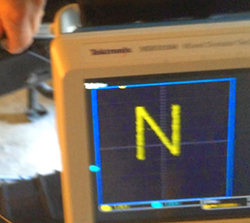
‘Better’ is a relative term, and depending on what you’re optimizing for, a more complex solution can easily be superior. [Pat] figured tripling the value of his motorcycle is a worthwhile goal, so he replaced that seven-segment display with an oscilloscope. It’s the world’s only oscilloscope based motorcycle gear position indicator, and now [Pat] needs a really, really long extension cord.

Like the earlier, more practical version, This build reads the voltage off the bike’s ECM to determine what gear the bike is in. The current gear is then displayed on a Tek MDO3000 with two PWM pins on a microcontroller. Practical? No, but it does look cool. Video below.

Continue reading “A Most Impractical Gear Position Indicator”
ServoBender, The Electronic Pedal Steel

You’ve most certainly heard a pedal steel guitar before, most likely in any ‘old’ country song, or more specifically, any country song that doesn’t include the word ‘truck’ in its lyrics. Pedal steels are strange devices, looking somewhat like a 10-string guitar with levers that change the pitch of individual strings. Historically, there have been some attempts to put a detuning mechanism for individual strings in normal electric guitars, but these are somewhat rare and weird. [Gr4yhound] just nailed it. He’s come up with the perfect device to emulate a pedal steel in a real guitar, and it sounds really, really good.

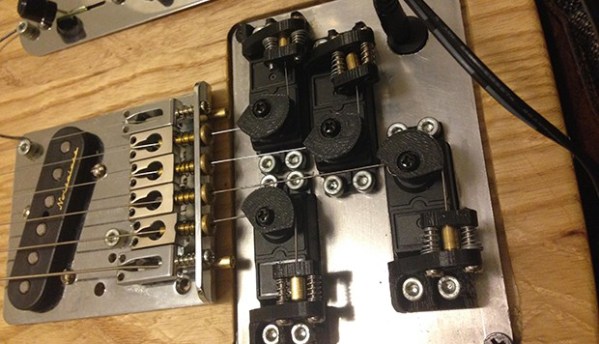
The imgur album for this project goes over the construction of the ServoBender in a bit more detail than the video. Basically, four servos are mounted to a metal plate below the bridge. Each servo has a spring and cam system constructed out of 3D printed parts. The detuning is controlled by an Arduino and a few sustain pedals retrofitted with hall effect sensors. Simple, really, but the effect is astonishing.

[Gra4hound]’s contraption is actually very similar to a B-Bender where a guitarist pushes on the neck to raise the pitch of the B string. This setup, though, is completely electronic, infinitely adjustable, and can be expanded to all six strings. Very, very cool, and it makes us wonder what could be done with one of those freaky robot guitars, a soldering iron, and a bit of code.

Video below, because you should watch it again.

Continue reading “ServoBender, The Electronic Pedal Steel”

THP Entry: TOME, The Portable 3D Printer

TOME Alright, 3D Printers exist. They’re machines you can simply buy for a few hundred dollars, set them on your desk, and have them start churning out plastic parts. A little pedestrian, isn’t it? How about something you can take into the field for a client, and print out some new parts right there? How about sending a printer to the latest humanitarian crisis? After all, all those humanitarian uses for 3D printers we’ve been hearing about won’t do any good without a 3D printer.

TOME is [Philip]’s attempt at portabilizing a 3D printer and also his entry into The Hackaday Prize. The preliminary goals for TOME are the ability to print for four hours on a single battery, an auto leveling bed, and an accessible hot end that’s easy to replace.

Already the design for TOME is rather interesting. The astute printer aficionado will notice there is no stepper motor on the X carriage. The task of moving the head in the X axis is taken care of by a stepper in the base, with a square shaft and set of gears moving everything back and forth.

With this odd yet ingenious motor setup, the entire printer is able to collapse in on itself, allowing it to be installed in a waterproof plastic case. That’s something you’re going to need if you’re taking a printer on the road.


SpaceWrencherThe project featured in this post is an entry in The Hackaday Prize. Build something awesome and win a trip to space or hundreds of other prizes.

The Future Of Distraction, Right In Front Of Your Face

Bird

Say you’re meeting someone new, and instead of communicating like a normal person that wasn’t born in a barn, they play with their phone the entire time. How about a cashier or sales person who is so insufferably distracted with the Facebooks you’d guess they had a side job in the QA department of some developer? All these things will soon be a distant, horrible memory, because now you can play Flappy Bird on Google Glass.

[Rich] has had his Glass for a while now, and has been meaning to write an app for it. It took a little bit of inspiration, but when the idea of using the eye sensor to control everyone’s favorite 8-bit bird, everything fell into place. It ended up being an interesting use for the Glass, and something we actually wouldn’t mind trying out.

The bird is controlled by a double blink. In the video below, you can see there might be a little bit of latency depending on how [Rich] put the video together. Better grab that .APK while there’s still time. [Rich] says it’s a free download for anyone who’s already overpaid for a Google Glass.

Continue reading “The Future Of Distraction, Right In Front Of Your Face”

Old Laptops, Modems, And The Hackaday Retro Edition

We haven’t been getting very many submissions of extremely old computers loading up the Hackaday Retro Edition in a while. For shame. Thankfully, [alnwlsn] is here to pick up the slack from the rest of you with his latest accomplishment, getting two old laptops on the Internet with some old telecom equipment.

The first is a Toshiba from about 1995, Pentium processor, 12 MB of RAM, and a 10 GB (!) hard drive. [aln] had a PCMICA modem sitting around, and with Windows 95 and IE 5.5, he was able to slowly connect.

Pentium class machines are okay, but the next one – a Zenith Data Systems laptop from about 1987 – is awesome. 80C88 CPU, two 720k floppy drives, and the exact amount of RAM in that quote falsely attributed to [Bill Gates]. [alnwlsn] is connecting with a 28.8k modem, but the serial port only supports up to 9600. It’s a computer so old, even the retro edition’s main page times out. The about page, though, loaded fine.

[alnwlsn] used a modem with both of these laptops, but he doesn’t have dial-up or even a landline. This forced him to make his own line simulator that requires plugging in the phone line at the right time, manually ringing a modem connected to another computer, and letting PPP take it from there. It’s a crude circuit, but it works. slow, but it works. Video below.

Continue reading “Old Laptops, Modems, And The Hackaday Retro Edition”

The Crane Game, Oculus Style

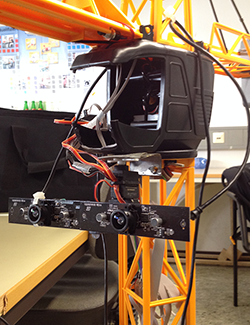
crane We’re pretty sure the Hackaday demographic is a a person who sees a giant tower crane lifting beams and girders above a skyline and says, “that would be fun, at least until I have to go to the bathroom.” Realizing the people who own these cranes probably won’t let any regular joe off the street into the cabin, [Thomas] and [screen Name] (see, this is why we have brackets, kids) built their own miniature version with an Oculus Rift.

Instead of a crane that is hundreds of feet tall, the guys are using a much smaller version, just over a meter tall, that is remotely controlled through a computer via a serial connection. Just below the small plastic cab is a board with two wide-angle webcams. The video from these cameras are sent to the Oculus so the operator can see the boom swinging around, and the winch unwinding to pick up small objects.

The guys have also added a little bit of OpenCV to add color based object detection. This is somewhat useful, but there’s also an approximation of the distance to an object, something that would be very useful if you don’t have a three-inch tall spotter on the ground.

Video below.

Continue reading “The Crane Game, Oculus Style”

MIDI And Vintage FM Synthesis

FM

Before the days when computers could play and record audio that far surpassed the quality of CDs, sound cards were very, very cool. Most audio chips from the 80s, from the Commodore SID is pretty much a synth on a chip, but you can also find similar setups in ancient ISA sound cards. [Emilio] pulled one of these cards with an ADLIB OPL2 chip on it, and used a PIC micro to create his very own FM synthesis synth (IT, translatatron, although Google is screwing up the formatting).

The Yamaha YM3812 chip, otherwise known as the OPL2, was a fairly complete synthesizer in a very tiny package using FM synthesis for some very unique sounds. Once [Emilio] had the PIC sending commands to the sound chip, he added MIDI support, allowing him to play this vintage ‘synth on a chip’ with a keyboard instead of a tracker.

Judging from the video below, it sounds great, and that’s with [Emilio] mashing the keys for a simple demo.

Continue reading “MIDI And Vintage FM Synthesis”