The great analog synths of Moog, Oberheim, Sequential Circuits, and more modern version from Doepfer are renouned for their sound, the sheer majesty of a rack full of knobs and plugs, and of course the price. Analog synths are simply expensive to build, and given that aficionados even scoff at digitally controlled oscillators, require a lot of engineering to build. [Jan]’s DSP-G1 isn’t like those analog synths – it uses microcontrollers and DSP to generate its bleeps and boops. It is, however, extremely cheap and sounds close enough to the real thing that it could easily find a home between a few euroracks and CV keyboards.
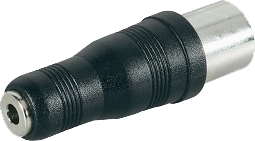 The heart of the DSP-G1 is a micro from NXP modeling an analog synthesizer with 15 digitally controlled oscillators with Sine, Triangle, Pulse and Saw outputs, a low frequency oscillator, two envelope filters, and a low pass filter, or about the same accouterments you would find in a MiniMoog or other vintage synth from the 70s. Since this is basically a synth on an NXP LPC-810, [Jan] has packaged it in something akin to a MIDI to 3.5mm cable adapter: Plug a MIDI keyboard into one end, an amp into the other, and you have a synth smaller than the MIDI Vampire, an already impossibly small music creation tool.
[Jan] has a few more versions of his little DSP device with varying amounts of knobs available on his indiegogo campaign. The DSP-Gplug is the star of the show, though, provided you already have a MIDI keyboard with a few knobs for the required CC messages. Videos and sound demos below.
 Here’s an interesting thought: it’s possible to build a cubesat for perhaps ten thousand dollars, and hitch a ride on a launch for free thanks to a NASA outreach program. Tracking that satellite along its entire orbit would require dozens of ground stations, all equipped with antennas, USB TV tuners, and a connection to the Internet. It’s actually more expensive to build and launch a cubesat than it costs to build a network of ground stations to get reasonably real-time telemetry from a cubesat. The future is awesome and weird, it seems.
 The project featured in this post is an entry in
  Finding your tent at a music festival is a tricky endeavor – not only are there miles and miles of tents exactly like yours, you most likely have a few beers or other substances in you that affect your sense of space and/or time. [James]
 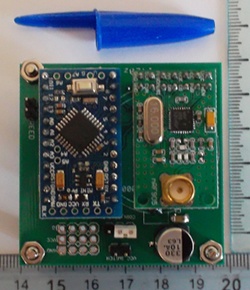 [Texane] had been thinking about how to monitor the state of his garage door from a remote place. The door itself isn’t around any power outlets, and is a few floors away from where his server would be located in his apartment. This presented a few design challenges – namely, the sensor itself should have a wireless connection to the server, and being low power would be a great idea. This led to the development of a