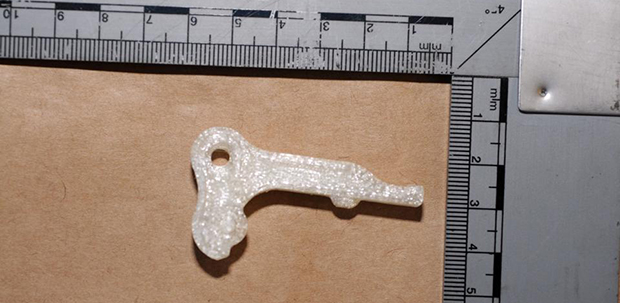
UK Cops Fear Gun; Pointlessly Seize 3D Printer

quoteGUNquote

Above, according to the greater Manchester Police force, is a 3D printed gun. Well, the rozzers say it’s merely a trigger for a gun. In part they’re actually correct; it is a trigger. For a spring-loaded extruder for the Makerbot Replicator.

For the past few days, the media has been abuzz about the first seizure of a 3D printer (a Makerbot Replicator 2) in Manchester, UK during a raid on suspected gang members. Despite numerous complaints and comments by makers across the UK (thanks, guys), Assistant Chief Constable [Steve Heywood] says, “We need to be absolutely clear that at that this stage, we cannot categorically say we have recovered the component parts for a 3D gun.” The seized 3D printer parts are being sent to ballistics experts to determine if a random piece of plastic can be used in the manufacture of handguns.

Alright kiddos, editorial time. We’re quite aware that the UK is a little…. different… than the US when it comes to firearms regulation. Nevertheless, we feel the need to defend anyone with a 3D printer, in a handy Q&A format:

What this has also done is open up a wider debate about the emerging threat these next generation of weapons might pose.

No, it doesn’t. I don’t know what the British equivalent of a Home Depot is, but I could go to that store, buy some stuff, and build a zip gun. Of course I wouldn’t, because that’s not safe. I could also use a mill and lathe to make a proper gun.

But it’s made of plastic and thus undetectable

Bullets aren’t. Also, I could machine some Delrin. You should really watch In the Line of Fire.

But plans for 3D printed guns are available, making it easy for anyone to fabricate their own gun

Yeah, and Hackaday made one. There were a lot of problems with those 3D printer files. The spring wouldn’t slice, the hammer wouldn’t print, every part was out of scale, and you’d need a lot of experience in 3D modeling and design to turn those ‘plans available on the Internet’ into something you can send to a printer.

Your posting this article further sensationalizes the role of 3D printers in gun control.

You’re right. Here’s what you do: every time someone mentions 3D printed guns, say, “You can build an even better gun with a combo mill/lathe that costs the same as a 3D printer. Equal skill is required to operate both machines. Do you intend to ban the sale or use of machine tools?”

But UK gun laws are weird.

Then print a knife.

via reddit

Weightless, The Internet Of Things Chip, Becomes Less Vaporware

weightless

Several months ago, we caught wind of Weightless, a $2 chip that will run for 10 years on a AA battery and communicate to a Weightless base station 10 Km away. Yes, this is the fabled Internet of Things chip that will allow sensors of every type to communicate with servers around the world. It looks like Weightless is becoming less and less vaporware, as evidenced by the Weightless SIG hardware roadmap; Weightless modules might be in the hands of makers and designers in just a few short months.

Weightless is an extremely low-cost wireless module that operates in the radio spectrum previously occupied by analog broadcast television. This is a great place for the Internet of Things, as signals in this spectrum have a lot of range and the ability to go through walls. These signals are sent to a Weightless base station where they are then sent over the Internet to servers around the world.

The Weightless SIG has been hard at work producing new silicon, with the third generation of chips heading for volume production next month. The only thing this chip requires is a battery and an antenna, making Weightless integration for new designs and projects a snap.

There’s one thing Weightless is not, and that’s a free, high-speed connection to the Internet with a $2 adapter. Weightless is designed for sensors that only transmit a kilobyte or so a day – medical sensors, irrigation control, and other relatively boring things. There’s a summary video from the recent 2013 Weightless SIG Summit going over all this information below.

Continue reading “Weightless, The Internet Of Things Chip, Becomes Less Vaporware”

Towards A Low Cost, Desktop CT Scanner

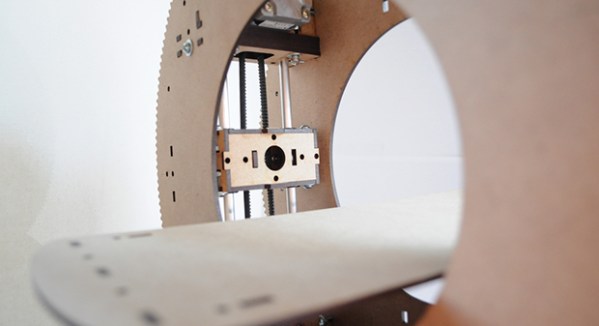
For [Peter Jansen], the most interesting course in grad school was Advanced Brain Imaging; each class was a lecture followed by a trip to the imaging lab where grad students would take turns being holed up in a MRI machine. A few years into his doctorate, [Peter] found himself in a very opportune situation – his local hackerspace just acquired a shiny new laser cutter, he had some free time on his hands, and the dream of creating a medical imaging device was still in the back of his mind. A few weeks later, the beginnings of an open source CT scanner began to take shape.

This isn’t an MRI machine that [Peter] so fondly remembered from grad school. A good thing, that, as superconducting magnets chilled with liquid helium is a little excessive for a desktop unit. Instead, [Peter] is building a CT scanner, a device that takes multiple x-ray ‘slices’ around an axis of rotation. These slices can then be recompiled into a 3D visualization of the inside of any object.

The mechanics of the build are a Stargate-like torus with stepper motor moving back and forth inside the disk. This, combined with the rotation of the disk and moving the bed back and forth allow the imager to position itself anywhere along an object.

For the radioactive detector, [Peter] is using a CCD marketed as a high-energy particle detector by Radiation Watch. Not only does this allow for an easy interface with a microcontroller, it’s also much smaller than big, heavy photomultiplier tubes found in old CT scanners. As for the source, [Peter] is going for very low intensity sources, most likely Barium or Cadmium that will take many minutes to capture a single slice.

The machine operates just above normal background radiation, so while being extremely safe for a desktop CT scanner, it is, however, very slow. This doesn’t bother [Peter], as ‘free’ time on a CT scanner allows for some very interesting, not seen before visualizations, such as a plant growing from a seed, spreading its roots, and breaking the surface as a seedling.

[Peter] still has some work to do on his desktop CT scanner, but once the stepper motor and sensor board are complete, he should be well on his way towards scanning carrots, apples, and just about everything else around his house.

Serial USB For Any AVR Microcontroller

If you’re using an AVR microcontroller and you’d like to add USB to a project, there are a lot of options out there for you. Both LUFA and V-USB add some USB functionality to just about every AVR micro, but if you’d like a native serial port, your only options are to look towards the USB-compatible Atmel micros.

[Ray] looked at the options for adding a USB serial port and didn’t like what he saw; seemingly, this was an impossible task without a second, more capable microcontroller. Then he had an idea: if the goal is only to transfer data back and forth between a computer and a microcontroller, why not write an HID-class USB serial port?

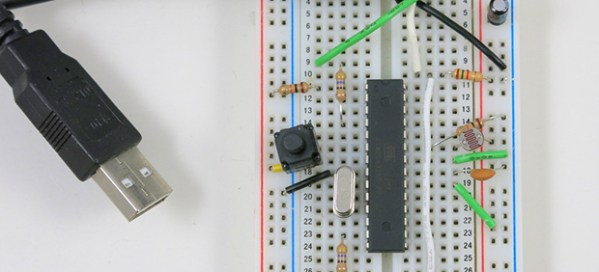
[Ray] based his project on The V-USB library and created a new HID descriptor to transfer data between a micro and a computer. While it won’t work with a proper terminal such as Putty, [Ray] managed to whip up a serial monitor program in Processing that’s compatible with Windows, Linux and OS X.

In the video below, you can see [Ray] using an ATmega328p with a standard V-USB setup. He’s transferring analog values from a photoresistor as a proof of concept, but just about everything that would work with a normal serial port will work with [Ray]’s library.

Continue reading “Serial USB For Any AVR Microcontroller”

3D Printering: A Call For An Open Source Automated Build Platform

I’ve said this before, and I’ll say it again: if you’re using a 3D printer to make a few hundred identical plastic parts, you’re doing it wrong. That’s the place for traditional manufacturing methods such as injection molding or resin casting. If, however, you’re looking at printing a few dozen identical plastic parts, or even running a script to optimize your machine time, the current open source 3D printer world leaves one thing to be desired.

An Automated Build Platform

An Automated Build Platform is a fairly simple idea: put a conveyor belt on your heated bed, and when the print is done, send a command to drive a motor, dumping the newly printed part into a bin, The printer then begins the next part with a clean bed, and the days of doting over a 3D printer soon fade into the past.

For such a simple and useful idea, it’s surprising there hasn’t been much done with this idea in open source circles. There are, of course, problems both technical and legal, but hopefully nothing that should indefinitely derail anyone who would want to create the first open source automated build platform.

Continue reading “3D Printering: A Call For An Open Source Automated Build Platform”

Cracking GSM With RTL-SDR For Thirty Dollars

Theoretically, GSM has been broken since 2003, but the limitations of hardware at the time meant cell phone calls and texts were secure from the prying ears of digital eavesdroppers and all but the most secret government agencies. Since then, the costs of hardware have gone down, two terabytes of rainbow tables have been published, and all the techniques and knowledge required to listen in on cell phone calls have been available. The only thing missing was the hardware. Now, with a super low-cost USB TV tuner come software defined radio, [domi] has put together a tutorial for cracking GSM with thirty dollars in hardware.

Previous endeavours to listen in and decrypt GSM signals used fairly expensive software defined radios – USRP systems that cost a few thousand dollars a piece. Since the advent of RTL-SDR, the price of software defined radios has come down to about $30 on eBay, giving anyone with a Paypal account the ability to listen in on GSM calls and sniff text messages.

The process of cracking GSM first involves getting the TMSI – Temporary Mobile Subscriber Identifier – a unique ID for each phone in a certain cell. This is done by sending a silent SMS that will send back and acknowledgement an SMS has been received on the victim’s phone, but won’t give the victim any indication of   receiving a message.

From there, the attacker listens to the GSM signals in the cell, receiving bursts attached to a TMSI, and cracking the encrypted stream using 1.6 TB of rainbow tables.

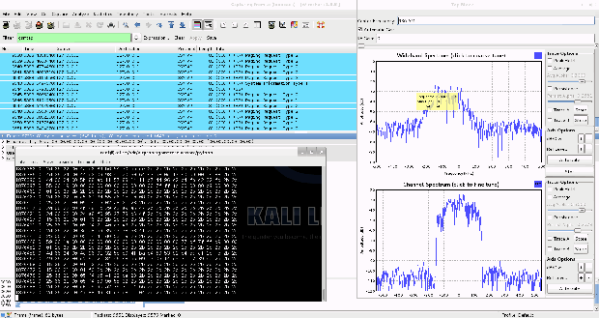
[domi] put up a four-part tutorial series (part 1 above; part 2, part 3, and part 4) that goes over the theory and the actual procedure of cracking text messages and voice calls with a simple USB TV tuner. There are a few limitations; the attacker must be in the same cell as the victim, and it looks like real-time voice decoding isn’t yet possible. Cracking GSM for $30, though, that’s good enough for us.

USB Implementers Forum Says No To Open Source

For the longest time. one of the major barriers to hobbyists and very small companies selling hardware with a USB port is the USB Implementers Forum. Each USB device sold requires a vendor ID (VID) and a product ID (PID) to be certified as USB compliant. Adafruit, Sparkfun, and the other big guys in the hobbyist market have all paid the USB Implementers Forum for a USB VID, but that doesn’t help the guy in his garage hoping to sell a few hundred homebrew USB devices.

Arachnid Labs had an interesting idea to solve this problem. Since other USB device vendors such as Microchip and FTDI give away USB PIDs for free, a not for profit foundation could buy a VID, give PIDs away to foundation members making open source hardware, and we would all live in a magical world of homebrew devices that are certified as USB compliant.

This idea did not sit well with VTM Group, the people serving as the management, PR, legal, and membership and licensing department of the USB Implementers Forum. In a slightly disproportionate response, the VTM Group told Arachnid Labs to,

Please immediately cease and desist raising funds to purchase a unique USB VID for the purpose of transferring, reselling or sublicensing PIDs and delete all references to the USB-IF, VIDs and PIDs for transfer, resale or sublicense from your website and other marketing materials.

Interestingly, Arachnid Labs’ and scores of other requests for an open source USB VID haven’t hit the desk of anyone at the USB Implementers Forum, the people who are actually in charge of designating USB VIDs and PIDs. There are a number of ideas to get around VTM Group that include squatting on USB VID 0xF055, but we’re at a loss why there couldn’t be a foundation that gives out open source USB PIDs. Microchip, FTDI, and Openmoko do the same, so perhaps it’s time to email some key people at HP, Intel, and Microsoft