Before You Throw Out That Pumpkin, Make A Dragon-o-lantern

Yes, it’s a little late for Halloween, but before you throw out that rotting gourd sitting outside your front door, how about planning for next year’s festivities with a dragon-o-lantern?

The first dragon-o-lantern that made its way into our tip line is a fire breathing dragon jack ‘o lantern built by [Aaron] for a pumpkin carving contest. The idea is simple; just carve a dragon head out of a pumpkin, insert candle, and spray the open flame with a can of Aquanet. Sure, it’s crude, but with a little engineering it could turn out to be a very, very cool build.

For a slightly more complex build, [Chris] built a fire-breathing jack ‘o lantern triggered by anyone saying the words, “trick or treat.” The key part of this build is a Microsoft Kinect, used for its voice recognition capabilities instead of its capacity to form a 3D depth cloud.

The fire portion of [Chris]’ build is controlled by an Arduino triggering a solenoid to dispense a small amount of fuel into the pumpkin shell. [Chris] doesn’t go over the construction of his ‘poofer,’ but any member of your local hackerspace should be able to show you how it’s done.

Videos after the break.

Continue reading “Before You Throw Out That Pumpkin, Make A Dragon-o-lantern”

MR-808 Is A Mechanical Version Of The Most Famous Drum Machine

Anyone who has listened to any music from the 80s has heard the percussive effects of the infamous TR-808 drum machine. To the modern ear, it sounds like an antique. Being the most popular drum machine of all time means it must have some redeeming qualities, right?

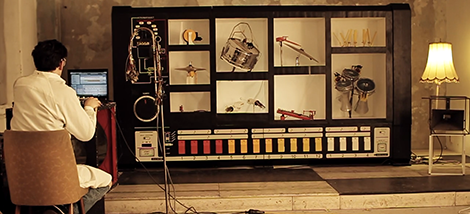
[Moritz Simon Geist] decided he wanted nothing to do with the wimpy computer-based emulations of a TR-808. Instead, he chose a more mechanical version that puts robots inside a gigantic 808 enclosure to play snares, high hats, cowbells, and drums in time with any MIDI drum track.

[Moritz] calls his build the MR-808 and puts a real-life bass drum, snares, hats, toms, claps, and a ride into a 3.3 x 1.7 meter ( 10.8 x 5.5 foot) case. The sound triggers are handled by Max/Msp communicating with a pair of Arduinos to handle the solenoids and light effects. You can read more about the hardware setup in [Moritz]’ behind the scenes look.

After the break you can see the MR-808 in action, both alone and by providing the percussion for [Moritz]’ band. A very cool build that now cries out for an Arduinofied bassist placed into an overgrown TB-303 enclosure.

Continue reading “MR-808 Is A Mechanical Version Of The Most Famous Drum Machine”

Skittles Sorting Machine Sorts Skittles, Keeps The Band Happy

In 1982, Van Halen had the biggest stage show around. Their rider – a document going over the requirements for the show – reflects this. In the middle of the requirements for the lighting and sound rigs, Van Halen placed a rather odd request; one (1) bowl of M&M, (ABSOLUTELY NO BROWN ONES). The theory being if the request for no brown M&Ms wasn’t followed, the lighting and sound rigs probably weren’t up to spec either.

It’s not M&Ms this time (they wouldn’t fit in the machine), but [egenriether] came up with a seriously clever solution for sorting Skittles by color. Why? We have no idea, other than, ‘just because.’

The build details are a little scant, but we know [egenriether] used a BASIC Stamp 2 for the electronics portion of the build. To sort the Skittles by color, a TAOS RGB color sensor reads the red, green, and blue values for each Skittle and actuates a servo that guides each piece of candy into its respective bowl.

It’s a very, very cool, if completely useless build. Still, we’re thinking it could be put to use if [egenriether] is ever backstage setting up before the band arrives.

Videos after the break. Thanks [Andrew] for sending this one in.

Continue reading “Skittles Sorting Machine Sorts Skittles, Keeps The Band Happy”

[Jeri] Shows Off A Delta Sigma ADC

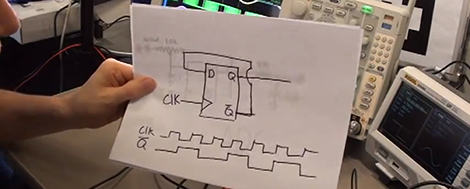
[Jeri] has had a bear of a time moving up to Valve Software, but electron microscope is safely in her garage (!) and her electronics lab is slowly taking shape. Since she can’t bring out the real-life gravity gun she’s working on, she decided to show off a one-bit ADC that uses just a flip-flop to sample an analog waveform  into digital data.

By toggling the clock input of a 74xx74 (or any flip-flop, really) and feeding the complimentary output to back into the data input, [Jeri] can get an output that is a 50% duty cycle feeding into the input of the chip. Adding an audio input to this data input with 10k pot to this feedback loop will cause the duty cycle to change in relation to the analog input, making a one-bit ADC.

As with any electronic shortcut, there are a few drawbacks: the clock cycle feeding into the flip-flop has to be pretty fast; at least a few dozen kilohertz if you’re sampling audio. Still, if you don’t have a free ADC pin, or you’d just like to build a bitcrushing guitar pedal, it’s a very simple (and cheap) way to get analog into a digital micro.

Continue reading “[Jeri] Shows Off A Delta Sigma ADC”

Hackaday Links: November 4, 2012

Wait, you’re using a Dremel to cut PCBs?

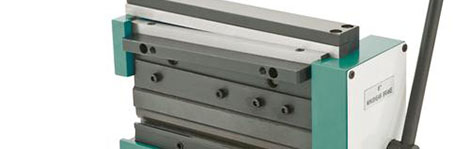
Cutting copper-clad board or – horrors – depanelizing PCBs is a pain if you don’t have the right tool. Over at Hub City Labs they’re using a small, cheap metal shear & break. Bonus: it can cut and bend sheet metal, so the Hub City folks can also make enclosures.

Color Codes? Yes, Color Codes.

[Joe] sent in a cool utility he whipped up called resisto.rs. Plug in a resistor value, and it’ll spit out the 4-band, 5-band, and surface mount labels for that resistor value. Pretty neat.

Parallel Ports

Parallel ports may be a dying breed, but that didn’t stop [Electroalek] from putting together a VU meter that connects to his LPT port. It’s an extremely simple design; just connect some LEDs and resistors to the pins of a parallel port, and you can easily control them via software on a computer. Playing around with an LPT port used to be common knowledge, so we’re glad to see [Electroalek]’s work here.

The power is out, but Radio Shack is still open

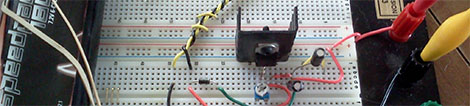
[Jason] is stuck in New Jersey without power and needed a way to charge his phone. He whipped up a cell phone charger using an RC car battery and an LM317 voltage regulator. It’s an easy circuit to piece together, and judging from [Jason]’s picture will hopefully keep his cell phone charged until the power comes back on.

Shooting 50 Nerf darts all at once

If [Rob]’s project log is to be believed, it looks like they’re having a lot of fun over in the Sparkfun warehouse. They decided to have a full-scale Nerf gun war for a summer intern’s last day. [Rob] came up with a DIY Nerf shotgun that shoots 50 darts across the room, just waiting to be found sometime in the next decade.

There’s a great video of [Rob] firing the single barrel (yeah, they made a trident-shaped one as well) gun at well prepared but unsuspecting coworkers. Be sure to check out the comments of this post to see Hackaday readers frothing at the mouth because PVC pipe isn’t a pressure vessel guys. You’ll all surely die.

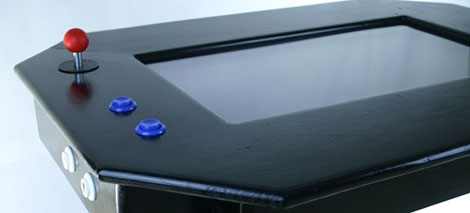
Turning The Raspberry Pi Into A Cocktail MAME Coffee Table

Ah, the cocktail arcade cabinet. With the right design, its able to blend right in to any living room decor, much more than any traditional stand-up cabinet, at least. [graham] over on Instructables didn’t tear apart a 30-year-old arcade cabinet for his new coffee table. Instead, he built one from scratch, connected it to a Rasberry Pi, and brought hundreds of arcade classics right in front of his couch.

The build began by cutting up some wood to house the 24″ LCD screen, Raspi, and arcade controls. The LCD screen is supported with a rather clever system of cross braces screwed into the VESA mount, and of course a piece of perspex protects the screen from the inevitable spills and scratches.

The joystick two blue ‘player’ buttons and the player 1 and player two buttons are wired directly to the GPIO pins of the Raspberry Pi. The Raspi boots up into a selection of MAME games, but there’s also an option for opening up the window manager and browsing the web.

It’s a very neat build that’s a lot smaller (and easier to build) than a traditional cocktail cabinet. As [graham] is using it for a coffee table, it might get more use than a regular MAME build, to boot.

On Not Proving The Twin Prime Conjecture With AutoCAD

As an HVAC engineer by trade, [Carlos Paris] spends a lot of time in AutoCAD designing all those hidden pipes, tubes, and ducts hidden in a building’s rafters. One day, [Carlos] read of an open contest – the prize was over a million dollars – to generate a prime number with a billion digits. [Carlos] misheard this as, ‘a prime number greater than one billion’ and of course said this was a trivially easy task and opened up his favorite tool – AutoCAD – in an effort to discover the largest prime ever. [Carlos] never generated a remarkably large prime, but he did come up with a very, very cool visualization of prime numbers on a number line, as well as a great justification of the twin prime conjecture, a problem in mathematics that has remained unsolved for several generations.

[Carlos] started his investigations into the properties of prime numbers by drawing a series of circles on a number line in AutoCAD. These circles were of diameters of all the integers, and going down the number line, these circles started to have an interesting, chaotic pattern (see above picture). [Carlos] found that whenever two circles intersected, that position was a prime number. It’s really nothing more than a Sieve of Eratosthenes, but it’s a very cool-looking visualization nonetheless.

Looking deeper into his graph, [Carlos] discovered there were certain primes that had another prime number just two places down the number line. For example, the numbers 3 and 5, 29 and 31, and 41,and 43 are twin primes, as the difference between the primes is only 2. The idea there are infinitely many twin primes is a famous unsolved problem in mathematics – it’s obvious it must be true, but no mathematician has yet come up with a proof of this conjecture.

[Carlos] looked at his number line and simplified it to a generic prime number. By taking a generic number line and overlaying the multiples of other prime numbers on this graph, [Carlos] had a very, very clever way of understanding exactly how twin primes come into existence.

In the end, [Carlos] is no closer to proving the twin prime conjecture than anyone else. We’ve got to hand it to him, though, for nerding out with an engineer’s favorite tool – AutoCAD – and managing to derive some fairly obscure mathematics on his own.

After the break you can see [Carlos]’s videos describing the though process that went into his creation. Very, very cool work.

Continue reading “On Not Proving The Twin Prime Conjecture With AutoCAD”