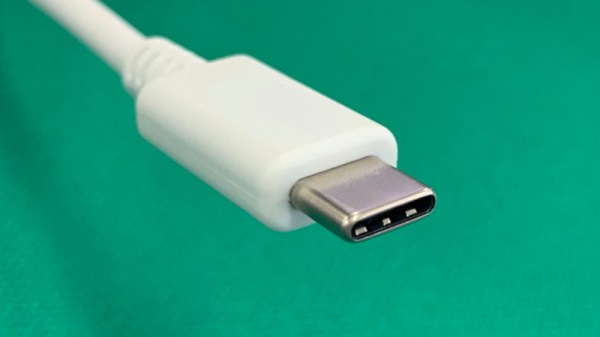
USB-C Charger Juices Up 100 Devices At Once

Back when phones used to ship with chargers in the box, you’d get a plugpack that could charge one device. Aftermarket manufacturers eventually started making chargers with four or five ports which were great for travelling. But what if you wanted to charge even more devices? You might build something like this rig from [DENKI OTAKU].

The goal was to build a charger that could handle 100 devices at once. The charger is designed to charge devices at up to 1.5 amps. That’s no mean feat, as the device would have to be able to deliver 150 amps total when fully loaded. As for the actual design, though, it’s relatively simple. [DENKI OTAKU] simply built a simple USB-C charger PCB based around an off-the-shelf chip which has ten individual chargers on it, and stacked it up ten of those in a housing made out of aluminium extrusion. To deliver the current to run all these chargers, the rig got two massive switching power supplies to feed the charger array a massive amount of current. The open enclosure design here makes sense, in that it probably helps keep everything cool.

The only thing missing from the build video? A heavy-duty test. We’d love to see if it actually holds up under full load with 100 phones connected. We have some suspicions as to whether the traces on the PCBs would hold up under a continuous 15 amp load, for example. Still, if you wanted to provide phone charging en-masse at an event or similar, this kind of simple stacked design could be an easy way to go.

Phone chargers are still moving forward; the last big leap was the adoption of GaN technology. Video after the break.

Continue reading “USB-C Charger Juices Up 100 Devices At Once”

GaN Charger Teardown Reveals Value Of This New Technology

Every so often, a new technology comes along that offers a broad range of benefits over what we already have. Just as lithium-ion batteries have made nickel-cadmium cells boring and old hat, gallium nitride semiconductors are making silicon parts look unimpressive by comparison. [Brian Dipert] looked at what this means in a practical sense by tearing down a GaN phone charger.

The charger in question is a 30 watt USB-C charger produced by Voltme. It cost [Brian] just $10, as prices of GaN hardware have come down significantly as economies of scale have kicked in. The charger measures just 1.2×1.3×1.2 inches, and weighs only 1.5 ounces. That compact size is thanks to GaN semiconductors, which are able to run cooler at higher power levels than their silicon forebearers.

Cracking into the charger required levering open the case. The back panel came off with some work, revealing the mains terminals, which deliver AC power to the PCB inside via the case holding them in contact. Interestingly, the entire circuit inside is filled with an adhesive thermal goop, which helps pass heat from the hottest components to the charger’s case. [Brian] is able to guide us through the circuit, and he identified many of the major components. However, some of the markings on chips were beyond his research skills, and he asks any knowing readers to contribute their own information.

It’s interesting to see just what makes the high-powered compact chargers of today tick. Plus, it’s a hallmark of progress that what was once considered a wonder material can now be had in a $10 commodity phone charger from Amazon. How times change!

That Cheap USB Charger Could Be Costly

[Big Clive] picked up a keychain battery to charge his phone and found out that it was no bargain. Due to a wiring mistake, the unit was wired backward, delivering -5 V instead of 5 V. The good news is that it gave him an excuse to tear the thing open and see what was inside. You can see the video of the teardown below.

The PCB had the correct terminals marked G and 5 V, it’s just that the red wire for the USB connector was attached to G, and the black wire was connected to 5 V. Somewhat surprisingly, the overall circuit and PCB design was pretty good. It was simply a mistake in manufacturing and, of course, shows a complete lack of quality assurance testing.

The circuit was essentially right out of the data sheet, but it was faithfully reproduced. We should probably test anything like this before plugging it into a device, but we typically don’t. Does our phone protect against reverse polarity? Don’t know, and we don’t want to find out. [Clive] also noted that the battery capacity was overstated as well, but frankly, we’ve come to expect that with cheap gadgets like this.

This isn’t, of course, the first phone charger teardown we’ve seen. This probably isn’t as deadly as the USB killer, but we still wouldn’t want to risk it.

Continue reading “That Cheap USB Charger Could Be Costly”

the full charger with gas tank and engine

Charge Your Apple With Apples

When you think of ethanol, you might think of it as a type of alcohol, not alcohol itself. However, in reality, it is the primary ingredient in adult beverages. Which means humans have gotten quite good at making it, as we’ve been doing for a long time. With this in mind, [Sam Barker] decided to make ethanol out of apples to power a small engine to charge his phone.

The steps for making pure ethanol is quite similar to making alcoholic cider. A friend of [Sam’s] had an orchard and a surplus of apples, so [Sam] boiled them down and stored the mush in jugs. He added activated dry yeast to start the fermentation process. A dry lock allowed the CO2 gas that was being created to escape. Over a few weeks, the yeast converted all the sugar into ethanol and gas. In the meantime, [Sam] sourced a chainsaw and adapted the engine to run on ethanol, as ethanol needs to run richer than gasoline. The video below the break tells the story.

Continue reading “Charge Your Apple With Apples”

Showdown Time For Non-Standard Chargers In Europe

It seems that few features of a consumer electronic product will generate as much rancour as a mobile phone charger socket. For those of us with Android phones, the world has slowly been moving over the last few years from micro-USB to USB-C, while iPhone users regard their Lightning connector as the ultimate in connectivity. Get a set of different phone owners together and this can become a full-on feud, as micro-USB owners complain that nobody has a handy charging cable any more, USB-C owners become smug bores, and Apple owners do what they’ve always done and pretend that Steve Jobs invented USB. Throwing a flaming torch into this incendiary mix is the European Union, which is proposing to mandate the use of USB-C on all phones sold in its 27 member nations with the aim of reducing considerably the quantity of e-waste generated.

Minor annoyances over having to carry an extra micro-USB cable for an oddball device aside, we can’t find any reason not to applaud this move, because USB-C is a connector born of several decades of USB evolution and brings with it not only the reversible plug but also the enhanced power delivery standards that enable fast charging no matter whose USB-PD charger you are using. Mandating USB-C will put an end to needlessly overpriced proprietary cables, and bring eventual unity to a fractured world. Continue reading “Showdown Time For Non-Standard Chargers In Europe”

Hot Wire Ribbon Cutter Ceremoniously Heats Up Productivity

Anyone who’s ever cut ribbon, grosgrain or otherwise, may be dismayed by the frayed edge. There are methods of avoiding this, like cutting the ribbon diagonally, or double-diagonally into a forked point, or cutting it straight across and cauterizing the threads with a lighter. But if you have a thirteen dozen baker’s dozens’ worth of goodies to festoon, ain’t nobody got time for that.

[IgorM92] made this hot wire ribbon cutter for his wife, who has a yummy-looking baking business. It combines the cutting and the heat-sealing into a single step by using the heating element from an old soldering iron. If you don’t have one of those, you could just as easily use the nichrome wire from an old hair dryer, a toaster, or wire-wound resistor.

Since the idea is essentially shorting a power source to heat up a wire, it should be done safely. [IgorM92] used a phone charger to condition mains power down to 5 V. There isn’t much else to the circuit, just a rocker switch, a power-indicating LED, and its resistor, but this simple project will no doubt save a lot of time and labor. Burn past the break to watch it ramp up production.

Nichrome wire is good for cutting foam, too. Here’s a bare-bones version that can be made in minutes.

Continue reading “Hot Wire Ribbon Cutter Ceremoniously Heats Up Productivity”

Pedal Faster! I Need To Join A Conference Call!

It is rare to find a car these days without some mechanism for charging a cell phone. After all, phones need charging all the time and we spend a lot of time in our cars. But what if you spend a lot of time on your bike? Five teens from Lynchburg, Virginia decided to build something to charge their phones from pedal power.

This isn’t a new idea, of course. Your alternator is charging your phone in your car, and bikes have had alternators connected to them for lights and other purposes. According to the team, you need to pedal about 4 miles per hour to get enough voltage to charge the phone. You can go faster though, because the circuit has a regulator. We especially liked how they determined the speed versus the voltage using a tachometer and an electric drill. We also liked the 3D printed parts such as the handlebar mount that you could probably repurpose for other things.

Continue reading “Pedal Faster! I Need To Join A Conference Call!”