Hackaday Links: December 16, 2011

Free-form Christmas ornament
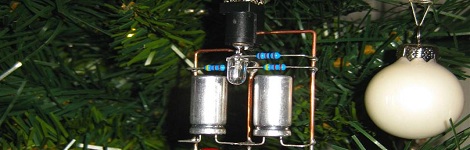
Here’s [Rob]’s free form circuit that’s a Christmas ornament for geeks. It looks great, but sadly isn’t powered through a Christmas light strand. It’s just as cool as the skeletal Arduino we saw.

Prototyping with flowers
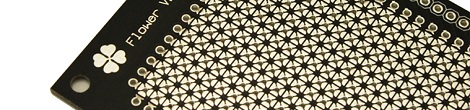
Well this is interesting: protoboard that’s specifically made to make SMD soldering easier. The guys at elecfreaks went through a lot of design iterations to make sure it works.

We’ll call it Buzz Beer
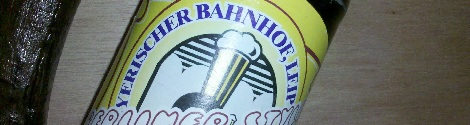
The days are getting longer and cabin fever will soon set in. Why not brew beer in your coffee maker? It’s an oldie but a goodie.

Christmas oscilloscope
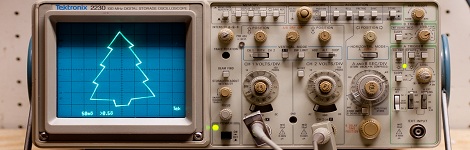
With just an ATtiny and a little bit of  futzing around changing the coefficients of a partial differential equation, you too can have your very own oscilloscope Christmas tree. Don’t worry though, there are instructions on how to implement it with an Arduino as well. HaD’s own [Kevin] might be the one to beat, though.

So what exactly does a grip do?

You know what your home movies need? A camera crane, of course. You’ll be able to get some neat panning action going on, and maybe some shots you couldn’t do otherwise. Want a demo? Ok, here’s a guy on a unicycle.


Welding And Casting ABS

Anybody who has a 3D printer always has a ton of useless plastic lying around. Some of that plastic may be from useless baubles, but most of it is in bad prints, short bits of filament, and general scraps. [Luke] found an interesting way to put those ABS scraps to use, and ended up turning trash into valuable plastic parts.

Commonly sold as nail polish remover, acetone will turn anything made out of ABS into a puddle of plastic. [Luke] makes glue using the same process – he fills a small container half full of acetone and half with small bits of ABS. After a day or so, he has a nice thin glue that dries into solid ABS. [Luke] used this to create a 400mm long piece of extruded t-slot. We don’t know if it would be suitable to build a child RepRap from, but it would sure be an interesting experiment.

[Luke] also did a little bit of casting with his ABS glue. With a thicker solution of ABS and Acetone, he managed to make this ‘thing’. The entire process is explained over at Thingiverse, We can’t wait to see what can be done with this stuff.

Making Paint With Inorganic Chemistry

Back during the Renaissance, great artists like Leonardo, Michelangelo, and Raphael would create their own paints. Of course paint is very cheap and readily available, but that doesn’t mean you can’t make your own paint by playing with chemistry.

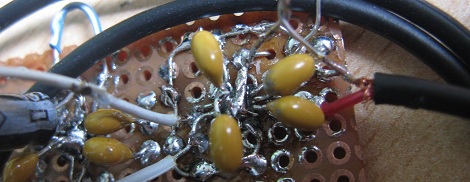
Last summer, [Sean] at the Philly hackerspace Hive76 did some experiments with ferrofluids. For these experiments [Sean] prepared a bunch of magnetite from rusty iron screws. In the process a lot of iron hydroxide was formed, which can produce wonderful colors. The red-brown eye in the title pic was made from some of the stuff floating on the top of [Sean]’s beaker.

[Sean] was really after something really black, so he turned his efforts towards hematite, a very dark pigment and is now working with other metals to produce some interesting colors. Already he’s made green and yellow pigments with two copper compounds. We’ll just have to hope he uses a fume hood when he starts taking apart mercury switches to make red.

Improving Terrible Computer Speakers

[Victor] likes to watch movies on his laptop, but the tiny speakers in his machine don’t do [John Williams] and other perfectly fine soundtracks justice. To pump up the jams a little bit, [Victor] got a pair of Trust Mila 2.0 speakers for Sinterklaas. Unfortunately, these speakers were terrible – noise everywhere, tinny output and a brighter-than-the-sun blue LED. These problems were fixed once [Victor] replaced the amplifier in both speakers.

After shopping around for a new power amp to go in each speaker, [Vic] hit upon the MAX9575 3.2 Watt amplifier. This little guy met all of [Victor]’s requirements. The only problem is that the MAX9575 is only available in a TQFN package.

After a deep breath and much sweat of the brow, both amps found a new home in their respective speakers, deadbug style. It probably would have been easier to etch a PCB, but we’ll give a tip of the hat to [Victor]’s fine motor skills anyway.

Because of the insane soldering skill demonstrated in the title pic, [Vic] now has a really nice pair of speakers. Check out the demo of the improved speakers after the break.

Continue reading “Improving Terrible Computer Speakers”

Censoring All The ‘F’ Words On TV

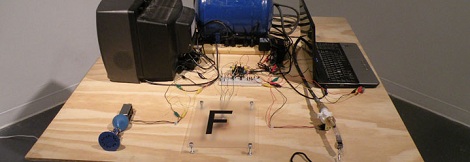
[Milton] sent in a build that censors every ‘F’ word on TV, and not just the one that rhymes with ‘duck,’ either. His setup sounds the alarm every time someone inside the moving picture box says a word that contains the letter F.

The build is based around Nootropic Design’s Video Experimenter Shield. This neat little shield has been used as a video sampler and has analyzed what the talking heads are actually saying. The Video Experimenter Shield has support for closed captions, meaning a transcript from a TV show can be read in real-time. All [Milton] had to do so the ‘F word’ alarm could be sounded was strchr().

The F-Chip, as [Milton] calls his build, includes three outputs – a solenoid sounds a bicycle horn, sends some air through a whistle, and lights up an ‘F-word’ alarm. From the video of the F-Chip in action (available after the break), we can tell that this build is awesome, thoughtful, and annoying. The only way it could be made more annoying is by making an ‘E-word’ alarm, but there are ways around that.

Continue reading “Censoring All The ‘F’ Words On TV”

Adding HTTP To Ikea DIODER

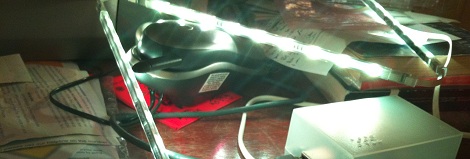
[Alex] sent in a neat Ikea DIODER build that controls strings of RGB LEDs with HTTP requests.

We’ve seen Ikea DIODERs controlled wirelessly and over USB, but using the Internet with a DIODER is new to us. For his build, [Alex] used a Nanode, a small Arduino-like board that has built-in web connectivity.

The hardware portion of the build is very simple. A MOSFET controls each LED strip on the DIODER. The stock controller of the DIODER was ditched, meaning [Alex] needed to figure out how to convert an RGB color space to a Hue, Saturation, and Lightness color space “for super-classy fading.” Once that was figured out, [Alex] implemented a 1D Perlin noise function to blend between two colors.

Finally, the great EtherCard library was used to turn HTTP requests into dancing LEDs. [Alex] is thinking about building a JQuery webpage so he won’t have to muck around with entering commands like 192.168.1.25/hsl?i=0&h=135&s=90&l=50 into a browser. Without a nice web interface, it’s not as futuristic as [Alex] would like, but it’s still cool to us.

Music-synced Christmas Light Suit

Ah, the end of the 4th financial quarter – the magical time of increased sales, being at work the entire time the sun is up, and holiday parties. For [Andy] at National Instruments, though, things don’t seem too bad. He built a neat Christmas light suit to entertain everyone with his brilliant persona.

[Andy] always loves great Christmas light displays (he even blogs about them), so he figured a wearable light display synchronized with music would be very doable. The build is controlled with LabVIEW to convert .WAV files to power levels and frequency bands. This info is then piped into the Arduino that controls the lights.

[Andy] actually made two light suits, one for him and one for his friend [Richard]. Both guys have two light-up Christmas staffs to wield light mage powers on their coworkers. The lighsuits are controlled by Arduino/Xbee setups – one each for each suit and staff. The result is phenomenal, and should really get everyone in the holiday spirit.