Adorable And Small Portable NES

The Queen of Bondo is back again, this time with an adorably small NES portable, the HandyNES.

When last saw [lovablechevy], she had just finished up her build of a Nintenduo, a build that stuffed an NES and SNES into a single box. The Nintenduo was such a clean build it would be a crime to let her talents go to waste, so [Lovablechevy] finished up one of the smallest NES portables we’ve seen.

The build is based on a top-loading NES with a 3.5″ screen. [rekarp]’s NES2 composite mod was used to get the NES and screen working together. Two LiIon batteries provide 3 hours of play time (with a low battery indicator, natch).

[lovablechevy] also included an AV out so she can connect her HandyNES to a larger CRT screen. Like our old Sega Nomad, this allows for a little two-player action – player one using the HandyNES and player two using an extra controller. Support for the Zapper was also included after modding the Zapper connection to a USB port.

Check out the video walkthrough after the break. To prove that her build isn’t a clone, [lovablechevy] also include a video of herself playing Battletoads past the point where the clones crash. Excellent work from the Queen of Bondo.
Continue reading “Adorable And Small Portable NES”

Rebuilding A Mac SE As A Server Again

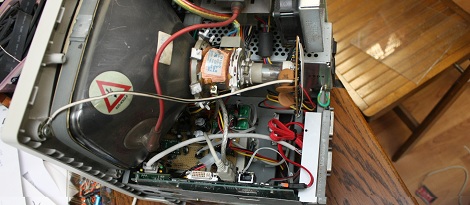
Around this time last year, [Sprite_TM] took a 1980’s-era Macintosh SE and rebuilt it as a home file server. He used a Seagate Dockstar as the new motherboard, but over the past year he’s been annoyed with the fact that the Dockstar doesn’t have real SATA ports. Using USB to SATA converters on a server is a slow way of doing things, so [Sprite_TM] rebuilt his SE using an HP thin client. To do this, he had to break out the onboard SATA and PCIE; not an easy task, but that’s why [Sprite_TM] is around.

The first order of business was installing a pair of SATA ports. The stock thin client had two NAND-flash chips serving as the drive, both connected to a SATA controller. All [Sprite_tm] had to do was desolder the flash chips and wire up the new SATA connections. Easy enough.

Because the HP thin client only had 100Mbps Ethernet, [Sprite_tm] wasn’t looking forward to the order of magnitude difference between his expected rsync speeds and what he would get with a 1Gbps connection. The only problem is the thin client didn’t have a spare PCIE connection for an Ethernet card. That’s really no problem for [Sprite_tm], though: just desolder the GPU and run a few wires.

Just like last year’s work on his SE, [Sprite_tm] ended up with a functional and very cool home server. The old-school System 7 is still there, and of course he can still play Beyond Dark Castle. Awesome work, in our humble opinion.

A Trojan Horse Full Of Music

With a Sound + Vision exhibition coming up, the folks over at Seaweed Factory decided they needed something big. Somehow they landed on building a giant pinata that responds to being walloped with a stick by playing MIDI notes. The end result is called the Trojan Chorus. Instead of Greek soldiers, though, the pinata is filled with electronics and candy.

The pinata was constructed out of cardboard and more colored tissue paper than we care to imagine. The horse stands seven feet tall and was built with a little more structural integrity than a normal pinata. Check out the ‘making of’ video for the pinata here.

From what we can tell, the electronics are 24 contact microphones implanted all over the inside of the pinata. Impacts on these contact mics are recorded by a small dev board, transcribed to serial data, and sent to a computer. You can check out the electronics in action right here. A horse neighing MIDI notes may sound fairly weird, but similar setup could be added to make the Trojan Chorus cry out in pain.

Continue reading “A Trojan Horse Full Of Music”

Internet Controlled Robotic Arm

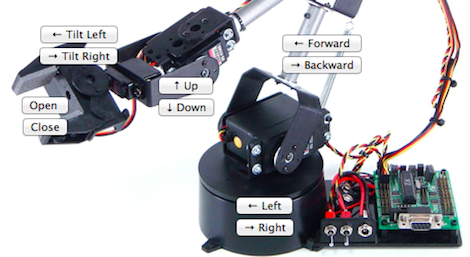
The guys over at Rusty Nail Workshop have put up an Internet controlled robotic arm for your amusement. While you’re waiting for the turkey to be done (or, you know, working), try your hand at moving some LEGO pieces around with a remote-controlled robotic arm.

The build log goes through the parts needed for the build. The arm itself is a Lynxmotion AL-5D, a heavy-duty device that’s far more capable and looks a lot better than our old Armatron.

The arm is controlled by an Arduino Uno. The Arduino is connected to the arm’s servo controller. Movement commands are received by an Ethernet shield and translated into servo commands. The entire build runs independently of a computer just like this project’s inspiration, the Orbduino.

Of course you can imagine the mayhem that would ensue if multiple people tried to take control of the robot simultaneously. A bit of code on the project’s website makes sure only one person has control of the robot at any given time. Check out what somebody else is building out of LEGO blocks with a Waldo. If you’re lucky, you’ll be able to knock that work down.

Hackaday Links: November 24, 2011

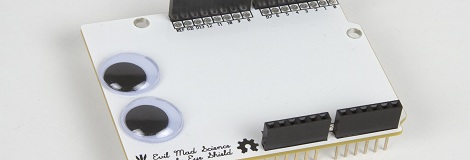
Finally an Arduino shield that does nothing

The folks at Evil Mad Scientist labs have finally created the Googly Eye Shield for Arduinos. With it’s pass-through .100 headers, it adds googly eyes to your Arduino projects. Of course, instead of in addition to the googly eyes you could add a breadboard, making it somewhat useful. A million fake internet points goes to the first person to implement Xeyes on this thing.

Phat beats from kids toys

[Ville] couldn’t afford an Akai MPC for laying down some beats. Wanting a real tactile interface, he hacked this kid’s toy. It’s just an RCA cable attached to the tiny chip inside the toy. The new line out goes to his mixers where he does some pretty impressive stuff.

Mona Lisa is Vigo the Carpathian

What did we just say about real-life Xeyes? [Geert] just made a print of the Mona Lisa follow you around the room with her eyes (Dutch, translation). The build is a pair of servos and a DIY motion capture app running on a laptop. Now we need to find a print of Vigo…

Quantifying heat sink efficiencies

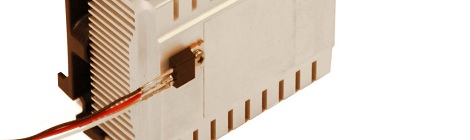
[Mike] is an experimenter at heart. He was wondering about the efficiency of small, clip-on heat sinks versus the ones we use to defrost frozen food. The results are exactly as you would expect, but he did find something interesting – his experimental technique didn’t find much of a difference between thermal paste/grease/pads and no thermally conductive material.

Mini-fig sized R/C LEGO car

The guys at Brickmodder.net took a car from a LEGO set and made it remote control. The drive train and steering both use servos controlled by the smallest 3-channel receiver they could find.

Seeing With Another Person’s Eyes

We suppose they could just trade shoes, but that wouldn’t be a hack. [Timothy] wanted to design a team-building exercise at work, and he figured the best way to get some empathy would be to have people swap eyes. He calls his project eyeSwap and it is supposed to, “put the eye back in team.”

[Tim] found a few CRT viewfinders in a junk box attached small video cameras to each one. During the ‘training phase’ of his team-building exercises, both people playing the game complete a few hand-eye coordination tasks to get a feel for the rig. After the training phase, the inputs are swapped; Alice’s cameras are sent to Bob’s viewfinders and vice versa. The participants then complete the same tasks they did during the training phase.

The tasks aren’t that hard – putting balls into holes, for example – but it does require a huge amount of communication and coordination. eyeSwap reportedly builds trust and empathy towards others, and looks like a lot more fun than a ‘trust fall.’

Check out the video of two people playing eyeSwap after the break.

Continue reading “Seeing With Another Person’s Eyes”

Kitchen Hacks: Home Made Meat Smoker


[Matt] noticed an overabundance of sous vide builds in the past week, so he decided to throw his Home made meat smoker into the ring. There’s not many things more delicious than a nice cut of smoked meat, and the fact that it’s very similar to the sous vide hacks we’ve seen is an added bonus.

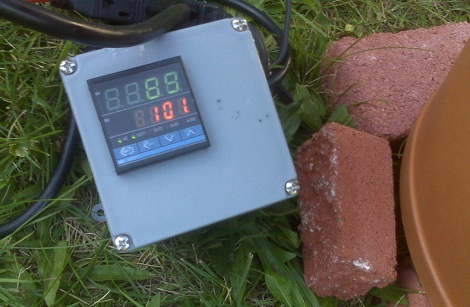
[Matt] decided to build a ceramic smoker like a Big Green Egg. He took a cue from [Alton Brown] and used two terracotta planters and a hot plate for the smoker. For controlling the hot plate, the cheap $35 PID controller we’ve seen in a few sous vide builds was used. The PID can’t control the 7 amps of AC that the hot plate needs, so [Matt] used a solid-state relay he had lying around.

A stainless steel mixing bowl was placed on the hot plate for wood chips. So far, [Matt] has run his smoker for more than 12 consecutive hours, and the results are really promising – there wasn’t much change in temperature between the chill of the morning and the heat of afternoon. [Matt]’s build is great and perfect for venison jerky now that deer season is coming up.