
Halloween Hacks: Building A Dark Ride In A Garage

Instead of the usual Jack-o-lanterns and creepy Halloween decorations, [Rick Murphy] built a dark ride in his garage a few years ago.

In case you’ve never been fortunate enough to see one in person, a dark ride is a track-based haunted house meant to be experienced on a small cart. Usually featuring sound, light, and animatronic displays, dark rides can be just as entertaining now as when you were eight years old.

[Rick]’s dark ride, “Scream in the Dark” was built in his 2-car garage over a few years. The kids that went though the ride were genuinely scared, but that made the kids in line even more curious – just the reaction [Rick] wanted.

The build is for the most part completely modular. The track is made up of 4-foot square panels that have either a straight track or 90 degree bend. The modular design means [Rick]’s garage doesn’t need to be a dark ride the entire year. The cart rides on this curved, raised track with the help of a few gear motors and 12 V battery pulled from a Power Wheels.

There’s a great gallery of the interior of the dark ride and a video after the break. If you’d like to build your own dark ride, check out dafe.org for a whole bunch of dark ride and fun house enthusiasts.

Continue reading “Halloween Hacks: Building A Dark Ride In A Garage”
Building A Better Clock To Drive You Insane

[youtube=http://www.youtube.com/watch?v=YpqFU4SGe1Y&w=470]

[Simon] came up with an improved version of Lord Vetinari’s clock that begs to be installed in waiting rooms around the world.

Last week, we were introduced to a real-life Vetinari Clock that keeps regular time but ticks at irregular intervals. It’s a great way to turn someone’s mind into porridge, but the original build broke after a few weeks because of some limitations in the clock drive. [Simon] built a very minimal circuit does away with these problems.

Just as in the first build, a microcontroller pulses the second hand motor once every second. As for the random component of this build, the microcontroller has a puts 32 bytes into a 128 byte array. The array is checked 4 times a second, and if the byte is 1, the second hand is incremented. If the byte is 0, time stops for a little bit. [Simon] included the schematic, board layout and code if you’d like to build one yourself.

There are a few drawbacks to this design; the pattern of ticking and not ticking is hard-coded into the microcontroller. Even though the 32 second long pattern shouldn’t be noticeable by watching the clock, it’s not an entirely random solution. Judging from the comments on the original build, using radioactive decay to increment a second might be a bit uncalled for.

We would like to see a second hand that stops when you look at it though. Facial recognition, anyone?

Send A Satellite Into Space For $300

There’s a new Kickstarter campaign that promises to launch a personalized satellite into orbit for 300 bones.

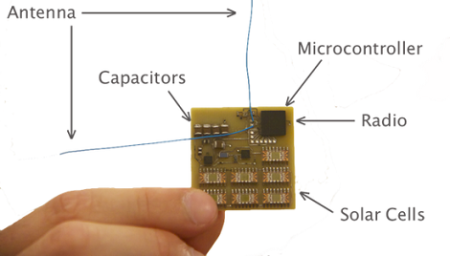
The KickSat project is headed by [Zac Manchester], [Mason Peck], [Justin Atchison] and a few more contributors hailing from Cornell University. Their goal is to launch a CubeSat filled with hundreds of postage stamp-sized satellites and release these ‘Sprites’ into low Earth orbit.

The Sprite concept has been in development for a while now and has been featured on IEEE Spectrum. The tiny satellites are simple PCBs with a microcontroller and a radio powered by solar cells and capacitors. The first version of the Sprite is designed to beam down a few bytes of data – just a unique identifier and a Kickstarter backer’s name. Future versions will undoubtedly include more advanced sensors such as cameras, thermometers, and very tiny particle detectors.

The KickSat team will use the funding from the Kickstarter campaign to test and integrate the systems. The team hopes to hitch a ride on one of NASAs many CubeSat launches, but if they get funding from 400 people, they’ll get to fly on a commercial launch by early 2013.

We were wondering about the amazing amount of space junk this KickSat/Sprite build will produce, but the team says not to worry: The Sprites fly in a pretty low orbit and will reenter the atmosphere a few weeks after being deployed. Not bad, considering Sputnik orbited for only 3 months.

Announcing Our Next Theme: Halloween Hacks

It seems every year, Hack A Day is a little bit behind the times when it comes to Halloween hacks. Builds like the Mario costumes and the house singing Thriller are great, but it makes a lot more sense for us to post them before Halloween.

To introduce our Halloween theme, we’d like to present [heavyweighthowe]’s Halloween project. It’s a small lighting automation build that syncs a string of lights to the theme of the best Halloween Christmas 2nd best [Tim Burton] movie, The Nightmare Before Christmas. [heavyweighthowe] used Vixen to sequence the lights and an Arduino to interpret the serial commands from Vixen. It’s a nice build that would look great sitting on a porch next to a giant bowl of candy.

If you’ve got a Halloween build you’d like to show off, like a haunted house ride an awesome costume or even a really great Jack-O-Lantern, send it in on the tip line. We’re planning on putting up at least one Halloween post a day, so keep sending in those builds.

Genetic Testing With Lego

From the dark recesses of the Internet circa 2009 comes the BioBrick-A-Bot, a liquid handling system for molecular biologists.

The 2009 iGEM competition was a student competition to build devices for synthetic biology. The BioBrick-A-Bot’s goal is to build a simple, low-cost liquid handling system that sucks liquids out of petri dishes and into vials.

Like most lab equipment, the commercial version of this tech is insanely expensive – about 10 grand for a commercial liquid handling robot. The BioBrick-A-Bot is made nearly entirely out of LEGO parts, so the cost of the entire system was brought down to about $700.

There are two main parts to the BioBrick-A-Bot. The Alpha module holds four pipette on a delta platform We’ve seen this type of robot built out of LEGO before, but moving liquids is new territory. The Phi module contains all the mechanics to suck microliters of liquid into a pipette and spit them out into vials.

The BioBrick-A-Bot didn’t win the 2009 iGEM competition (that honor was taken by students from Heidelberg Cambridge), but we’d take a LEGO robot any day of the week. Check out the demo after the break.

Continue reading “Genetic Testing With Lego”

Electric Mountain Board With Glove Control

Last summer, we saw [Andres Guzman]’s electric mountain board tearing around the University of Illinois campus. He’s back again, only this time the board isn’t controlled with a PlayStation controller. [Andres] built a wireless glove to control his mountain board.

An Arduino and power supply is mounted to the glove. A 2.4GHz transceiver serves as the comm link between the glove and board. The speed control is handled by this flex sensor from Sparkfun. With the flex sensor held between the middle and ring fingers, all [Andres] needs to do to apply power is slightly bend his fingers.

There’s also a number of safety features built into the board. To enable power to the boards motor, there’s a dead man switch on the glove underneath the thumb. If [Andres] were to take a nasty spill, he would release the switch and the board would come to a stop. [Andres] also made sure the board would shut down if the wireless link was interrupted. The build seems pretty safe, even if he is tearing around his campus in the video below.

Continue reading “Electric Mountain Board With Glove Control”

Animated X-mas Sign

Sure, it may be two and a half months until Christmas. That doesn’t mean we can’t start building a few Christmas decorations. Last year, [RB] over at Embedded Lab made an animated Christmas sign using a simple microcontroller setup. This year, [RB] is adding a blinking LED border and doing the entire project with 74xx ICs.

The letters for this year’s sign were recycled from last years’. This time, however, two strings of 12 LEDs are used for the blinking border. The blinking circuitry uses a 74hc14 Schmitt trigger to provide the clock. A pair of 74hc595 shift registers turn each letter on one at a time. The speed is controlled with a small trim pot.

Using ICs to drive a series of lights in a pattern isn’t a new thing – you’d be hard pressed to not find a similar setup in the blinking panels of sci-fi shows of the 60s and 70s. Of course this sign doesn’t compare with what can be done with a microprocessor a lot of patience, it’s still a very nice build. Check out the video after the break to see the X-mas sign in action.

Continue reading “Animated X-mas Sign”