Want To Learn Artificial Intelligence? Good.

In a little more than a month, tens of thousands of people around the world will attend a class on Artificial Intelligence at Stanford. Registration for this class is still open for both class ‘tracks’. The “basic” track is simply watching lectures and answering quizzes, or a slightly more advanced version of MIT OpenCourseware or Khan Academy. The “advanced” track is the full class, requires homework and exams, and aspires to Stanford difficulty.

With thousands of people taking this class, there’s bound to be a few study groups popping up around the web. The largest ones we’ve seen are /r/aiclass on Reddit and the stack overflow style aiqus. The most common reply to ‘what language should I learn from this class?’ is Python, although there’s an online code repo that has the text’s working code in Lisp, Java, C++ and C#.

If AI doesn’t float your boat, there are two more classes being taught from Stanford this fall: machine learning and introduction to databases. Any way you look at it, you’re getting to take a class from one of the preeminent instructors in the field for free. Do yourself a favor and sign up.

Thanks to everyone who sent this in. You can stop now.

Czech-ing Out The View From 31 Kilometers

The team at czANZO, the Czech Amateur Near-Space Object group, sent up one of the best high-altitude balloons we’ve ever seen last weekend and the resulting video is remarkable.

The team’s build blog (Google Translate link for everyone without Chrome) goes through the design and construction of their payload. Like every other balloon build we’ve seen, a styrofoam cooler is used for the enclosure, but there’s a lot of really neat additions that make this build special.

The team included a cut down device in the event the balloon gets caught in the jet stream. Without this cut-down device the balloon could end up hundreds of miles away from the launch point. That’s the reason for the cut-down device they’ve given, although we suspect it’s an excuse to play around with pyrotechnic rope cutting. The optical and audible alarm is something we haven’t seen on many high-altitude balloon launches, which is odd because it made ground recovery much easier.

The team has a lot of video from the flight that [Pavel Richter] dumped onto Vimeo. We really like the footage showing all of Prague, you can check that out after the break.

Continue reading “Czech-ing Out The View From 31 Kilometers”

Upgrading RAM In An Arduino Mega

[Andy] stuffed some more RAM onto an Arduino Mega and his three-part walk through on the design, construction, and software is a great read and one of the more ‘hard core’ Arduino builds we’ve seen.

The build is centered around a 512K × 8 SRAM module [PDF warning]. Because the RAM is divided up into about 512,000 chunks of 8 bits, the Arduino has to access the RAM through 16 ‘address lines’, then send the data through 8 ‘data lines’. [Andy] didn’t want to use up 24 pins on his Arduino, so he used a latch to multiplex the lowest 8 address lines and the data lines together. With the 512KB RAM expansion installed, the Mega is able to address a whopping 520 Kilobytes.

We’ve seen a few builds that have been limited by the amount of RAM available in the Arduino, like capturing video and some robot hacks, and adding some more RAM to those builds would be great. Multiplexing data and address lines using a latch can be expanded even further, but 520KB ought to be enough for anybody.

Engine Hacks: A Pulse Jet UAV By Any Other Name Would Still Be A Cruise Missile

Imagine our surprise when we learned [Bruce Simpson], who made headlines in 2003 with his $5000 DIY cruise missile, is still alive, not illegally interned in a black ops prison, and still doing what he does best: building really awesome remote-control airplanes.

The first successful mass-produced pulse jet aircraft was the German V-1 flying bomb. The V-1 had a very primitive guidance system, but the unmanned pulse jet aircraft quickly evolved into a few target drones used by the US Air Force. There was never any significant advancement towards improving the fuel consumption, noise level, or heat signature of pulse jets, so they were superseded by the superior turbojet. Despite their failings, pulse jets are remarkably easy to build and amazingly fast.

Instead of being antagonized by the New Zealand and United States governments, [Bruce] spends most of his time now working on pulse jet projects. He’s flown quite a few modified R/C planes and has an electronic Engine Control Unit for his jets. One of his most impressive projects is the 100 pound thrust pulse jet that was later attached to a go-kart. His no weld version of a pulse jet can be built in even the most minimalist work shop and is the epitome of an easy-to-build jet engine.

To get an idea of how fast [Bruce]’s planes can be, check out his Long-EZ R/C pulse jet in action after the break.

Continue reading “Engine Hacks: A Pulse Jet UAV By Any Other Name Would Still Be A Cruise Missile”

Freakin’ Huge CNC Router

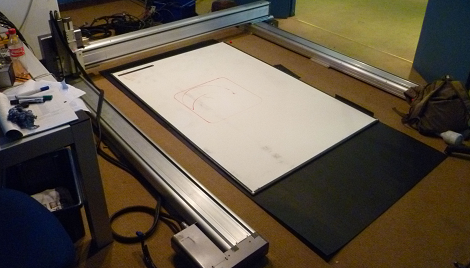
[Tom] sent in a gigantic 3-axis router that he pieced together during a 2 week-long work experience placement. Looking at this picture showing a 12-inch ruler on the work area, we realized that this may be the largest CNC router we’ve seen on Hack A Day.

[Tom]’s employer gave him some obsolete axes, so piecing the mechanical components together was very easy. The only real problem was interfacing the CNC controller to a computer. This meant [Tom] had to convert G Code to the code used by the antiquated NSK axes. Where G Code defines arcs with a start point, end point, and radius, the NSK code defines arcs with a start point, end point, and another point along the arc. It’s a tricky bit of math, but [Tom] built some software that did this in Visual Basic.

Right now, [Tom] only has a pen tool attached to the router; you can check that in action after the break. We’re trying to imagine what we would do with a 4 m² work area; this could easily be used to make a giant reprap or other 3D printer.

Continue reading “Freakin’ Huge CNC Router”

Delta Robot 3D Printer

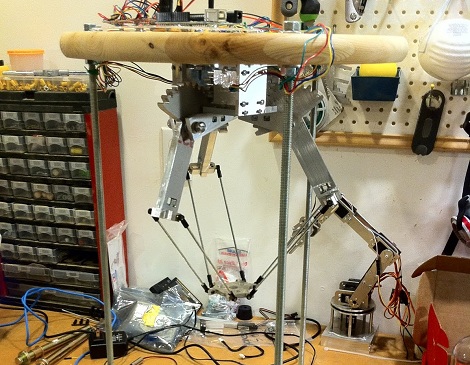
Sometimes, not all our builds work out the way we hoped. That’s what happened to [Rob] and his attempt at a Delta robot that does stereo lithography. A Delta robot is capable of very fast and precise movements, so [Rob] slapped a laser module on the end of the arms. After putting some UV curing resin in front of the laser, he was left with a blob of goo and we’re trying to figure out why.

[Rob] thinks the admittedly terrible print quality was due to diffraction and the reflective build plate. If this were the case, we’d agree with the assessment that adding some dye to the resin would help. Some commentors on [Rob]’s blog have suggested that he’s running the laser too slowly. It’s a shame [Rob] scrapped his build and turned it into a plain-jane X & Y axis build. Delta robots can be really damn fast, and adding a printer to one might mean prints that take minutes instead of hours. There are a few people working to get a Delta RepRap off the ground, but this project still has another prototype or two before that happens. Check out [Rob]’s attempt at Delta robot stereolithography after the break.

Thanks to [techartisan] for sending this one in.

Continue reading “Delta Robot 3D Printer”

Coil Gun Revolver

[Sam] sent in a coil gun revolver – a feature we’ve never seen on a coil gun build before. The gun is based on a cheap toy revolver and is powered by a 9 Volt battery connected to an “electrified fly swatter tennis racquet” instead of the usual disposable camera build.

The revolver mechanism isn’t perfect – [Sam] has to advance the chamber with his thumb while the capacitor is recharging. This is only because of the mechanics of the plastic toy his gun is based on, though. He figures a small motor could do the work for him, but he’ll be forgoing that project to work on the MK II version.

Most of the coil gun builds on Hack A Day have been muzzle or breech loaders, so with [Sam]’s revolver we’re probably seeing the evolution of firearms mirrored in coil gun advancements. Does anyone want to take a guess and predict when we’ll see the equivalent of a this .50 caliber beast?. [Sam] says his next project is going to be a rifle, so he might have his work cut out for him.