Lamp Sheds Light On Air Quality

It can be difficult to appreciate when the air quality is decent and when it’s poor, unless conditions are so bad that you can literally see the smog hanging in the air. Rather than try to digest a bunch of air quality numbers, [guillaume_slizewicz] built Canari — a lovely lamp that sheds light on the air pollution problem by taking local air quality data and turning it into light patterns.

Canari is of course named after the brave birds that once alerted miners to dangerous air conditions before they were forced to switch to carbon monoxide sensors. This bird has a Raspberry Pi Zero W that gets air quality data from a public API and controls the lights with a PWM bonnet based on the concentration of particulates in the air. The more particulates, the dimmer the LEDs are, and the faster they fade in and out.

The main piece of data that Canari grabs is the amount of particulate matter, and the display can switch between representing the level of PM2.5 (particulate matter with diameter less than 2.5 micrometers)  in the air and PM10. Check out the demo and setup video after the break.

More of a numbers person? All you really need is a microcontroller, an air quality sensor, and a display.

Continue reading “Lamp Sheds Light On Air Quality”

Retro Useless Clock Eventually Shows You The Time

It’s true; hackers like clocks. And hackers like useless machines. But would they like an intersection of the two? We’re thinking yes, probably, though we would argue that this QR clock was at no point fully useless. Yes, a QR clock as in, whip out your phone and, ignoring the conveniently-available phone time, open the bar code reader so you can check the time on this thing. So, it’s semi-useless. But at least it doesn’t detect cameras and then hide the QR code. That would be evil.

This project started life as a display piece for the hex wall down at [megardi]’s hackerspace, but, state of the world being what it is, [megardi] hasn’t made it down there yet. And meanwhile this little guy was looking cuter and cuter, so [megardi] decided to make him more useful and freestanding. The ESP32 inside gets the official time from NIST and displays it on the 1.5″ OLED screen. It also has a single alarm now, along with some other non-QR code clock faces that display the time in various ways.

We really like the look of this clock. Honestly, with those uniform tics around the edge, it sort of reminds us of the doomsday clock — you know, the ‘minutes to midnight’ quarter clock face that shows the current perceived threat level of how close we are to destroying the world with the technologies we’ve created. That clock is kind of cute, too, which is a little bit weird considering what it represents.

Speaking of our delicate planet, here’s a gorgeous little Earth clock that casts a shadow on whatever slice of the planet is currently shrouded in darkness.

Trials Begin For Lozenge That Rebuilds Tooth Enamel

For all the cool regenerative tricks the human body can do, it’s kind of weird that we only have one shot at tooth enamel with no way to get it back. That may be about to change, as researchers at the University of Washington have developed a lozenge that rebuilds this precious protective coating a few microns at a time and are taking it to the trial stage. Could it really work? It’s certainly something to chew on.

The lozenge uses a genetically-engineered peptide (a chain of amino acids) derived from a protein that’s involved in developing enamel in the first place, as well as with the formation of the root surface of teeth. Inside the lozenge, this peptide works alongside phosphorus and calcium ions, which are the building blocks of tooth enamel. It’s designed to bind to damaged enamel without harming the gums, tongue, or other soft tissues of the mouth.

The researchers have already verified the efficacy on teeth extracted from humans, pigs, and rats, so the trials will largely revolve around comparing it to other whitening methods and documenting their findings.

One added advantage is that the new enamel the lozenges produce is really white, because it’s brand new. These lozenges sound like an all-around great solution, especially compared with traditional whitening techniques that often make enamel weaker. The researchers are also developing an over-the-counter toothpaste and some kind of solution for hypersensitivity, which is right up our alley.

We are skeptical of course, because nothing in history thus far has been able to regenerate enamel. Then again, yours truly uses toothpaste with nano-hydroxyapatite, which is touted as a non-toxic version of the same mineral that makes up teeth and bones. Skepticism abounds with that stuff, too, although my grill looks better to me. But why settle for new enamel when you could regrow entire teeth?

Main image by Eric Moreau and thumbnail image by Kevin Bation via Unsplash

Algae Gene Gives Blind Man Some Light-Based Sight

What are single-celled organisms good for, you may wonder? Science has found a wonderful new use for one of them — restoring partial sight to people with inherited forms of blindness. More specifically, they took a gene from algae that responds to light and moves toward it in order to replace dead or defective photo-receptor cells that lie between the human pupil and the optic nerve.

When light enters the eye, it triggers photo-receptor cells that in turn send signals to nerve cells called ganglions. These add information about motion and send the complete picture to the brain via the optic nerve. The researchers basically hacked the ganglion cells and turned them into photo-receptors. First they used a virus to get light-sensing molecules called chrimson into one of the retinas of the lone volunteer they’d managed to train before the pandemic. He’d been wearing the goggles out on walks and told them he could see the stripes of the crosswalk.

They were able to get him into the lab in summer 2020, where he donned a pair of goggles that register light changes and send amber light into the eye whenever that happens. He also wore a cap full of electrodes so the researchers could see what parts of his brain lit up when the goggles do their thing. With the goggles on and ready to fire, the man was able to distinguish whether a black cup was in front of him, and was even able to count multiple cups correctly most of the time. Although this is not a full restoration of vision, it’s an excellent development in that direction, and we’re excited to see where it goes.

In the future, the researchers hope to slim down the goggles into something more fashionable. Combine them with these camera-enabled shoes, and accessibility goes way up.

Thanks for the tip, [foamyguy]!

Disposable Rocket Stove Keeps You Fueled In The Wild

Don’t know about you, but we can’t start the day without coffee and a shower. If you were to drag us on some overnight trip into the wilderness, we could probably forego the shower for a day, but we will be a grumpy trail mate without some kind coffee, even instant.

Yes, if you were to get us on an overnight outdoor adventure, we would insist on bringing along a couple of these little disposable, self-destructing rocket stoves, if for no other reason than that we can have some coffee without having to forage for a bunch of firewood and build a whole regular-sized campfire. Don’t worry — we’ll share the water because there’s plenty of time built in. Per [smogdog], these Swedish torches will boil water in 20 minutes and burn for 60 — that’s enough time to make a coffee, a bowl of soup, and toast a single marshmallow before the fire consumes the scrap wood.

We love the use of bike chain as a burner to raise up the pot for fire ventilation. But our favorite bit has to be the dual-purpose packaging. It’s nice-looking, it’s informative, and it’s paper, so you can use it as a fire starter. Failing that, [smogdog] has a backup fire starter system — rubbing alcohol in a small spray bottle. Unwrap a protein bar and check out the demo video after the break.

Tired of the same old, boring trail foods? How about flat-pack pasta that morphs into fun shapes when you boil it?

Continue reading “Disposable Rocket Stove Keeps You Fueled In The Wild”

[Emily]’s Eerie Educational Electric Eyeball Entertains

Like many of us, [Emily’s Electric Oddities] has had a lot of time for projects over the past year or so, including one that had been kicking around since late 2018. It all started at the Hackaday Superconference, when [Emily] encountered the Adafruit Hallowing board in the swag bag. Since that time, [Emily] has wanted to display the example code eyeball movement on a CRT, but didn’t really know how to go about it. Spoiler alert: it works now.

See? It’s educational.

Eventually, [Emily] learned about the TV out library for Arduino and got everything working properly — the eyeball would move around with the joystick, blink when the button is pressed, and the pupil would respond visually to changes in ambient light. The only problem was that the animation moved at a lousy four frames per second. Well, until she got Hackaday’s own [Roger Cheng] involved.

[Roger] was able to streamline the code to align with [Emily]’s dreams, and then it was on to our favorite part of this build — the cabinet design. Since the TV out library is limited to black and white output without shades of gray, Emily took design cues from the late 70s/early 80s, particularly the yellow and wood of the classic PONG cabinet. We love it!

Is Your Pet Eye the worst video game ever, as [Emily] proclaims it to be? Not a chance, and we’re pretty sure that the title still rests with Desert Bus, anyway. Even though the game only lasts until the eye gets tired and goes to sleep, it’s way more fun than Your Pet Rock. Don’t miss the infomercial/explanation/demonstration video after the break. If one video is just not enough, learn more about [Emily’s] philosophy of building weird projects from the Supercon talk she presented. It’s also worth mentioning that this one fits right into the Reinvented Retro contest.

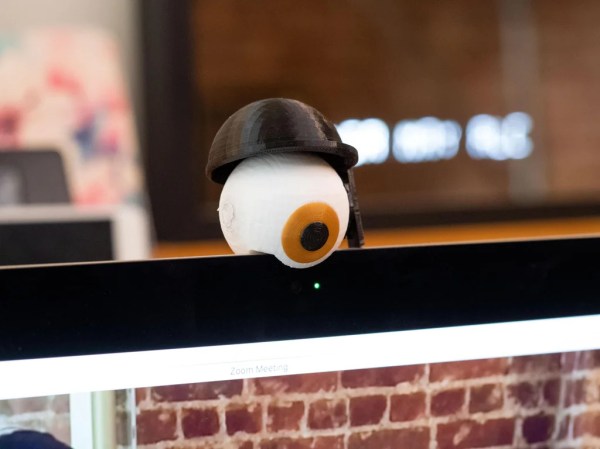
Why are eyeballs so compelling? We can’t say for sure, but boy, this eyeball web cam sure is disconcerting.

Continue reading “[Emily]’s Eerie Educational Electric Eyeball Entertains”

Small Swedish Stores Are Miniature Oases In A National Food Desert

It all started one night in 2016 after [Robert Ilijason] dropped the last remaining jar of baby food in the house, breaking it. On the 20-minute drive to the nearest supermarket, he had an idea: what if there were small, 24-hour convenience-level grocery stores that could fill the glaring need for access to basics across the country?

Sweden has lost a few thousand smaller grocery stores in the last 25 years or so, mostly in rural areas. For many people living outside the cities, the nearest place to buy milk is several miles away, at a huge supermarket that’s either in a city, or close to it. After [Robert] built Sweden’s first 24-hour unmanned convenience store, the idea received quite a bit of media attention.

Five years and a pandemic later, the concept is still going strong. A chain of 30 of these bite-sized bodegas have popped up all over Sweden, run by a company called Lifvs. They have no staff at all, not even a cashier. Instead, shoppers unlock the door with their phones. They scan all their barcodes into an app, which provides a bill every month and is linked to both their bank account and national identity system. Beyond that, security is in the form of a single camera.

Because these tiny stores are staff-less, the prices can be kept relatively low. The only problem is that the technology is a bit of an issue for some older residents. Back in 2016, [Robert Ilijason] was trying to figure out another way for customers to unlock the door, but it doesn’t look like Lifvs has solved that problem yet.

One thing you can’t complain about with a store like this is the selection. We have to wonder if shoppers are more or less likely to encounter fasciated fruit amongst the produce.