Flat-Pack Pasta: Like Ikea Furniture Without The Weird Wrench

When it comes to food packaging, there’s no bigger scam than potato chip bags, right? People complain about the air (nitrogen, actually) inside, but it’s there for a reason — nitrogen pushes out oxygen, so the chips live in a state of factory-fresh dormancy until you rip open the bag and release the gas. If you want flat-pack chips, there’s always those uniformly-shaped potato slurry wafers that come in a can. But even those usually manage to have a few broken ones.

On the other hand, no one complains about the extra space in their box of fusilli — that would be silly. But seriously, successfully shipping fragile foods requires either flat packing or a lot of extra space, especially if that food comes in a myriad of fun 3D shapes like pasta does. Everybody knows that 3D pasta is superior to flat pasta because it holds sauces so much better. The pasta must be kept intact!

The great thing about pasta as a food is that it’s simple to make, and it’s more nutritious than potato chips. Because of these factors, pasta is often served in extreme situations to large groups of people, like soldiers and the involuntarily displaced. But storing large quantities of shapely pasta takes up quite a bit of space. And because of all that necessary air, much of the packaging goes to waste.

So what if you could keep your plethora of pasta in, say, a filing cabinet? A research team led by the Morphing Matter Lab at Carnegie Mellon University have created a way to make flat-pack pasta that springs to life after a few minutes in boiling water.

Continue reading “Flat-Pack Pasta: Like Ikea Furniture Without The Weird Wrench”

Voidstar’s Vitals, Visualized For Video

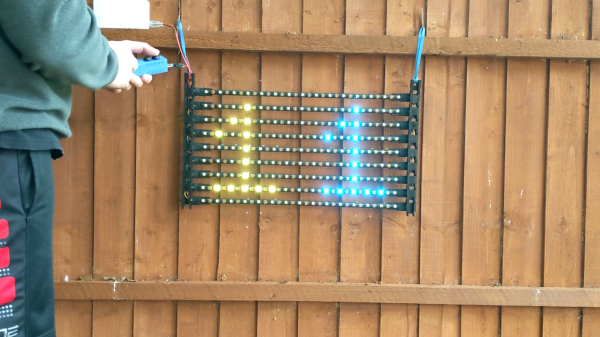
Great news for fans of [Voidstar Labs] — [Zack] is going to be streaming future builds live on YouTube instead of trying to keep up with a grueling and limiting schedule of releasing a build video every week. The only problem is that the wall behind him is totally blank and boring, which matters quite a bit for pretty much any streamer that doesn’t broadcast from a hot tub. Well, not anymore! Now the wall has twenty square feet of rainbow hexagons, because blinkenlights.

But these aren’t just any blinkenlights. They’re informative. They dance to the beat of [Zack]’s bio-metrics, or in other words, they are visualizing how sweaty and anxious [Zack] may be at a given moment, and turning that information into art.

At the heart of this build is a brand-new bio-metric board called the EmotiBit which boasts sixteen sensors in a small package, including a pulse oximeter. The EmotiBit sends vitals to [Zack]’s PC, which is running an oscilloscope app to interpret the signals. Then they are sent over Open Sound Control to an ESP32, which runs the light show.

Like [Zack] says in the video after the break, this isn’t a terribly difficult project, but the construction takes time. [Zack] used aluminum extrusion meant for under-cabinet lighting and ran forty strips of fourteen DotStar LEDs each. The nodes are printed in carbon-fiber PLA and hold the lights away from the wall so it looks cooler. Worried about the current draw? It’s okay, because the brightness and number of lit LEDs at any one time is limited. Add in the fact that none of the LEDs are ever turned off — they fade by one percent each loop — and you have some really cool animations. Check them out after the break.

Want some localized blinkenlights to wear about town? Wear your heart on your sleeve and show them how hard you’re crushing the elliptical at the gym.

Continue reading “Voidstar’s Vitals, Visualized For Video”

Custom Music Box Cylinder Puts A Spin On Romance

Music boxes are awesome little mechanical devices. These days, they even make some with slightly more modern tunes, like the Zelda and Star Wars themes.  But they don’t have everything, of course — certainly not that one song from that TV series that [RandomPrototypes]’ girlfriend absolutely adores.

But it’s 2021, and there are options for making your own music box. [RandomPrototypes] could have printed the whole thing, but those don’t sound as good with their plastic combs. Then there’s those paper punch ones, but you have to sit there and crank the thing continuously to hear the song. In the end, [RandomPrototypes] mixed methods and made a custom cylinder that’s playable with a standard music box mechanism.

[RandomPrototypes] started by taking the music box apart to measure the cylinder, and then created a software representation of a cylinder that’s designed to pluck the eighteen notes from low to high rather than play a song. Then he used a Python script to turn it in a 3D model. The slicing preview showed a lot of stops and starts and weak points, so [RandomPrototypes] generated the Gcode directly so that it would print in one continuous spiral and be much stronger.

In order to generate a cylinder with the song his girlfriend likes so much, [RandomPrototypes] printed this scale cylinder and used it to record the notes as a single mp3 and make note of the start times of each note. Finally, he built the new score based on the available notes built into the music box comb. If you want to do this yourself, the code is freely available. The hard part will be choosing a music box mechanism, because they tend to come with a single comb that’s designed to play a specific song. You’ll have to figure out which tune has most or all of the notes you need.

If you don’t mind doing the cranking to listen to the tune, then the paper-punched type of music box is going to be much easier. But why do all that punching yourself, when you could build a machine?

Continue reading “Custom Music Box Cylinder Puts A Spin On Romance”

Smart Guitar Will Practically Play Itself

Playing the guitar is pretty difficult to do, physically speaking. It requires a lot of force with the fretting hand to produce clear notes, and that means pressing a thin piece of metal against a block of wood until the nerve endings in your fingertips die off and you grow calluses that yearn to be toughened even further. Even if you do get to this point of being broken in, it takes dexterity in both hands to actually make music. Honestly, the guitar is kind of an unwelcoming instrument, even if you don’t have any physical disabilities.

A Russian startup company called Noli Music wants to change all of that. They’re building a guitar that’s playable for everyone, regardless of physical or musical ability. Noli Music was founded by [Denis Goncharov] who has a form of muscular dystrophy. [Denis] has always wanted to rock out to his favorite songs, but struggles to play a standard guitar.

If you can touch the fretboard, it seems, you can whale away on this axe without trouble. It’s made to be easier to play all around. The strings aren’t fully tensioned, so they’re easy to pluck — the site says they only take 1.7oz of force to actuate.

Right now, the guitar is in the prototype stage. But when it’s ready to rock, it will do so a couple of ways. One uses embedded sensors in the fretboard detect finger positions and sound the appropriate note whether you pluck it or simply fret it. In another mode, the finger positions light up to help you learn new songs. The guitar will have a touchscreen interface, and Noli are planning on building a companion app to provide interactive lessons.

We have to wonder just how exactly this will be able to mimic the physics of guitar playing, especially since it’s designed with all players in mind. How satisfied will seasoned players be with this instrument? Can it do pull-offs and hammer-ons? What about slides? Do the sensors respond to bends? And most importantly, will the built-in speaker be loud enough to drown out the string vibrations? It seems to do just fine on that front, as you can see in the video below.

If the built-in speaker didn’t drown out the strings, it could make for some interesting sounds that stray outside the western chromatic scale, much like this LEGO microtonal guitar.

Continue reading “Smart Guitar Will Practically Play Itself”

Custom Macro Keyboard Looks Good In Wood

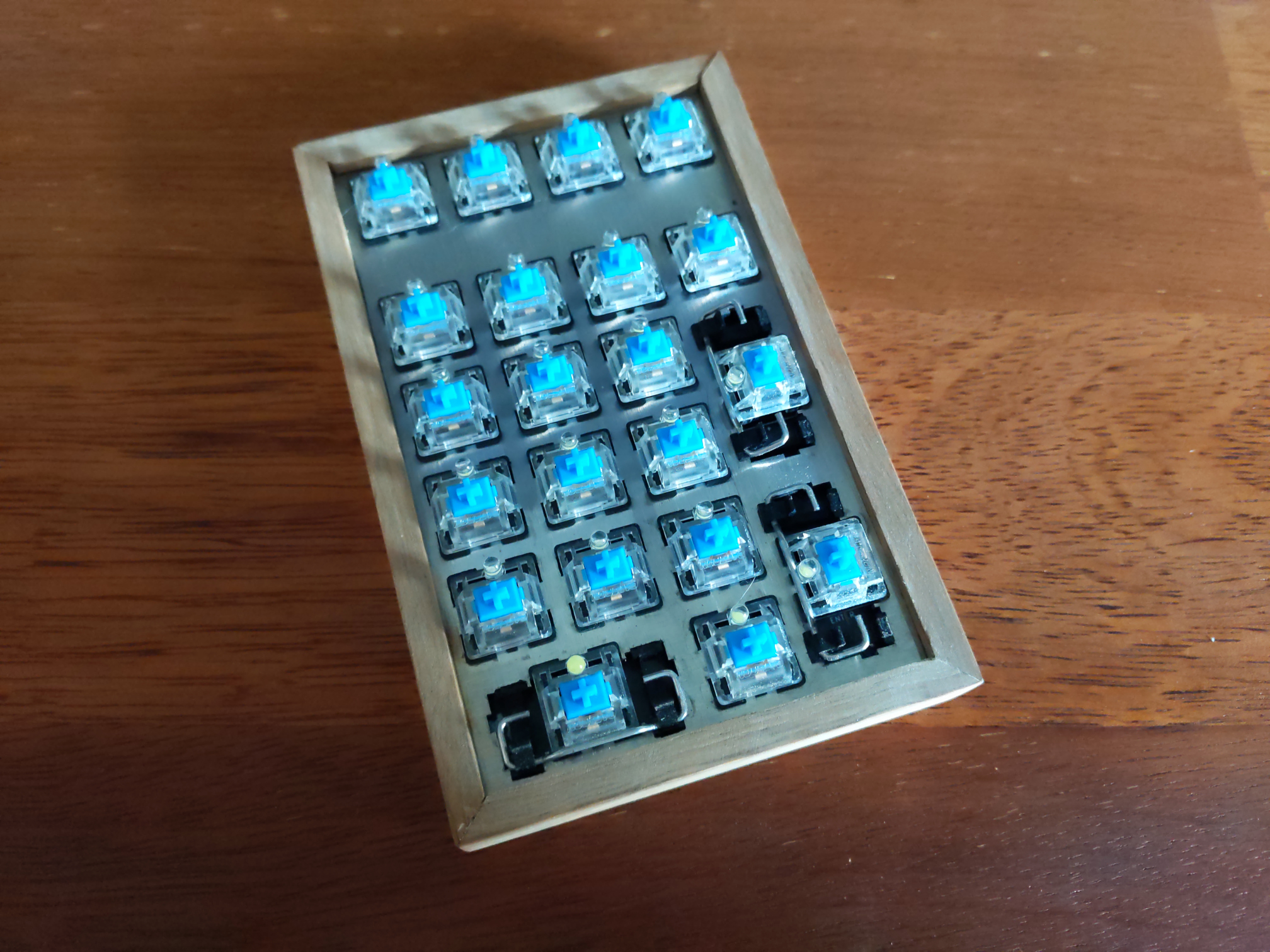
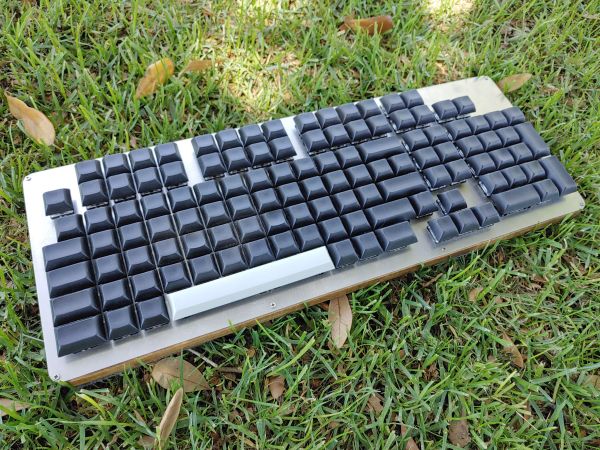
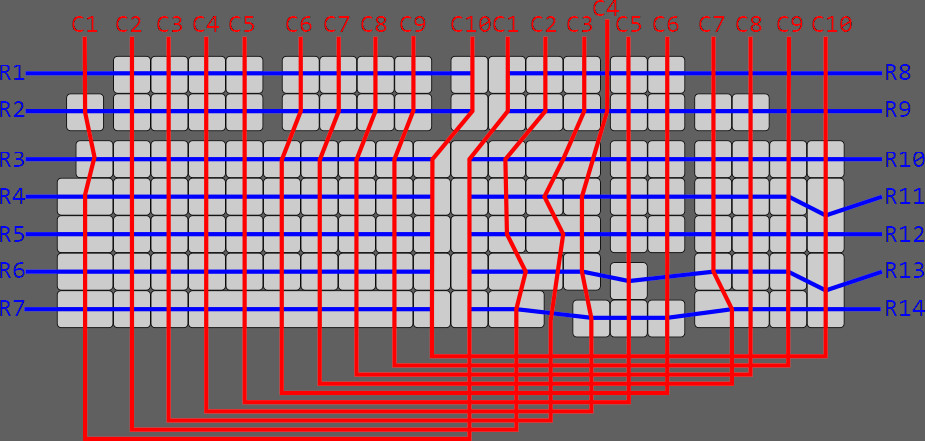
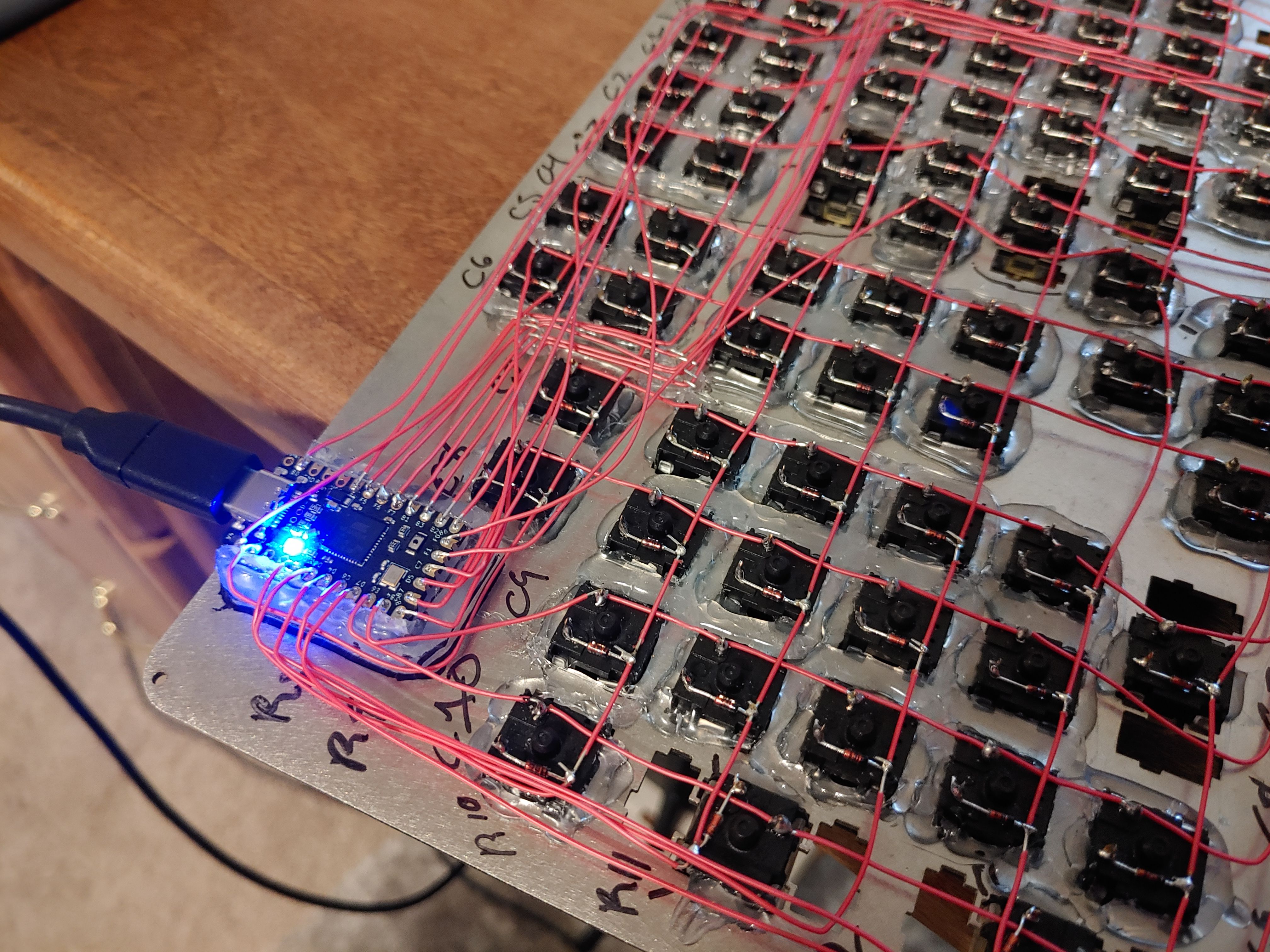
There’s more than one way to make a mechanical macro pad, and this wooden wonder represents one of our favorites. [Tauno Erik] had an old rubber dome rectangle keyboard lying around that still worked, but the poor thing was missing some of its caps. After salvaging the controller, [Tauno Erik] got to work on the tedious task of figuring out the mapping of the matrix, which was made easier with a Python script.

Almost every component of this beauty is wood, including the mounting plate and those thicc and lovely keycaps — their top layer is solid oak, and the bottom bit is birch plywood. In order to interface the ‘caps with the switches, [Tauno Erik] designed and printed connector pieces that sit inside the extra large keycaps and accept the stems of the key switches.

Speaking of switches, we’re not sure if [Tauno Erik] ended up using Cherry green switches, browns, or a mix of both (that would be interesting), but each one is mounted on a custom PCB along with a diode and a pull-up resistor. You can see more build pictures at [Tauno Erik]’s site, and stick around for a visual tour of the completed build after the break.

Wood is a great choice for keycaps, and we imagine they’ll only look better with age and use. A more common use for wood on a keyboard build is in surprisingly comfortable wrist rests.

Spherical Keyboard Build Leaves Hacker Well-Rounded

Often times we as hackers don’t know what we’re doing, and we sally forth and do it anyway. Here at Hackaday, we think that’s one of the best ways to go about a new project, and the absolute fastest way to learn a whole lot as you go. Just ask [Aaron Rasmussen] regarding this spherical, standing 5×6 dactyl manuform keyboard build, which you can see in a three-part short video series embedded after the break.

[Aaron] gets right down to it in the first video. He had to get creative right away, slicing up the dactyl manuform model to fit on a tiny print bed. However, there’s plenty of room inside the sphere for all that wiring and a pair of Elite-C microcontrollers running QMK. Be sure to turn on the sound to hear the accompanying voice-overs.

The second video answers our burning question: how exactly does one angle grind a slippery sphere without sacrificing sheen or shine? We love the solution, which involves swaddling the thing in duct tape and foam.

You may be wondering how [Aaron] is gonna use any kind of mouse while standing there at the pedestal keyboard. While there is space for a mouse to balance on top, this question is answered in the third video, where [Aaron] learns the truth behind the iconic ThinkPad nubbin and applies this knowledge to build a force-feedback joystick/trackpoint mouse. Awesome answer, [Aaron]!

Not ready to go full-tilt, sci-fi prop ergo? Dip your toe in the DIY waters with a handy macropad.

Continue reading “Spherical Keyboard Build Leaves Hacker Well-Rounded”

PSA: Amazon Sidewalk Rolls Out June 8th

Whether you own any Amazon surveillance devices or not, we know how much you value your privacy. So consider this your friendly reminder that Amazon Sidewalk is going live in a few weeks, on June 8th. A rather long list of devices have this setting enabled by default, so if you haven’t done so already, here’s how to turn it off.

Don’t know what we’re talking about? Our own Jenny List covered the topic quite concretely a few months back. The idea behind it seems innocent enough on the surface — extend notoriously spotty Wi-Fi connectivity to devices on the outer bounds of the router’s reach, using Bluetooth and LoRa to talk between devices and share bandwidth. Essentially, when Amazon flips the switch in a few weeks, their entire fleet of opt-in-by-default devices will assume a kind of Borg hive-mind in that they’ll be able to share connectivity.

A comprehensive list of Sidewalk devices includes: Ring Floodlight Cam (2019), Ring Spotlight Cam Wired (2019), Ring Spotlight Cam Mount (2019), Echo (3rd Gen), Echo (4th Gen), Echo Dot (3rd Gen), Echo Dot (4th Gen), Echo Dot (3rd Gen) for Kids, Echo Dot (4th Gen) for Kids, Echo Dot with Clock (3rd Gen), Echo Dot with Clock (4th Gen), Echo Plus (1st Gen), Echo Plus (2nd Gen), Echo Show (1st Gen), Echo Show (2nd Gen), Echo Show 5, Echo Show 8, Echo Show 10, Echo Spot, Echo Studio, Echo Input, Echo Flex. — Amazon Sidewalk FAQ

Now this isn’t a private mesh network in your castle, it’s every device in the kingdom. So don’t hesitate, don’t wait, or it will be too late. Grab all your Things and opt-out if you don’t want your doorbell cam or Alexa machine on the party line. If you have the Alexa app, you can allegedly opt out on all your devices at once.

Worried that Alexa is listening to you more often than she lets on? You’re probably right.