
Homebrew Espresso Machine Has Closed-Loop Control

[Ben Katz] is in the process of building a compact, closed-loop espresso machine, and really seems to be pulling it off in the first shot. Though it may not be the final product, we’re in awe of the beautiful guts and would love to taste-test the early results.
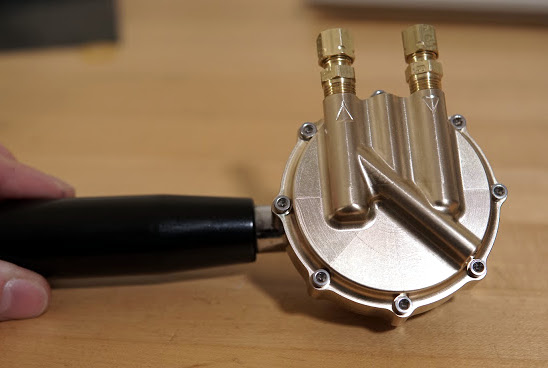
This machine will hit a sweet spot between lever-type espresso machines that are like driving a manual without power steering, and those fully automated machines that squeeze all the fun out of playing barista but are easier on the joints.

Here’s how it works so far: a motor drives an electric gear pump that pumps the water through a heater. It’s a closed-loop system, so there’s a 3-way valve after the heater that keeps sending the water back until it’s deemed hot enough. Once that happens, the valve switches functions and begins to pump water through the group head and on to the coffee grounds.

[Ben] designed and milled a beautiful group head that’s designed to fit a La Pavoni portafilter and some other parts he already had on hand. Grab a coffee and watch it pull the first shot after the break, then stick around to see the milling and the drilling.

Ready to kick that Keurig to the curb and get an espresso machine? Don’t just throw it out or take it to a field and smash it with a baseball bat — turn that thing into an automatic drip for a small houseplant.

Continue reading “Homebrew Espresso Machine Has Closed-Loop Control”

Can Plants Bend Light To Their Self-Preserving Will?

It does sound a bit silly — the idea that given enough time, a plant could influence the order of hardware-generated random numbers in order to get enough light to survive. But not so silly that [DeckerM] couldn’t wait to try it out after seeing a short clip about an unpublished study done at Princeton’s Engineering Anomalies Research (PEAR) lab that came to this very conclusion. The actual verbatim conclusion from the clip: “It’s as though life itself – even life or consciousness in something as simple as a house plant, bends probability in the physical world in the direction of what it needs, in the direction of its growth and evolution.”

The idea is this: a plant is made to suffer by languishing in the corner of a windowless room. The room has exactly one light in the middle of the ceiling — a repositionable spotlight of sorts that can only shine into any of the four corners and is controlled by a random number generator. A set of dividers ensure that none of the light leaks out of the quadrant and into any of the others.

[DeckerM]’s recreation of this experiment is much more practical. It’s essentially a little plywood cabinet with four open partitions and a ceiling. Each quadrant has a grow light strip planted in the corner, and all the wires are run through the top, where each has been stripped of its pesky power-governing controller and rewired to go straight into a smart plug. [DeckerM] is using a hardware RNG hosted on a Raspberry Pi, which is running a Python script that takes numbers from the RNG that corresponds to one of the quadrants, and then lights that quadrant.

And the results? They don’t really support the PEAR study’s bold conclusion unless viewed in small sample sizes, but [DeckerM] isn’t giving up that easily. Since the paper is unpublished, there are a lot of unanswered questions and juicy variables to play with, like the type, number, and age of the plants used. We’re excited to see if [DeckerM] can shed some light on plant psychokinesis.

Interested in portable plant propagation? A sunny location is usually ideal, but this all-in-one solution can take care of the rest.

The 70s Are Calling To Shed Some Light

Remember when phones didn’t all look the same? We had a good thing going in the early cell phone days, which seemed like a brief holdover from the Western Electric (et. al) era where you could get a phone that suited your inner minimalist or princess, and choose the color to boot.

[Dubchinsky] found a beautiful phone from this bygone era and saved it from one of two likely fates — the landfill, or else a life languishing as a piece of vintage technology that’s just sitting around for looks. Instead, this phone found a second calling as a lovely desk lamp with secret goose neck flexibility. The lamp itself is an inexpensive LED module from ebay that’s wired up to mains power through a push button switch in the phone’s base.

We absolutely love that [Dubchinsky] wrapped the curly cord around the goose neck, but were a bit disappointed that he didn’t use the hook switch to turn the lamp on and off. In the comments, he says that the plastic felt like it was too brittle to stand up to repeated actuation of such a heavy switch. That’s understandable. [Dubchinsky] also thought about using the rotary dial as a dimmer, and we think that’s a bright idea.

Between the guide, the pictures, and the build process video after the break, this is pretty much a complete how-to. We think that is commendable given that [Dubchinsky] is selling these lamps on etsy.

Do ya miss spinning the rotary dial and long for somewhat simpler days? Hook your finger into this rotary cell phone.

Continue reading “The 70s Are Calling To Shed Some Light”

Rube Goldberg’s Least Complicated Invention Was His Cartooning Career

The name Rube Goldberg has long been synonymous with any overly-built contraption played for laughs that solves a simple problem through complicated means. But it might surprise you to learn that the man himself was not an engineer or inventor by trade — at least, not for long. Rube’s father was adamant that he become an engineer and so he got himself an engineering degree and a job with the city. Rube lasted six months engineering San Francisco’s sewer systems before quitting to pursue his true passion: cartooning.

Rube’s most famous cartoons — the contraptions that quickly became his legacy — were a tongue-in-cheek critique meant to satirize the tendency of technology to complicate our lives in its quest to simplify them. Interestingly, a few other countries have their own version of Rube Goldberg. In the UK it’s Heath Robinson, and in Denmark it’s Robert Storm Petersen, aka Storm P.

Rube Goldberg was a living legend who loved to poke fun at everything happening in the world around him. He became a household name early in his cartooning career, and was soon famous enough to endorse everything from cough drops to cigarettes. By 1931, Rube’s name was in the Merriam-Webster dictionary, his legacy forever cemented as the inventor of complicated machinery designed to perform simple tasks. As one historian put it, Rube’s influence on culture is hard to overstate.

Continue reading “Rube Goldberg’s Least Complicated Invention Was His Cartooning Career”

Don’t Tase Me, Keeb!

Okay, so this doesn’t really use a taser — that’s just click bait and we apologize. An actual taser would be a terrible way to train yourself to be a better typist, because depending on where you choose to deliver the shock, you could damage your typing nerves pretty quickly with a few milliamps at 50,000 volts.

Instead of a taser, [nobody6502] got a pack of prank gum off of Amazon that delivers a much more doable shock that is painful enough to get the user to type more carefully. [nobody6502] set up a simple no-pain, no-train website that presents random English words one at a time and checks for typos against an open-source list of nearly half a million entries. Misspell a word, and a get a relay-driven shock from the gum circuit.

The main brain of this pain trainer is a Particle Argon board which has I/O pins that can be controlled from the web. When the website detects a typo, it sends a signal to the Argon, which turns on a relay that activates the shock mechanism. What’s most impressive is that [nobody6502] doesn’t have a full-blown computer and programmed everything on an iPad. Check out the build video after the break.

Are you a hunt and peck typist? There’s a negative reinforcement keyboard for that.

Continue reading “Don’t Tase Me, Keeb!”

Machining A Honing Jig Will Keep Skills Sharp

[Amy Makes Stuff] has long used a pair of diamond honing blocks to freehand sharpen planes, chisels, and all the other dull things around the shop. Although this method works fairly well, the results are often inconsistent without some kind of jig to hold the blade securely as it’s being sharpened. These types of devices are abundant and cheap to buy, but as [Amy] says in the video after the break, then she doesn’t get to machine anything. Boy, do we know that feeling.

[Amy] was able to make this completely out of stuff she had lying around, starting with a block of scrap aluminium that eventually gets cut into the two halves of the jig. The video is full of tips and tricks and it’s really interesting to see [Amy]’s processes up close. Our favorite part has to be that grippy knob that expands and contracts the jig. [Amy] made it by drilling a bunch of holes close to the outside edge of a circle, and then milled away the edge until she had a fully fluted knob. Once she had the jig finished, she upgraded her honing blocks by milling a new home for them out of milky-white high-density polyethylene.

Mills are fantastic tools to have, but they’re a bit on the pricey side. If you’re just getting started, why not convert a drill press into a mill? Wouldn’t that be more fun that just buying one?

Continue reading “Machining A Honing Jig Will Keep Skills Sharp”

World’s First EVTOL Airport Will Land This November

We have to admit that flying cars still sound pretty cool. But if we’re ever going to get this idea off the ground, there’s a truckload of harsh realities that must be faced head-on. The most obvious and pressing issue might seem to be the lack of flying cars, but that’s not really a problem. Air taxis are already in the works from companies like Airbus, Rolls-Royce, and Cadillac, who premiered theirs at CES this year.

Where we’re going, we don’t need roads. But we do need infrastructure to support this growing category of air traffic that includes shipping drones that are already in flight. Say no more, because by November 2021, the first airport built especially for flying cars is slated to be operational in England.

Image via Hyundai

British startup Urban Air Port is building their flagship eVTOL hub smack dab in the center of Coventry, UK, a city once known as Britain’s Detroit due to the dozens of automobile makers who have called it home. They’re calling this grounded flying saucer-looking thing Air One, and they are building it in partnership with Hyundai thanks to a £1.2 million ($1.65M) grant from the British government. Hyundai are developing their own eVTOL which they are planning to release in 2028. Continue reading “World’s First EVTOL Airport Will Land This November”