Tetris On Split-Flap Go Brrr

It hardly seems possible, but engineer collective and split-flap display purveyors [Oat Foundry] were able to build a working implementation of Tetris on a 10 x 40 split-flap display in the span of a single day. Check it out in the video after the break.

This project is a bit understaffed in the details department, but we do know that [Oat Foundry] started with [Timur Bakibayev]’s open-source implementation of Tetris in Python and modified the draw function to work on a split-flap display. As you may have guessed, the biggest obstacle is the refresh rate and how it affects playability — particularly during those tense moments when a player rotates a piece before dropping it. Split-flaps flip quickly from on to off, but flipping back to on requires a full trip around through all the other characters.

We think this is nice work for a one-day build. Should they go further, we’d like to see the same things implemented as [Oat Foundry] does: a high score tracker and a preview of the next piece.

Don’t have a split-flap display? Yeah, us either, but we do have televisions. Turn on the tube and check out this Nano-scale Tetris.

Continue reading “Tetris On Split-Flap Go Brrr”

Eyesight Guardian Polices Your Poor Pupils

Don’t know about you, but over the last year or so, we have gone from spending ten or twelve hours a day at this computer to upwards of sixteen or eighteen. Fortunately there’s a window behind the monitor for taking those 20/20/20 breaks that are supposed to prevent eye strain, but it’s so hard to remember (and boring) to do it. And nobody needs yet another thing to remember in the name of self-care.

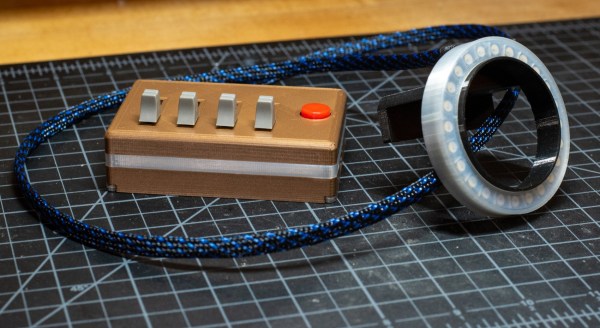
[Daniel Hingston] certainly agrees. As you’ll see in the delightful video after the break, [Daniel] has made a game out of the whole process of stopping every twenty minutes to spend twenty seconds looking at a point that’s at least twenty feet away. Once the break is over, [Daniel] uses the dual-purpose start button to acknowledge having looked away for 20 seconds. The device is meant to clip onto the corner of any monitor, and [Daniel] has provided several sizes of the bridge piece so that everyone can find their fit.

The Guardian’s guts are pretty simple — an Arduino Pro Mini runs the stop watch and a TFT display to show the graphics that live on an SD card. This is a great way to preserve your eyesight by gamifying something we all know we should be doing. It might be nice to add a break timer that counts up to 25 or thereabouts so you have time to stand up and come back. If you press the button too soon, it scolds you and you have to start your eye break over.

Need some more self-care lately? Our own [Jenny List] has your back in these interesting times.

Continue reading “Eyesight Guardian Polices Your Poor Pupils”

Elegant And Portable DIY Nightlight Becomes A Fixture For Hacker’s Kids

When [itzikdiy]’s kids asked for a night light for their room, he got the bright idea to build something that straddles the line between portable and permanent. This fixture-less fixture plugs directly into a wall socket and is turned on and off with a handsome rocker switch on the bottom.

This lovely little lamp is mostly made from scrap — the oak on the front appears to have come from an old cabinet door, and the other two ring-shaped pieces are made from pine. [itzikdiy] even took the acrylic from broken panel lamps. Everything was cut with a Dremel and a circle-cutter attachment except the oak, which required a jigsaw. We think it looks great, especially with the different grain directions — call it art deco woodworking.

When it was all said and done, [itzikdiy] found it was too heavy to hang by the plug alone, so he added an L-shaped support beneath the power supply that holds it more evenly against the wall. [itzikdiy] also made a pair of hooks that snap into a pair of slots on the sides of the outlet itself. The solution is simple, sturdy, and effective without disrupting the lines of the lamp at all. Carve out a little bit of time to watch the build video after the break.

We know that someone of your hulking intelligence has no fear of the dark. But if you think you could use a nightlight in the bathroom for those 2 AM trips, look no further.

Continue reading “Elegant And Portable DIY Nightlight Becomes A Fixture For Hacker’s Kids”

Homebrew Espresso Machine Has Closed-Loop Control

[Ben Katz] is in the process of building a compact, closed-loop espresso machine, and really seems to be pulling it off in the first shot. Though it may not be the final product, we’re in awe of the beautiful guts and would love to taste-test the early results.

This machine will hit a sweet spot between lever-type espresso machines that are like driving a manual without power steering, and those fully automated machines that squeeze all the fun out of playing barista but are easier on the joints.

Here’s how it works so far: a motor drives an electric gear pump that pumps the water through a heater. It’s a closed-loop system, so there’s a 3-way valve after the heater that keeps sending the water back until it’s deemed hot enough. Once that happens, the valve switches functions and begins to pump water through the group head and on to the coffee grounds.

[Ben] designed and milled a beautiful group head that’s designed to fit a La Pavoni portafilter and some other parts he already had on hand. Grab a coffee and watch it pull the first shot after the break, then stick around to see the milling and the drilling.

Ready to kick that Keurig to the curb and get an espresso machine? Don’t just throw it out or take it to a field and smash it with a baseball bat — turn that thing into an automatic drip for a small houseplant.

Continue reading “Homebrew Espresso Machine Has Closed-Loop Control”

Can Plants Bend Light To Their Self-Preserving Will?

It does sound a bit silly — the idea that given enough time, a plant could influence the order of hardware-generated random numbers in order to get enough light to survive. But not so silly that [DeckerM] couldn’t wait to try it out after seeing a short clip about an unpublished study done at Princeton’s Engineering Anomalies Research (PEAR) lab that came to this very conclusion. The actual verbatim conclusion from the clip: β€œIt’s as though life itself – even life or consciousness in something as simple as a house plant, bends probability in the physical world in the direction of what it needs, in the direction of its growth and evolution.”

The idea is this: a plant is made to suffer by languishing in the corner of a windowless room. The room has exactly one light in the middle of the ceiling — a repositionable spotlight of sorts that can only shine into any of the four corners and is controlled by a random number generator. A set of dividers ensure that none of the light leaks out of the quadrant and into any of the others.

[DeckerM]’s recreation of this experiment is much more practical. It’s essentially a little plywood cabinet with four open partitions and a ceiling. Each quadrant has a grow light strip planted in the corner, and all the wires are run through the top, where each has been stripped of its pesky power-governing controller and rewired to go straight into a smart plug. [DeckerM] is using a hardware RNG hosted on a Raspberry Pi, which is running a Python script that takes numbers from the RNG that corresponds to one of the quadrants, and then lights that quadrant.

And the results? They don’t really support the PEAR study’s bold conclusion unless viewed in small sample sizes, but [DeckerM] isn’t giving up that easily. Since the paper is unpublished, there are a lot of unanswered questions and juicy variables to play with, like the type, number, and age of the plants used. We’re excited to see if [DeckerM] can shed some light on plant psychokinesis.

Interested in portable plant propagation? A sunny location is usually ideal, but this all-in-one solution can take care of the rest.

The 70s Are Calling To Shed Some Light

Remember when phones didn’t all look the same? We had a good thing going in the early cell phone days, which seemed like a brief holdover from the Western Electric (et. al) era where you could get a phone that suited your inner minimalist or princess, and choose the color to boot.

[Dubchinsky] found a beautiful phone from this bygone era and saved it from one of two likely fates — the landfill, or else a life languishing as a piece of vintage technology that’s just sitting around for looks. Instead, this phone found a second calling as a lovely desk lamp with secret goose neck flexibility. The lamp itself is an inexpensive LED module from ebay that’s wired up to mains power through a push button switch in the phone’s base.

We absolutely love that [Dubchinsky] wrapped the curly cord around the goose neck, but were a bit disappointed that he didn’t use the hook switch to turn the lamp on and off. In the comments, he says that the plastic felt like it was too brittle to stand up to repeated actuation of such a heavy switch. That’s understandable. [Dubchinsky] also thought about using the rotary dial as a dimmer, and we think that’s a bright idea.

Between the guide, the pictures, and the build process video after the break, this is pretty much a complete how-to. We think that is commendable given that [Dubchinsky] is selling these lamps on etsy.

Do ya miss spinning the rotary dial and long for somewhat simpler days? Hook your finger into this rotary cell phone.

Continue reading “The 70s Are Calling To Shed Some Light”

Rube Goldberg’s Least Complicated Invention Was His Cartooning Career

The name Rube Goldberg has long been synonymous with any overly-built contraption played for laughs that solves a simple problem through complicated means. But it might surprise you to learn that the man himself was not an engineer or inventor by trade — at least, not for long. Rube’s father was adamant that he become an engineer and so he got himself an engineering degree and a job with the city. Rube lasted six months engineering San Francisco’s sewer systems before quitting to pursue his true passion: cartooning.

Rube’s most famous cartoons — the contraptions that quickly became his legacy — were a tongue-in-cheek critique meant to satirize the tendency of technology to complicate our lives in its quest to simplify them. Interestingly, a few other countries have their own version of Rube Goldberg. In the UK it’s Heath Robinson, and in Denmark it’s Robert Storm Petersen, aka Storm P.

Rube Goldberg was a living legend who loved to poke fun at everything happening in the world around him. He became a household name early in his cartooning career, and was soon famous enough to endorse everything from cough drops to cigarettes. By 1931, Rube’s name was in the Merriam-Webster dictionary, his legacy forever cemented as the inventor of complicated machinery designed to perform simple tasks. As one historian put it, Rube’s influence on culture is hard to overstate.

Continue reading “Rube Goldberg’s Least Complicated Invention Was His Cartooning Career”