Hackaday Prize Entry: OrthoSense, A Smart Knee Brace For Physical Therapy

If you have knee surgery, you can probably count on some physical therapy to go with it. But one thing you might not be able to count on is getting enough attention from your therapist. This was the case with [Vignesh]’s mother, who suffers from osteoarthritis (OA). Her physiotherapist kept a busy schedule and couldn’t see her very often, leaving her to wonder at her rehabilitation progress.

[Vignesh] already had a longstanding interest in bio-engineering and wearables. His mother’s experience led him down a rabbit hole of research about the particulars of OA rehabilitation. He found that less than 35% of patients adhere to the home regimen they were given. While there are a lot of factors at play, the lack of feedback and reinforcement are key components. [Vignesh] sought to develop a simple system for patients and therapists to share information.

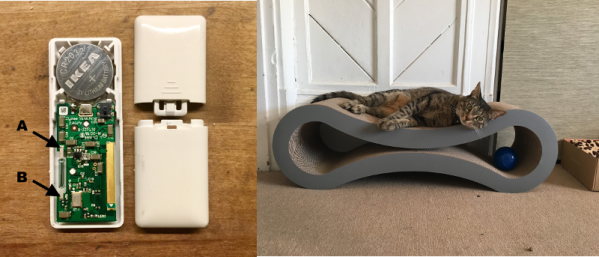
The fruit of this labor is Orthosense, an intelligent knee brace system that measures gait angle, joint acoustics, and joint strain.  The user puts on the brace, pairs it with a device, and goes through their therapy routine. Sensors embedded in the brace upload their data to the cloud over Bluetooth.

Joint strain is measured by a narrow strip of conductive fabric running down the length of the knee. As the user does their exercises, the fabric stretches and relaxes, changing resistances all the while. The changes are measured against a Wheatstone bridge voltage divider. The knee’s gait angle is measured with an IMU and is calculated relative to the hip angle—this gives a reference point for the data collected by the strain sensor. An electret mic and a sensitive contact mic built for body sounds picks up all the pops and squeaks emitted by the knee. Analysis of this data provides insight into the condition of the cartilage and bones that make up the joint. As you might imagine, unhealthy cartilage is noisier than healthy cartilage.

[Vignesh]’s prototype is based the tinyTILE because of the onboard IMU, ADC, and Bluetooth. Since all things Curie are being discontinued, the next version will either use something nRF52832 or a BC127 module and a la carte sensors. [Vignesh] envisions a lot for this system, and we are nodding our heads to all of it.

Scooter Wheels Keep DIY Barn Doors On Track

[MotoGeeking] built a giant spray booth and is in the process of making customized, air-filtering barn doors for it. When it came to buy hardware to move the doors, though, he found all the ready-made options to be prohibitively expensive. You know what comes next: he designed barn door hardware from the ground up, and did it as cheaply as possible.

After intensely studying many images of barn doors and hardware, [MotoGeeking] decided on the right wheels and went from there. Kick scooter wheels fit the bill nicely, since they are designed to support a lot of weight and come with their own bearings and spacers. And they’re cheap, too — just $9 for a pair.

[MotoGeeking] found some C channel extruded aluminium that seemed to be a perfect match for the wheels, but the wheel was quick to bind whenever it touched the sides. He solved that one by epoxying a length of round bar into the bottom corners. This allows the wheel to move freely while forcing it to stay centered in the track.

In designing the 1/4″ aluminium brackets, [MotoGeeking] took a measure thrice, order once approach to selecting the fasteners. You probably know by now that McMaster-Carr has free CAD drawings for every little thing. [MotoGeeking] imported the ones he liked into Illustrator and built around them. This helped him get it right the first time and kept the headaches and hair-tearing away. Watch the giant door skeleton glide effortlessly on its track after the break.

Continue reading “Scooter Wheels Keep DIY Barn Doors On Track”

Low-Vision Reading Through A Camera’s Eye

Borescope cameras are great inspection tools. They’re flexible, they magnify on a variable scale, and they come with their own lighting. Oh, and they’re pretty cheap, too. Because of all this, these tiny cameras can serve a number of purposes. Doctors put them down your cake hole to look for ulcers and polyps, and mechanics probe pistons with them to check for buildup. [agulesin] used one to make a reading aid for his mom.

Mom suffers from macular degeneration, and can’t read print smaller than 1″ (2.5cm). This condition can cause issues ranging from blurred vision to complete loss of vision in the center of the visual field. Standard handheld magnifiers can work fairly well depending on a person’s condition, but they only provide a fixed magnification level and most offer no lighting.

[Agulesin] had the idea to make a reading magnifier by feeding video from a downward-facing borescope camera to an old netbook. The camera is mounted in a plywood arm that’s fixed to a bi-level platform made from scrap MDF. It’s a simple idea that’s well executed—just project flat, printed material on to a vertical screen. There’s nothing for the user to hold or mount, and no risk of neck strain from looking down over the material.

With any simple project comes limitations. The camera is fixed in place. This rig built to view sheets of A4 paper (between letter and legal size)  that are moved around by the user, and it can only handle a stack of so many sheets. If [agulesin]’s mom tried to read a thick novel this way, the camera would likely not focus.  Even so, it’s a great piece of assistive tech for people with low vision.

The Tourbillon: Anti-Gravity For Watch Movements

Do you know what time it is? Chances are good that you used a computer or a cell phone to answer that question. The time on your phone is about as accurate as chronometry gets these days. That’s because cell networks are timed from satellites, which are in turn timed from atomic clocks. And these days, it may be that atomic clocks are the only clocks that matter.

Before this modern era of quartz and atomic accuracy, though, timepieces were mechanical. Clocks were driven by heavy weights that made them impractical for travel. It wasn’t until the mainspring-driven movement came along that timekeeping could even begin to become portable.

But while the invention of the mainspring made portable timepieces possible, it hurt their accuracy. That’s because the driving force of a tightly wound spring isn’t constant like that of an inert, solid weight.  So pocket watches weren’t exactly an overnight success. Early pieces were largely ornamental, and only told the hour. Worst of all, they would slow down throughout the day as the mainspring unwound, becoming useless unless wound several times a day. The mainspring wasn’t the only problem plaguing pocket watches, but it was the among the most obvious.

Continue reading “The Tourbillon: Anti-Gravity For Watch Movements”

Hackaday Prize Entry: Staircane, A Walker That Takes The Stairs

[Jim]’s aunt has lived in the same house for the last 50 years. She loves it there, and she wants to stay as long as possible. There’s a big problem, though. The house has several staircases, and they are all beginning to disagree with her. Enter Staircane, [Jim]’s elegant solution that adds extendable legs to any standard walker.

Most of the time, walkers serve their purpose quite well. But once you encounter uneven ground or a staircase, they show their limitations. The idea behind Staircane is a simple one: quickly extend the back or front legs of a walker depending on the situation, and do so in unison. Staircane uses one button for each set of legs. Pushing the button engages a thin cable, much like the brake cable on a bicycle. The cable pulls a release trigger, unlocking the notched extensions. When the legs are sufficiently extended, the user simply releases the button to lock them in place. Once on flat ground, the user pushes the button again while pressing down on the walker to even out the leg lengths. Check out the video after the break to see the 3D-printed prototype.

Staircane is a semi-finalist in our Wheels, Wings, and Walkers challenge, which ended a few weeks ago. Did you know that you can enter your project into more than one challenge? Since this project falls squarely into assistive technologies territory, we hope that [Jim] and his team submit Staircane to our Assistive Technologies challenge before the deadline on September 4th. We don’t have many entries so far, so if  you’re thinking about entering, give in to temptation!

Continue reading “Hackaday Prize Entry: Staircane, A Walker That Takes The Stairs”

Hackaday Prize Entry: Analyzing And Controlling Hand Tremors

For the millions of people suffering from Parkinson’s and other causes of hand tremor, there is new hope in the form of [mohammedzeeshan77]’s entry into the Hackaday Prize: a glove that analyzes and controls the tremors.

The glove uses an accelerometer and a pair of flex sensors to determine the position of the hand as it oscillates. A Particle Photon crunches the raw data to come up with the frequency and amplitude of the tremors and uploads it to the cloud for retrieval and analysis by medical staff.

Hand tremors can vary in frequency and severity depending on the cause. Some are barely perceptible movements, and others are life-disrupting shakes. By analyzing the frequency and amplitude of these tremors, doctors can better understand a patient’s condition.

The best part of this glove is that it also provides immediate relief to the wearer by stabilizing the hand. A rapidly spinning super precision gyroscope counteracts the tremor oscillations as it tries to maintain its position. The last time we saw innovation like this, it came with a set of attachments.