
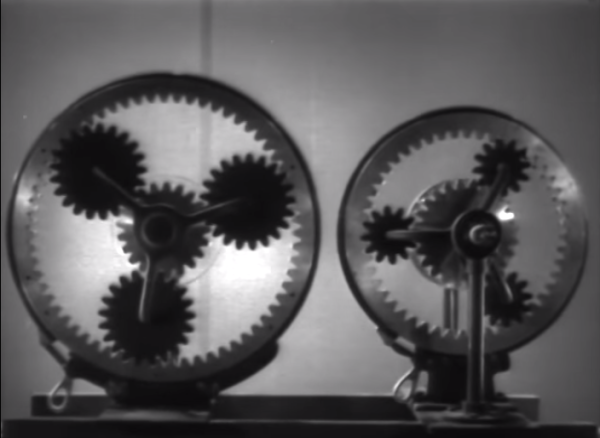
Continue reading “Retrotechtacular: Planetary Gears Are Out Of This World”

If you haven’t been watching The Dinosaur Den, shame on you. This joint enterprise between [Fran Blanche] and our very own [Bil Herd] premiered in July and it is, simply put, the duck’s guts. In spite of being introduced to each other just a few months before the first episode, they banter like old friends. When they’re not riffing off each other, they’re giving a show and tell of all kinds of vintage technology. Most importantly, they’re always wearing really cool t-shirts.
Hot on the heels of their excellent holiday special comes this Best of the Dinosaur Den 2014 highlight reel. Some of our favorite bits are from said holiday special, because they spent the whole hour talking about their best-loved toys from holidays past, most of which started them on their paths to greatness. Come for the t-shirts, stay for the Zaxxon tabletop arcade and the toy that probably inspired LittleBits. Check out the best-of after the break, and then cook a Hot Pocket or something and watch them all. You’re pretty much guaranteed to learn something cool and/or useful.
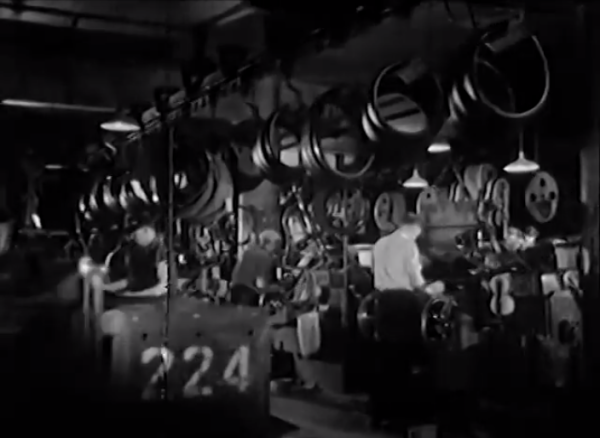
Somewhere between the early tires forged by wheelwrights and the modern steel-belted radial, everyone’s horseless carriage rode atop bias-ply tires. This week’s film is a dizzying tour of the Brunswick Tire Company’s factory circa 1934, where tires were built and tested by hand under what appear to be fairly dangerous conditions.
It opens on a scene that looks like something out of Brazil: the cords that form the ply stock are drawn from thousands of individual spools poking out from poles at jaunty angles. Some 1800 of these cords will converge and be coated with a rubber compound with high anti-friction properties. The resulting sheet is bias-cut into plies, each of which is placed on a drum to be whisked away to the tire room.
Continue reading “Retrotechtacular: Brunswick Shows A Bias For Tires”
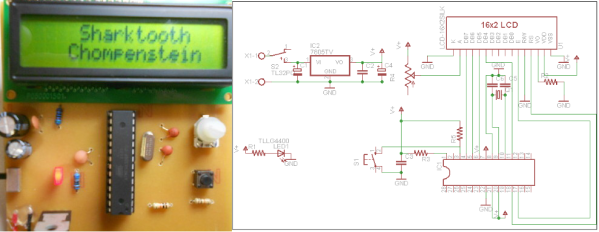
Take thirty seconds out of your day and try to make fun of the last name of the person who wrote this post. Go ahead, it’s okay. You probably won’t need more than ten seconds to come up with something that uses the same first, middle, and last letter. While nothing can be done to prevent last name-based harassment in the schoolyard, first names are another matter. [Ranthalion] recently dined with friends who are expecting twins and have yet to decide on names for them. It’s difficult enough to name one child, and we can imagine ourselves spending an entire day or two getting funny name pairs for twins out of our systems (Flora and Fauna, Scylla and Charybdis, &c). With the baby shower two weeks away, [Ranthalion] had to act fast in creating his Baby Namer.
It needed to be something he could make relatively cheaply with parts on hand. Although he made a prototype with an Arduino, he wasn’t about to just give one away. [Ranthalion]’s Baby Namer uses two arrays, one with awesome names like, well, Sharktooth Chompenstein, and one with regular names from census data such as Bob, Carol, Ted, and Alice. Things got a bit hairy with the volume of names he got from census data and he learned the value of PROGMEM for storing things.
On startup, it displays four names from the Awesome pile as a gag and then pulls from the Ho-Hum group. However, each time it pulls a regular name, there’s a 25% chance that part of an Awesome name will be included. Get thee to the gits and have a laugh at other names on the Awesome list.
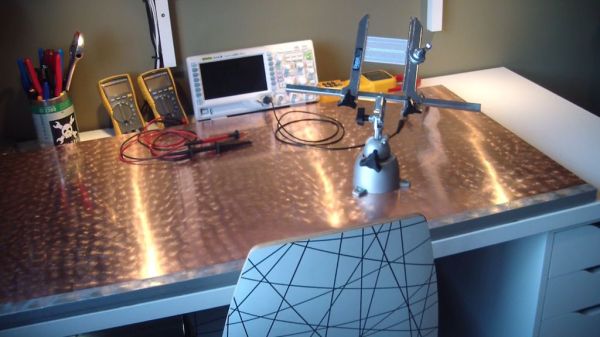
[Chris] seems to have commandeered a decent portion of the wife’s sewing room for his electronic adventures. As it is still her claim, she made it clear that his area needed some organization and a new desk. Dissatisfied with the look and feel of the replacement IKEA desk-like substance they acquired, he took it upon himself to ratchet up both the style and value by adding a copper laminate.
His decision is not purely based in aesthetic. If you’re following along, this means that his new electronics work surface is conductive. And yeah, it’s connected to ground at the wall. Although he doesn’t care for the stank of of anti-static mats or their susceptibility to fading and cracking, he does intend to use a tiny patch of it to keep his silicon happy.
[Chris] used a 20-gauge copper sheet that he cut and scored down to fit his Swedish sandwich wood base with enough margin for overhang. After scratching up one side of the copper sheet and one of the receiving base, he squidged down some adhesive nasty enough to require the rubber glove protocol and clamped it all together for several hours. Stay put the copper did, but stay flat it did not. After hammering down the overhang, [Chris] hand-burnished the copper in small swirls with a Scotch Brite pad to visually break up the slightly wavy surface. Instructional and hilarious play-by-play after the break.
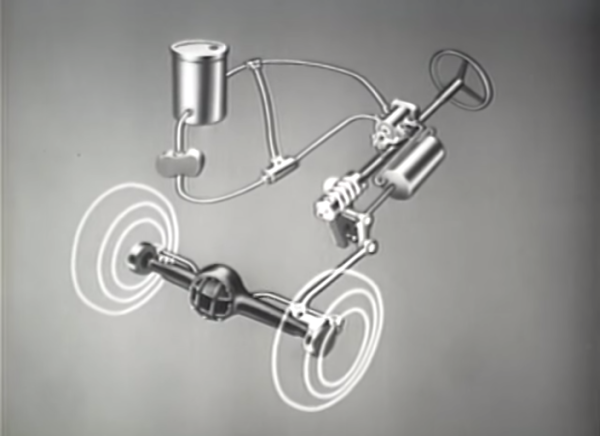
Have you ever had the pleasure of trying to steer a one-ton pickup from the 1940s or wondered how hard it would be to turn your car without power-assisted steering? As military vehicles grew larger and heavier in WWII, the need arose for some kind of assistance in steering them. This 1955 US Army training film handily explains the principles of operation used in a hydraulically-assisted cam and lever steering system.
The basic steering assembly is described first. The driver turns the steering wheel which is attached to the steering shaft. This shaft terminates in the steering cam, which travels up or down along the camshaft depending on the direction steered. The camshaft connects to the steering shaft through a spline joint, which keeps the travel from extending to the steering wheel. The steering cam is connected to the Pitman arm lever and Pitman arm shaft. Movement is transferred to the Pitman arm, which connects to the steering linkage with a drag link.
The hydraulic system helps the Pitman arm drive the linkage that turns the wheels and changes the vehicle’s direction. The five components that comprise the hydraulic system use the power of differential pressure, which takes place inside the power cylinder. The hydraulic system begins and ends with a reservoir which houses the fluid. A pump driven by the engine sends pressurized fluid through a relief valve to the control valve, which is the heart of this system.
Continue reading “Retrotechtacular: Principles Of Hydraulic Steering”

We got a case of the Mondays just reading about [Sascha]’s work environment. Get this: every morning, first thing, the whole team gets together to check in and share how they’re all feeling. And they can’t even be candid about it—there’s actually an approved list of feeling descriptors, both good and bad. It’s an admittedly big list that includes, interestingly enough, both ‘tortured’ and ’embarrassed’. Yeah. We think something like group t’ai chi on the roof each morning sounds a lot more relaxing. Since [Sascha] is between a rock and a hard place on this one, it was time to let chance take over. He raised his HaD-imprinted Trinket skyward and Can I Borrow a Feeling? was born.
The gist is simple: [Sascha] abstracts his disposition out to either ‘good’ or ‘bad’ and pushes the corresponding button. The Trinket accesses an array and returns a randomly selected feeling to the LCD. Since the official list of feelings is about 300 words long, [Sascha] has to push the data into PROGMEM. He used good old Excel to split the list in twain, and her formulas came in very handy for centering the result on the LCD. Once [Sascha] knew how it would all fit together, he designed a cool enclosure in CorelDRAW and turned on the laser cutter. See the Spreadsheet of Acceptable Words for yourself on GitHub, and pick up the code and enclosure file while you’re there.
There’s still time to enter the Trinket Everyday Carry Contest. The main contest runs until January 2, but we’re having random drawings every week! Don’t forget to write a project log before the next drawing at 9pm EST on Tuesday, December 30th. You and all of the other entrants have a chance to win a Teensy 3.1 from The Hackaday Store!









