It’s Printable, It’s Programmable, It’s E. Coli

Well, whaddya know? It seems that E. coli, the bane of Romaine and spinach everywhere, has at least one practical use. Researchers at Harvard have created a kind of 3D-printable ink that is alive and made entirely of microbes produced by E. coli. Although this is not the first so-called living ink, it does hold the title of the first living ink that doesn’t need any additional polymers to provide structure.

Passing the pillar test up to 16mm. Image via Nature

Because the ink is alive, it is technically programmable in the sense that it can self-assemble proteins into nanofibers, and further assemble those into nanofiber networks that comprise hydrogels.

One of the researchers compared the ink to a seed, which has everything it needs to eventually grow into a glorious tree. In this way, the ink could be used as a renewable building material both on Earth and in space. Though the ink does not continue to grow after being printed, the resulting structure would be a living system that could theoretically heal itself.

The ink creation process begins when the researchers induce genetically-engineered bacteria cultures to grow the ink, which is also made of living cells. The ink is then harvested and becomes gelatin-like, holding its shape well enough to go through a 3D printer. It even passes the bridging test, supporting its own weight between pillars placed up to 16 mm apart. (We’d like to see a Benchie.)

Continue reading “It’s Printable, It’s Programmable, It’s E. Coli”

DIY bagpipe made from a latex glove and some straws.

Ring In The New Year With DIY Bagpipes

Remember early on in the pandemic when people would don protection just short of a full hazmat suit to go out, and wore rubber gloves to the grocery store? Was that just us? The point is, we are surely not alone in having an excess of latex gloves left over, and pitifully few uses for them aside from the usual — gross jobs around the house, and making hand-shaped ice cubes.

Circular breathing, explained.Well, here’s something a little more fun: DIY bagpipes. No matter how you feel about the sounds they produce, the way that bagpipes work is pretty interesting. In the video embedded after the break, [Charlie Engelman] shows us how they work and compares them to saxophonist Kenny G’s little jazz mouth.

See, Mr. G can circular breathe, which means he can hold a note for as long as he wants. Basically, he is able to keep a reserve of air in his mouth for playing the thing, while at the same time inhaling new air.

If we bring this back around to bagpipes, the bladder is akin to Kenny G’s mouth. It always contains air, so it perpetually releases air through the sound pipes that stick up. In the case of the glove pipe, the glove is the bladder, and the pipes are made of drinking straws. Check it out after the break — we think the sound is far more tolerable than real bagpipes.

We’ve seen bagpipes made from common household items before (if you consider a couple of plastic recorders to be common household items), and we’ve also seen real bagpipes go electromechanical.

Continue reading “Ring In The New Year With DIY Bagpipes”

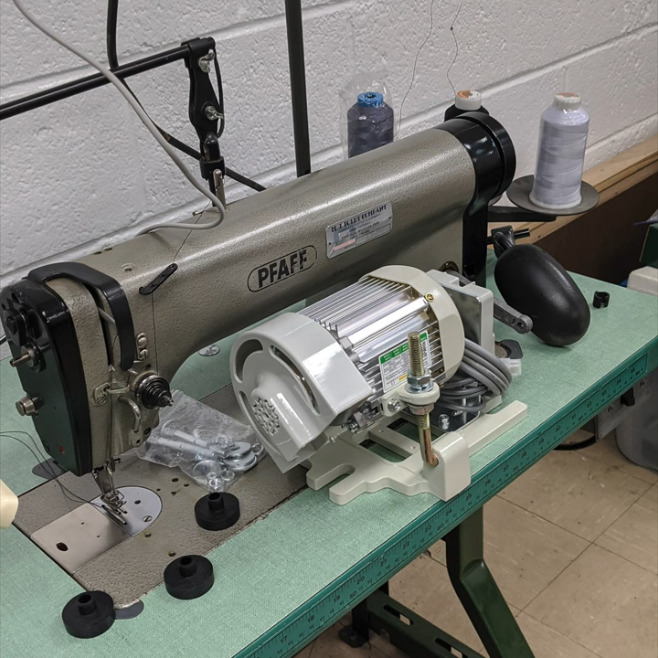
Eric Strebel peeks through his Pfaff 463 industrial sewing machine.

Simple Upgrades Make An Old Industrial Sewing Machine New Again

Well, this is a pleasant surprise: it seems that industrial designer [Eric Strebel] recently got a hold of an industrial sewing machine to tackle the softer side of prototyping. What doesn’t surprise us is that he did some upgrades to make it more user-friendly. Check them out in the video embedded below.

So, what’s the difference between a machine like this and what you might have around the house? Domestic sewing machines have a motor about the size of your fist, and it’s inside the machine’s body. Modern domestics can do light-duty work, but they can’t handle making bags and upholstery or sewing a bunch of layers of any material together. Industrial machines have either clutch or servo motors that are easily five times the size of a domestic’s motor, and are built into the table along with the machine.

Pfaff 463 industrial sewing machine with its new brushless DC servo motor.[Eric] found this Pfaff 463 on Craigslist. It was built somewhere around 1950, and it only does one thing — a single-needle, straight stitch, forward or reverse — but it will do it through damn near anything you want (unlike those computerized hunks of plastic made for home use nowadays). Again, these machines are always built into a table, and they come with a lamp.  While the machine itself may be a workhorse, the light is wimpy, so [Eric] replaced it with a goose-neck LED light that has a magnet for sticking it anywhere light is required around the machine.

No matter the size, electric sewing machines are driven with a foot pedal. On a domestic, the pedal is loose and you just put it on the floor wherever you want, but industrial foot pedals are built into the table frame. [Eric] drilled a bunch of new holes in the side of the pedal so he can move the connecting rod closer to the pivot point. This gives him better control with less footwork.

The biggest, baddest upgrade [Eric] did was to the motor. Although there was nothing wrong with the original  clutch motor, it makes the machine go very fast so that garment workers can fulfill their quotas. Because of this, it’s difficult to control. He upgraded to a brushless DC servo motor for greater precision and easier prototyping. He got really lucky, too, because it mounted directly into the old holes.

We agree wholeheartedly with [Eric]’s sentiment about old sewing machines, or any old machine for that matter. They tend to be overbuilt because planned obsolescence wasn’t a thing yet. If you can’t afford or find an industrial, an old Singer or something similar will likely serve your purpose, as long as you use the right needle.

If you already have an old domestic machine sitting around, you might be able to breathe new life into it with a 3D printer.

Continue reading “Simple Upgrades Make An Old Industrial Sewing Machine New Again”

Illustrated Kristina with an IBM Model M keyboard floating between her hands.

Keebin’ With Kristina: The One With The Hole-y Keyboard

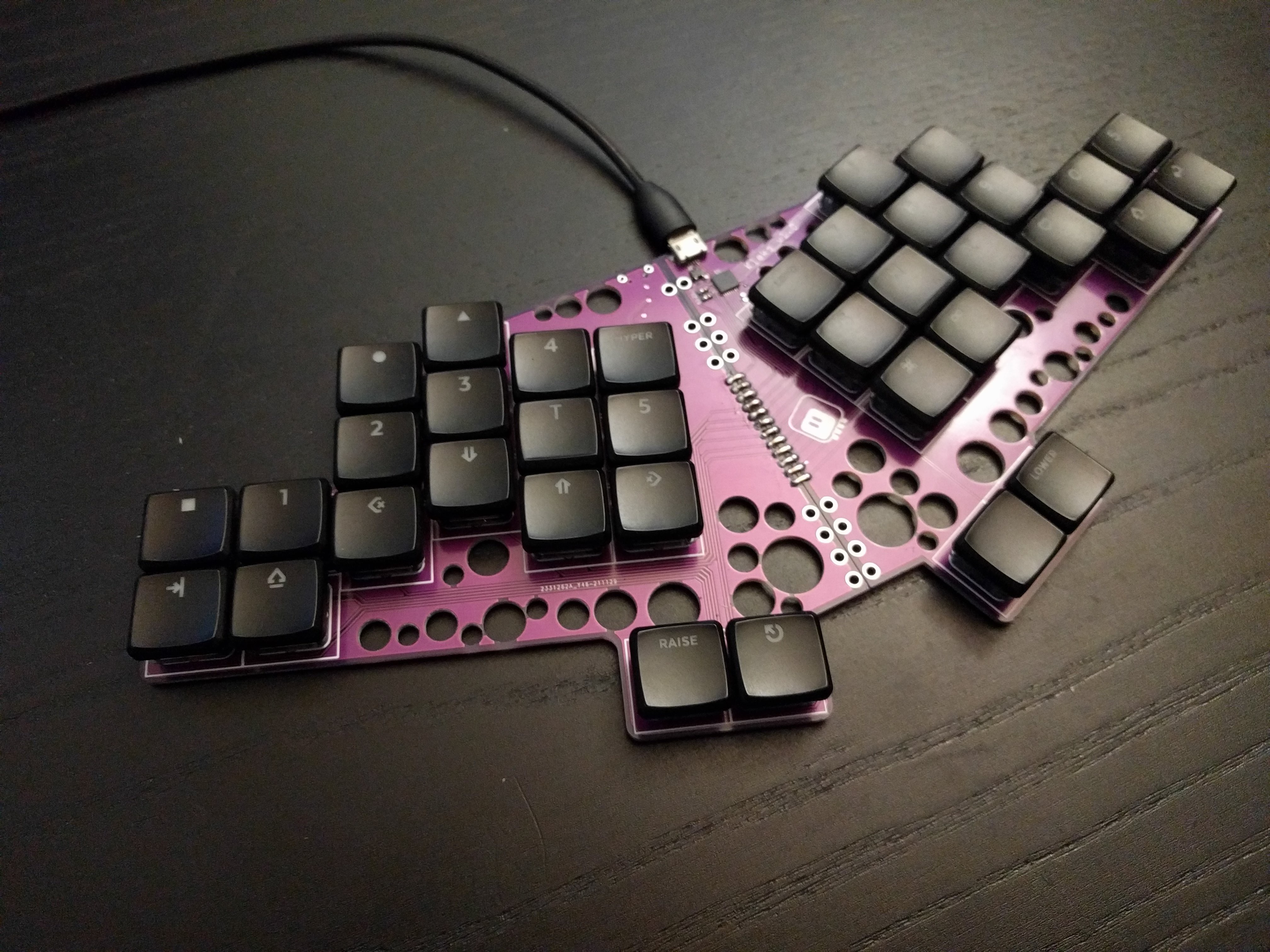
Can a keyboard get any more aerodynamic than this? Probably not.

According to Google Translate, kleks is Polish for (and I’m cherry-picking definitions here) the word ‘splash’. Well, [deʃhipu]’s hole-ful and soulful Kleks Keyboard certainly made a splash with me. [deʃhipu] knows what I’m talking about. As I said in Discord, I just love the look of those holes. They’re purely aesthetic and do a nice job of showing off [deʃhipu]’s routing skills.

One might argue that those holes also functional in that they increase aerodynamics and remove a not-insignificant amount of weight for travel considerations. But yeah, they mostly are there to look cool. Upon closer inspection, I saw that the two halves are joined with a series of soldered stitches that are made from a [ggconnector] bent into a u-shape. Now it’s a toss-up as to which is my favorite feature.

It seems that [deʃhipu] is never completely satisfied by this or that keyboard build, and that’s okay. That’s normal. That is . . . a big part of what this hobby is all about. Because honestly, what would be the fun in finding The One? We wonder what will happen when the droplets settle. Will [deʃhipu] be satisfied with the Kleks, or will those stylish holes become un-fillable voids?

Continue reading “Keebin’ With Kristina: The One With The Hole-y Keyboard”

Fabulous Flexure Mechanism Makes For Resetting Cat Calendar

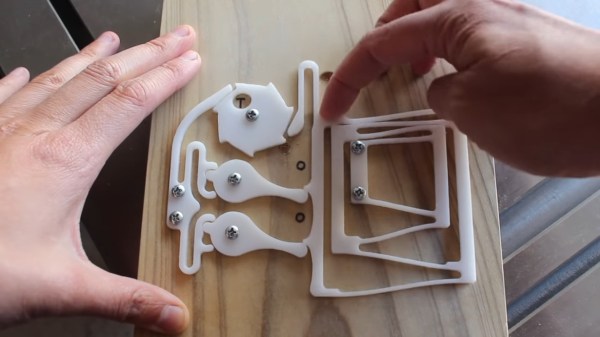
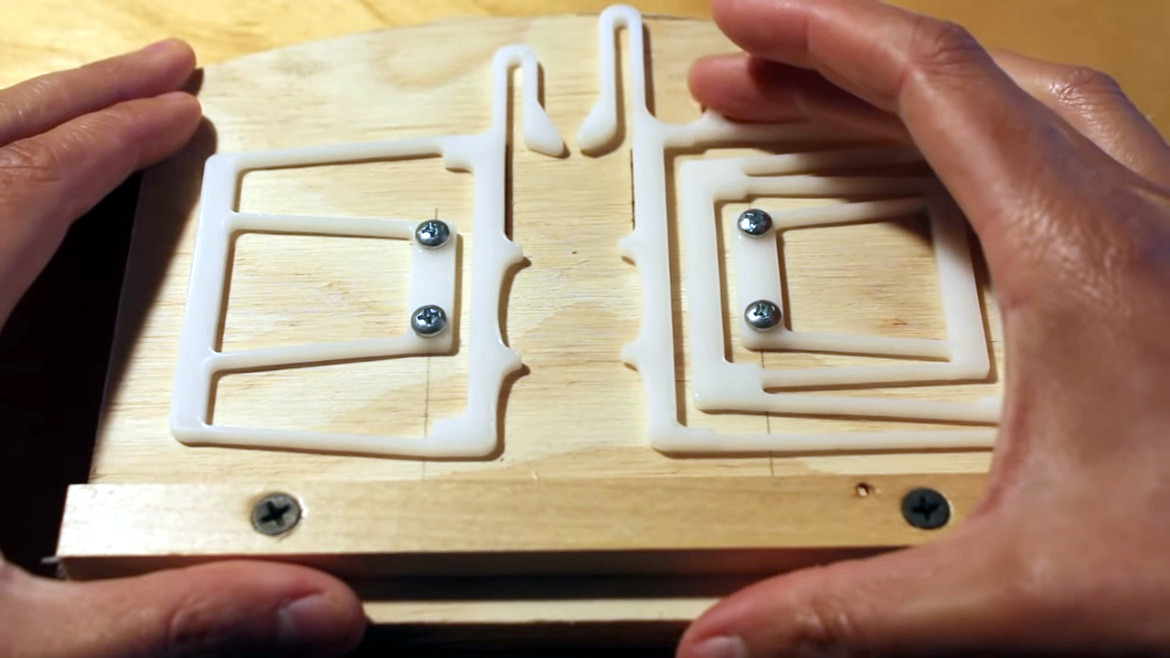
When we met [Amy Makes Stuff] at the 2019 Hackaday Superconference, we were immediately impressed with the array of flexure mechanisms displayed on a board hanging around her neck. That must be where we saw [Amy]’s original version of the cat calendar — a simple way to know for sure whether the shared house’s cat has been fed once, twice, or not at all on a given day.

Left: a simple flexure that gets heavily stressed when actuated. Right: a slightly more complicated flexure that uses less force.

Awesome as it is, the flexure mechanism doesn’t reset the yes/no indicators when the day clicks over — that has to be done manually. So when [Amy] was offered to try a small desktop CNC, she decided it was time to make a new version that resets automatically. Check it out in the video after the break, which also includes an exploration of [Amy]’s choice of flexure design as well as a bonus review of the CNC.

This is just an all-around great video, especially after [Amy] neglected to mill out the check marks and circles, sending her down a rabbit hole of attempting to make branding bits for these that could be chucked into a soldering iron. Unfortunately, the mill stops short of having the necessary mettle for milling metal.

Although [Amy] is likely known for her flexures, she has a ton of skills. Remember when she resurrected that burned and bubbled laser cutter? Or the time she machined a honing jig for hand-sharpening chisels and planes?

Continue reading “Fabulous Flexure Mechanism Makes For Resetting Cat Calendar”

USB LED Christmas Tree Is Making Spirits Bright

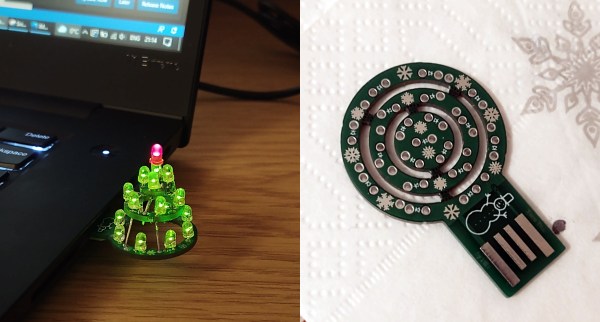
[Piotr SB] knows there is no way out of the holidays; the only path is through. You’ve got to find cheer wherever and however you can, so why not cater to your own interests and build the cutest little LED Christmas tree you ever did see? And did we mention it’s USB and absolutely free (as in carols, not eggnog)?

This O-Christmas tree is made up of concentric rings that are built into a tier as you solder the LEDs. And of course you’re supposed use the LED legs as supports! One leg from each LED — 18 green and a red one for the top. Because the PCB is not quite thick enough, you’ll need to add a plastic spacer to get it to stay in the USB port. Not only is this a nice design, the snowflakes and snowman on the silkscreen totally seal the cuteness deal.

Ever get so frustrated with your Christmas tree that you want to just empty a few rounds into the thing? No? Well, you’d have a good reason to if you built this Duck Hunt ornament.

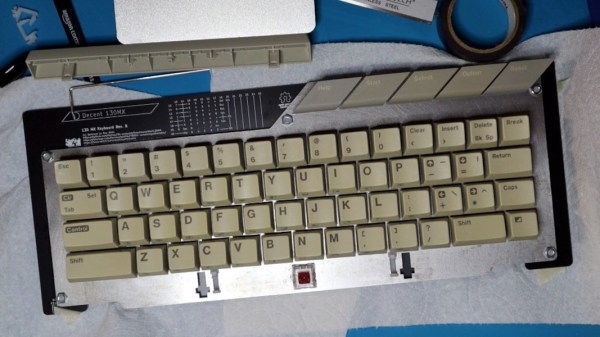
An Atari 130XE's keyboard made mechanical with Kailh box pinks and 3D-printed keyswitch stems.

Atari 130XE Keyboard Now Goes Clack

Performing a resto-mod on a beloved piece of childhood technology can be quite a ride. In [Bertrand]’s case, it was the keyboard to their Atari 130XE. Although it has those cool double-shot keycaps, they’re hiding a crappy membrane underneath that could really benefit from a mechanical upgrade. Relax — the membrane part was broken.

[Bertrand] designed and printed some new stems for Kailh box pinks that can accept both of the two known variants instead of the standard Cherry MX receptacle. He also made a new PCB (natch) and a keyboard adapter to replace the membrane interface, and had a steel keyswitch plate custom cut. The so-called Atari 130MX mod can be used with an Atari 130XE computer, or as a regular keyboard for a PC if you solder in a Pico.

[Bertrand] says that this labor of love was meant to be reproduced and told us that for some folks in the Atari community, it’s already on like Donkey Kong. If you’re going to attempt this mod, know that filament printers won’t work well at all for these tiny and precise parts. [Bertrand] printed the stems on an Elegoo with a resolution of 1/20 mm (50 micrometers). On the bright side, old-new stock Atari keycaps are not that hard to find. Check it out after the break.

We love to see vintage keyboards get modern upgrades. Did you see the nuclear missile silo keyboard/trackball combo? When we read that it came from ebay, our wallet took itself to DEFCON 1.

Continue reading “Atari 130XE Keyboard Now Goes Clack”