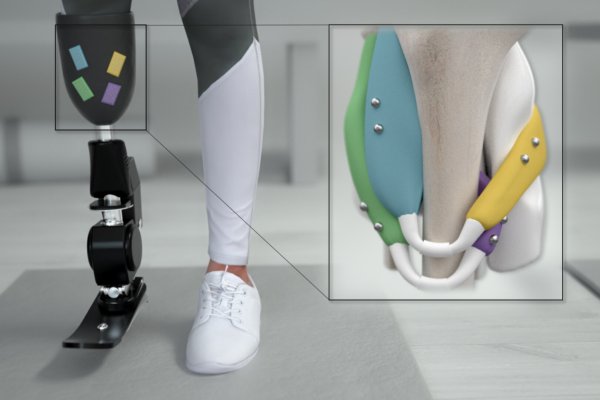
Tiny ball magnets implanted in muscles could provide much better control over prosthetics.

Magnets Could Give Prosthetic Control A Leg Up

Today, prostheses and exoskeletons are controlled using electromyography. In other words, by recording the electrical activity in muscles as they contract. It’s neither intuitive nor human-like, and it really only shows the brain’s intent, not the reality of what the muscle is doing.
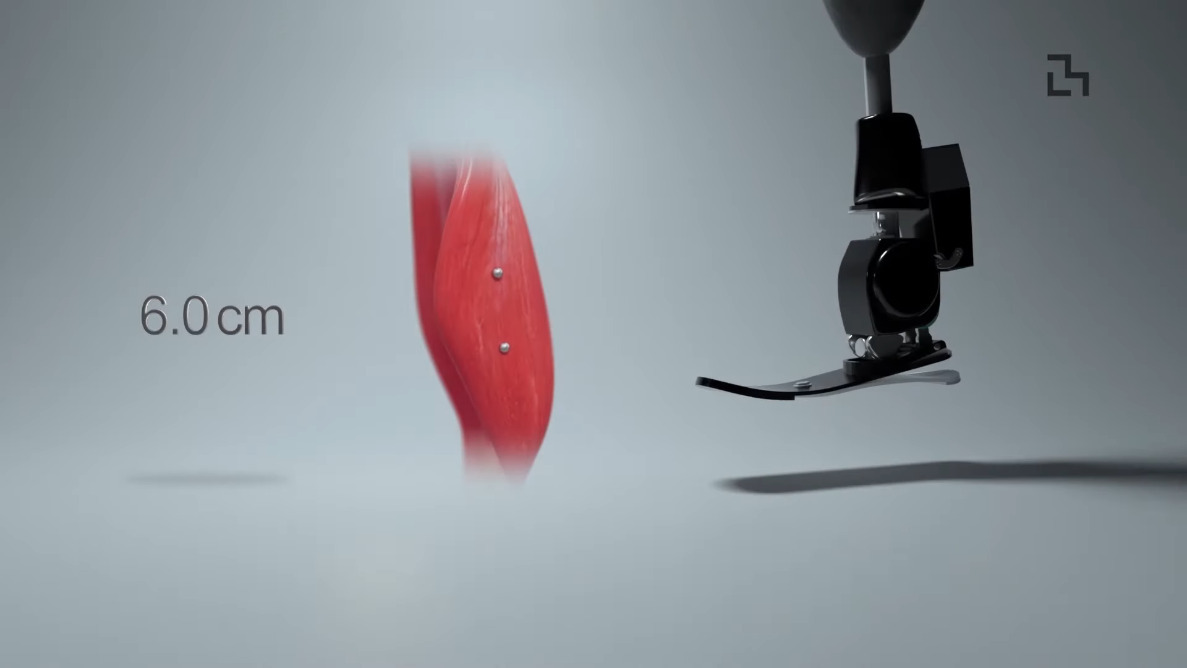
Researchers at MIT’s Media Lab have figured out a way to use magnets for much more precise control, and they’re calling it magnetomicrometry (MM). By implanting pairs of tiny ball magnets and tracking their movement with magnetic sensors, each muscle can be measured individually and far more accurately than with electromyography.

After embedding pairs of 3mm diameter ball magnets into the calves of turkeys, the researchers were able to detect muscle movement in three milliseconds, and to the precision of thirty-seven microns, which is about the width of a human hair. They hope to try MM on humans within the next couple of years. It would be a great solution overall if it works out, because compared with the electromyography method, MM is cheaper, less invasive, and potentially permanent. Couple MM with a new type of amputation surgery called AMI that provides a fuller range of motion, less pain overall, and finer control of prosthetics, and the future of prostheses and rehabilitation looks really exciting. Be sure to check out the video after the break.

There’s more than one way to control prostheses, such as deep learning and somatosensory stimulation.

Continue reading “Magnets Could Give Prosthetic Control A Leg Up”
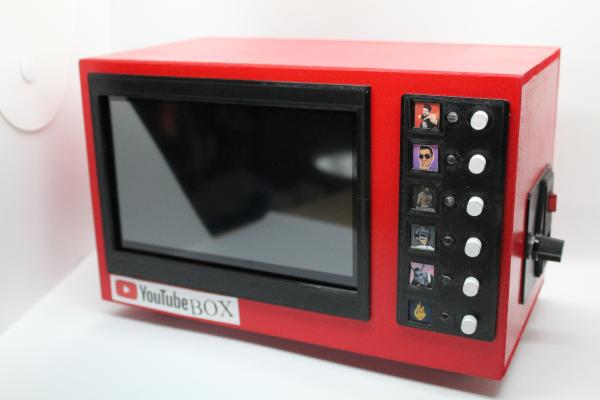
Dedicated box to play new videos from a handful of content creators.

Dedicated Box Makes YouTube More TV-Like

[Exposed Wire] is a huge fan of YouTube and consumes a lot of content. If that sounds familiar, maybe you should build a dedicated YouTube box, too. You get to push buttons, there’s LEDs, and you can take a break from other screens to look at this one for a while. [Exposed Wire] wanted to make it easier to watch the latest videos from their favorite creators, but we would argue that this is more fun, too.

The Rasberry Pi 4 inside checks every five minutes for new videos by keeping track of the creator’s total number of videos in a text file and doing a comparison. If one of the channels has a new video, then the corresponding LED lights up and the new video’s URL is linked to the button. Press the button and the Raspi opens the browser, goes the the URL, maximizes the video, turns off the LED, and updates the video count in the text file.

We like the construction job here. The 1/4″ MDF walls are connected by 3D-printed L-brackets in PETG. At first, [Exposed Wire] mounted the LEDs and buttons to a PCB, but that was really fiddly so they printed panels instead. Combined with the bracket around the screen, the finished build looks good. Check out the build montage after the break.

Regular old YouTube videos not doing it for you anymore? Try watching them at low resolution on an LED matrix.

Continue reading “Dedicated Box Makes YouTube More TV-Like”

Tree Of Life Branches Out With A Twist

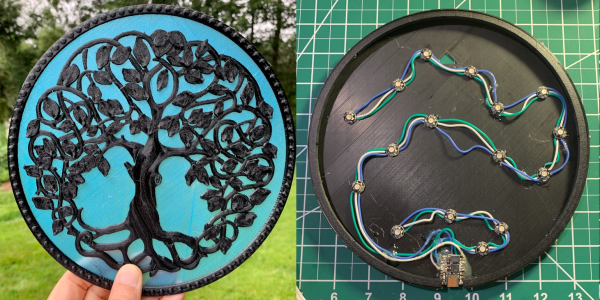
In the middle of 2020, [charlie] challenged himself to conceive of and finish one project every month for the next twelve. Here we are a year later with [charlie]’s last project of the challenge: a tree of life with a bit of a twist to it.

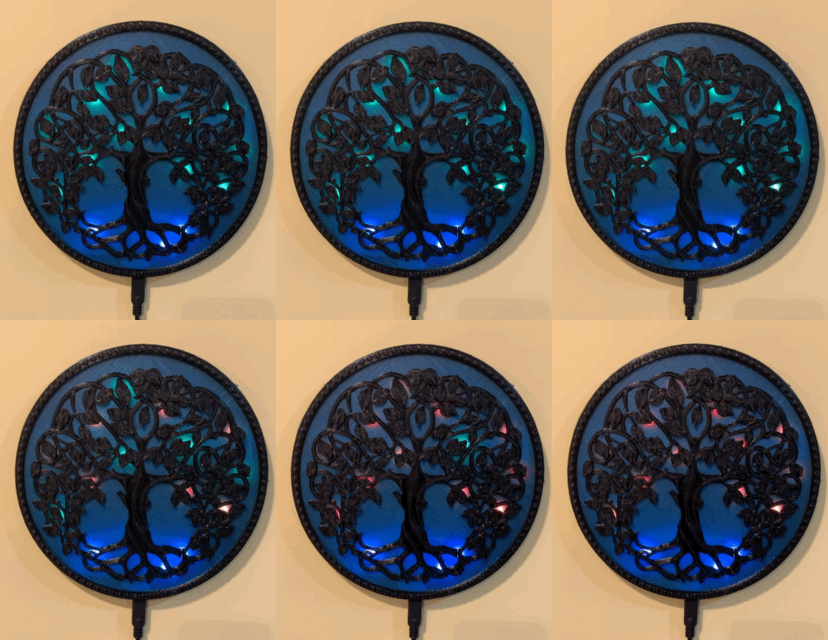
The idea was to build a tree with lights that would represent the leaves and change as the tree went through the seasons. After a lot of searching, he found a really elaborate model meant for CNC carving, but the model maker converted it to an STL. [charlie]’s original plan was to poke the LEDs through the print. After consulting a wise woman, he decided to take the two-color approach and make the background translucent so that the 16 RGB LEDs can shine through.

So, what’s the twist? Well, over time, the tree will develop dementia. One by one, the leaves will lose awareness and go through the seasons backward, or slow down their cycle, or speed up. Eventually, the entire tree recedes into a rainbow of confusion. Sadly beautiful, isn’t it?

No printer? No problem. Trees of life come in all forms, including free-form.

Pomodachi: A Productivity Pet You Feed By Working

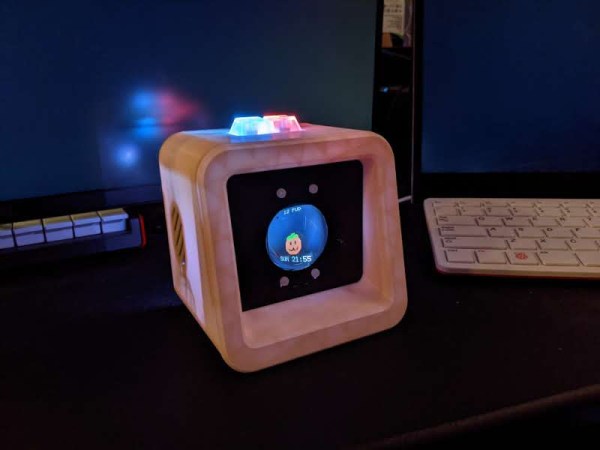
Being productive doesn’t have to be a lonely endeavor. Even if you’re a lone wolf, who wouldn’t benefit from having a cute little productivity pet to cheer them on? That’s the idea behind [droxpopuli]’s Pomodachi, which combines a hardware implementation of the Pomodoro technique with a virtual pet. It adds some fun, but doesn’t overly gamify time tracking to the point of distraction. And this is way more fun than just sticking a pair of googly eyes on a tomato-shaped timer.

Inside the box is an Adafruit HalloWing M4 Express and a NeoKey FeatherWing with two Kailh box white switches for a satisfying clack. [droxpopuli] printed up a PyPortal-inspired case and added a glass lens for a spiffy tube TV look.

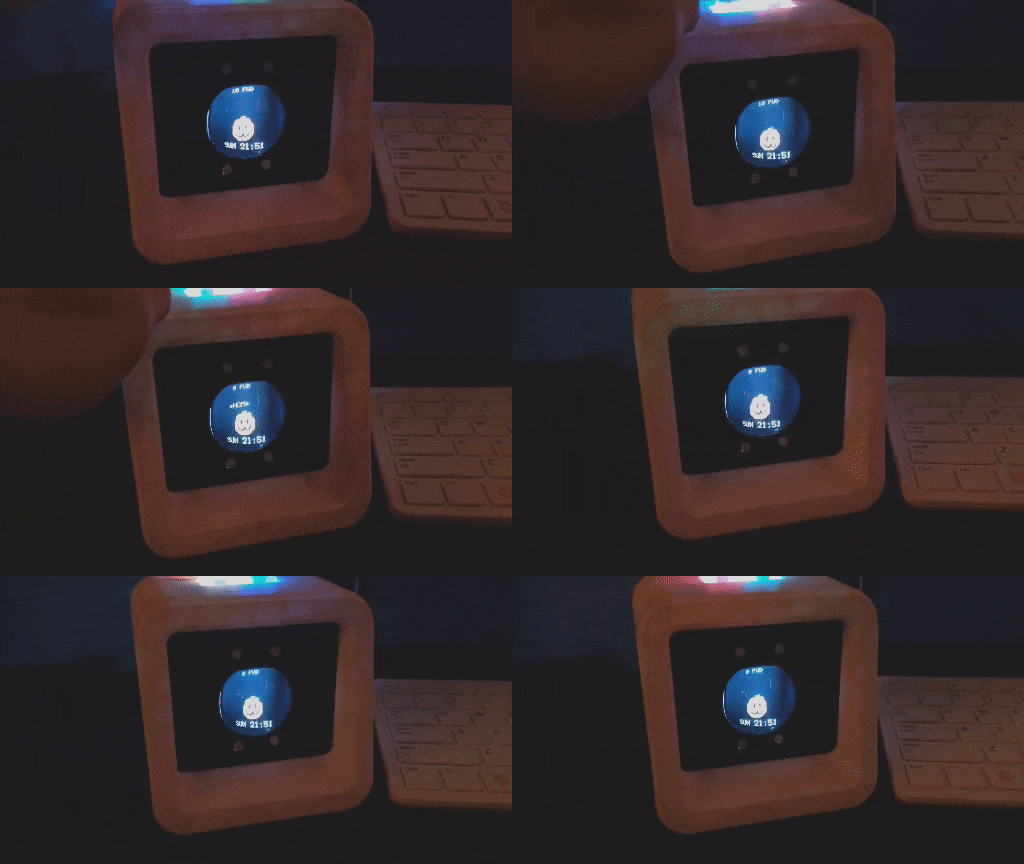
Pomo himself is a cute little jack-o-lantern looking creature with a teddy bear face and no arms or legs. He could eat with his face, but prefers to be fed. That’s where you come in. You feed him by completing a set of four 20-minute work intervals.

Don’t worry about keeping track of time, because he does that for you and spends the time foraging for food. When it’s break time, Pomo lets you know and suggests an activity. This is when you press the button and feed him. If your productivity begins to flag a bit, don’t freak out — there’s a multiplier for catching up, and you have seven chances before Pomo runs away forever.

The Pomodoro Technique is pretty great for productivity, and it’s versatile, too. Here’s a hydration-based Pomodoro that will flood your desk if you don’t drink enough water.

[via Hackaday.io]

Rotary Time Tracker Puts A New Spin On Productivity

Like many of us, [quincy] feels the distracting pull of non-work programs on what has become a mixed-use computer. So what’s the answer to the puzzle of work-life balance? We’re not sure, but time management and keeping track of tasks will probably get you most of the way there. The only problem is that keeping track of these things is boring and tedious and way too easy to forget, even for the fun tasks.

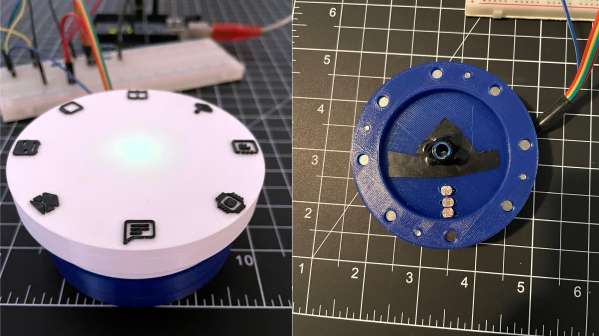
Similar commercial gadgets exist to serve this time-tracking purpose, but [quincy] wanted something much cooler that would work the same way: turn the indicator to the current task, and the status gets recorded on a computer. Rather than some smart polygon with informative stickers on each face à la the Timeflip2, [quincy] built a rotary task manager that serves the same purpose, but does it with magnets.

Our favorite part aside from the magnets has to be the clever binary encoding work. [quincy] is using three photoresistors and a single green LED to create a 3D-printed gray encoder that sidesteps the need to ever flip two bits at once. An Arduino takes care of reading the 3-bit code and converting it back into a decimal. There are more updates to come, including the main .ino file, but you can start printing the pieces while you wait.

If you have trouble staying on task, maybe you need a Pomodoro timer. We’ve seen a few over the years, ranging from the minimal to the sculptural.

How To Make Resin Prints Crystal Clear

[Matou] has always been entranced by the beauty of natural crystal formations [and has long wished for a glowing crystal pendant]. Once he got a resin-based 3D printer, he was majorly disappointed to find out that although transparent resin prints look like delicious candy when they’re still wet, they turn cloudy and dull after being washed in an isopropyl bath and cured with UV light. There must be a way to either polish pieces back to clear, or keep them clear in the first place, [Matou] thought, and set about experimenting with some test crystals (video, embedded below).

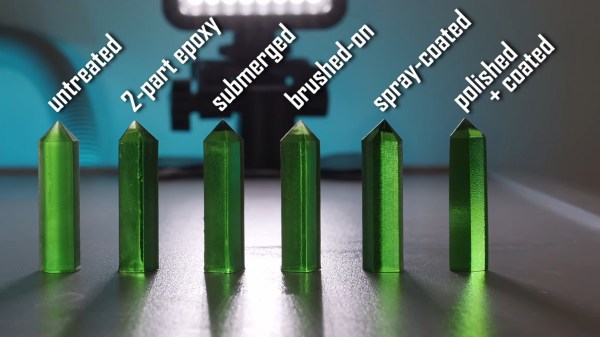
As [Matou] found out, the dullness is caused by surface imperfections. Resin prints have layer lines, too, and although they may be super fine and invisible to the naked eye, they will still scatter light. The choices seem obvious — either polish the proud parts down with many grits of sandpaper, or fill the valleys with something to smooth everything out. As you’ll see in the video after the break, [Matou] tried it all, including a coat of the same resin that made the print. It’s an interesting look at the different ways to smooth out resin prints, though you may not be surprised to find that the one with the most work put into it looks the best.

We were hoping to see [Matou] try a green LED in the pendant, but it didn’t happen. If you’re dying to know what that looks like, you can get one of these pendants for yourself by supporting [Matou] on Patreon.

We think crystals are pretty cool, too — especially crystal radios. Here’s the hack-iest one of those we’ve ever seen, free of charge.

Continue reading “How To Make Resin Prints Crystal Clear”

Hackaday Links Column Banner

Hackaday Links: August 8, 2021

Do you have burning opinions about GitHub Copilot, the AI pair programmer that Microsoft introduced a few months ago? Are you worried about the future of free and open software? The Free Software Foundation is funding a call for white papers of 3,000 or fewer words that address either Copilot itself or the subjects of copyright, machine learning, or free software as a whole. If you need more background information first, check out [Maya Posch]’s excellent article on the subject of Copilot and our disappointing AI present. Submissions are due by 10AM EDT (14:00 UTC) on Monday, August 23rd.

There are big antique books, and then there are antiphonaries — these are huge tomes full of liturgical chants and things of that nature. When one of them needs a lot of restoration work, what do you do? You build an all-in-one housing, display case, and cart that carefully holds it up and open (YouTube). Otherwise, you have to have multiple gloved people being extra careful. Jump to about the 14-minute mark to see the device, which is mostly made from extruded aluminum.

In more modern news: you may be waiting out this chip shortage like everyone else, but does it require renting out a bunch of real estate in perpetuity? We didn’t think so. Here’s an aerial photo of a stockpile of Ford Super Duty trucks that are waiting for chips at a dead stop outside the Kentucky Speedway. Thousands of brand new trucks, exposed to the elements for who knows how long. What could go wrong?

While we’re asking questions, what’s in a name? Well, that depends. We’ve all had to think of names for everything from software variables to actual children. For something like a new exoplanet survey, you might as well make the demonym remarkable, like COol COmpanions ON Ultrawide orbiTS, or COCONUTS. Hey, it’s more memorable than calling them X-14 and -15, et cetera. And it’s not like the name isn’t meaningful and descriptive. So, readers: do you think this is the worst name ever, planetary system or otherwise? Does it shake your tree? We’re on the fence.