DIY Roll Bender Keeps It Simple And Sturdy

If you’ve ever tried to bend a metal pipe or bar over your knee, you’ll know that even lightweight stock requires quite a bit of force. And the force needs to be properly directed, lest the smooth bend you seek become a kink or a crease. When your hands and knees no longer fill the bill, try [MakeItExtreme]’s sturdy and simple roll bender.

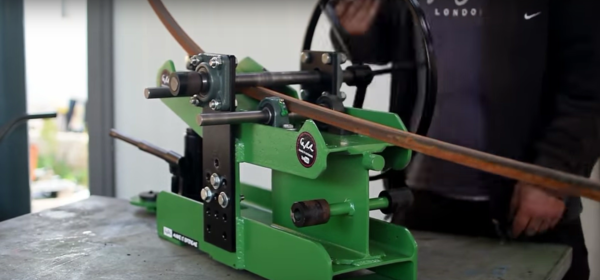
As we watched the video below, we had a little déjà vu — hadn’t the [MakeItExtreme] crew built a roll bender for their shop before? Turns out they had, but in reviewing that video, we can see why they gave it a second shot. This build is a model of simplicity compared to the previous. With a frame fabricated from just a few pieces of steel I-beam, this version is far more approachable than its big brother and just about as capable. The three forming rollers ride in stout pillow blocks and can be repositioned for different bending radii. A 2-ton hydraulic bottle jack provides the force needed to direct the stock through the rollers, which are manually powered. In a nice touch, the incomplete tool was used to create the rim of the large-diameter handwheel for the drive roller.

The tools keep piling up at [MakeItExtreme]’s open air workshop — we even get a glimpse of their heavy-lift electromagnet that we recently featured. As always, we love the fit and finish on these builds, and watching the time-lapse videos is like a condensed class in metalworking.

Continue reading “DIY Roll Bender Keeps It Simple And Sturdy”
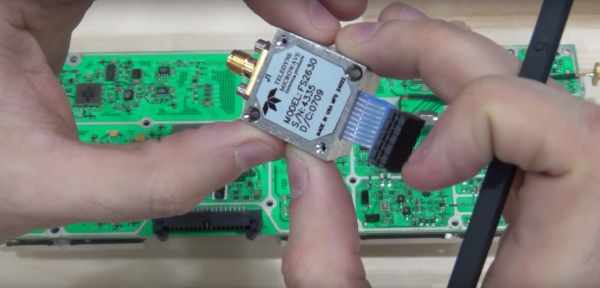
$2700 EBay Bet Pays Off For This 14 GHz Spectrum Analyzer Repair

The eBay addiction starts small. One night you’re buying $3 buck-boost converters and cheap Chinese USB power packs. The next thing you know you’re spending thousands on dead instruments with no documentation. You’ve got the skills though, and if your bet that you can diagnose and repair a 14 GHz real-time spectrum analyzer is right, you’ll be putting a snazzy instrument on the bench for a fraction of the original $50,000 it cost.

Make some popcorn and get cozy before settling in to watch [Shahriar]’s video below, because it clocks in at just over an hour. But it’s pretty entertaining, and just seeing how Tektronix built the RSA 6114A spectrum analyzer is worth the time. Things are different when you’re piping microwave signals around the chassis of a beast such a this, the interior of which is densely packed with pluggable modules. Tek factory service would no doubt perform a simple module swap to get this machine running again, but [Shahriar] wasn’t having any of that on his $2,700 eBay find. After isolating the problem to the local-oscillator generator module, [Shahriar] takes us on a tour of where the signals go and what they do. We won’t reveal the eventual culprit, but suffice it to say that after a little SMD rework, [Shahriar] has a very fancy new instrument for the shop.

If this repair gives you the itch to get working on microwave circuits, maybe it’s time to build that backyard synthetic aperture radar set you’ve always wanted.

Continue reading “$2700 EBay Bet Pays Off For This 14 GHz Spectrum Analyzer Repair”

Bandsaw Tension Gauge Uses Raspberry Pi And Load Cell

No matter what material you’re cutting, getting the blade tension right is one of the keys to quality cuts on the bandsaw. Unfortunately, most bandsaws come with only a rudimentary tension gauge, and while there are plenty of tricks for measuring blade tension indirectly, nothing beats a digital blade tension gauge for repeatable results.

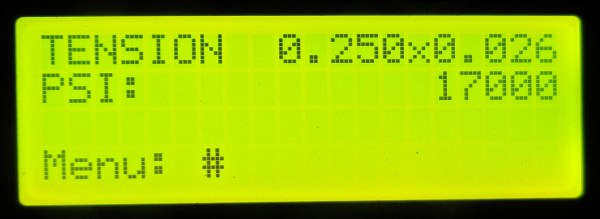
Despite being an aftermarket accessory for his beefy Hitachi CB-75F bandsaw, [Stephen B. Kirby]’s Pi-based tension guide looks like an OEM product. Housed in a sturdy case and sporting a sealed membrane keypad and four-line LCD display, the interface electronics are pretty straightforward. The tricky bit is sensing the amount of tension on the bandsaw blade. For that task, [Stephen] mounted a load cell in place of the original tensioning spring. A few adapters helped that job, and with a little calibration, the gauge is capable of displaying the tension by measuring the force over the cross-sectional area of the current blade.

We really like it when electronics can bring a new level of precision to old-school hardware, whether it’s a simple DRO for a manual lathe or a more accomplished build like [Stephen]’s. Sometimes adding new silicon can make old iron a little easier to use.

Op Amps Combine Into Virtual Ball In A Box

What happens when you throw a ball into a box? In the real world, the answer is simple – the ball bounces between the walls and the floor until it eventually loses energy and comes to rest. What happens when you throw a virtual ball into a virtual box? Sounds like something you might need a program running on a digital computer to answer. But an analog computer built with a handful of op amps can model a ball in a box pretty handily too.

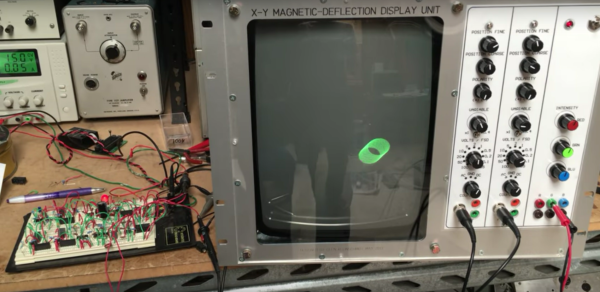
OK, it takes quite a large handful of op amps and considerable cleverness to model everything in this simple system, as [Glen Kleinschmidt] discovered when he undertook to recreate a four-decade-old demonstration project from AEG-Telefunken. Plotting the position of an object bouncing around inside the virtual box is the job of two separate circuits, one to determine the Y-coordinate and bouncing off the floor, and one to calculate the X-coordinate relative to the walls. Those circuits are superimposed by a high-frequency sine-cosine pair generator that creates the ball, and everything is mixed together into separate outputs for an X-Y oscilloscope to display. The resulting simulation is pretty convincing, with the added bonus of the slowly decaying clicks of the relay used to change the X direction each time a wall is hit.

There’s not much practical use, but it’s instructional for sure, and an impressive display of what’s possible with op amps. For more on using op amps as analog computers, check out [Bil Herd]’s “Computing with Analog” article.

Continue reading “Op Amps Combine Into Virtual Ball In A Box”

Bench Power Supply Uses Server Voltage Regulator

If you stuff a computer into a rack with a bunch of other machines, you’d better make it a tough machine. Server-grade means something, so using server parts in a project, like this high-wattage power supply using server voltage regulators, can take it to the next level of robustness.

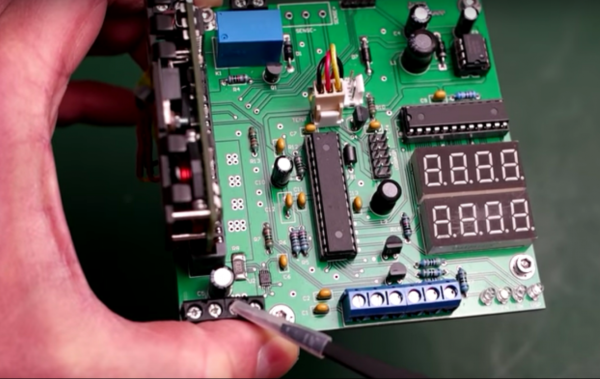
But before [Andy Brown] could build this power supply, he had to reverse-engineer the modules. Based on what he learned, and armed with a data sheet for the modules, he designed a controller to take advantage of all the capabilities of them and ended up with a full-featured power supply. The modules are rated for 66 watts total dissipation at 3.3 volts and have a secondary 5-volt output. Using an ATmega328, [Andy] was able to control the module, provide a display for voltage and current, temperature sensing and fan control, and even a UART to allow data logging to a serial port. His design features mainly through-hole components to make the build accessible to everyone. A suitable case is yet to come, and we’re looking forward to seeing the finished product.

Can’t scrape together some of these modules on eBay? Or perhaps you prefer linear power supplies to switched- mode? No worries – here’s a super stable unregulated supply for you.

Continue reading “Bench Power Supply Uses Server Voltage Regulator”

Woodworking Basics For The Hardware Hacker

Hackaday is primarily a place for electronics hackers, but that’s not to say that we don’t see a fair number of projects where woodworking plays a key role. Magic mirror builds come to mind, as do restorations of antique radios, arcade machines built into coffee tables, and small cases for all manner of electronic and mechanical gadgets. In some of these projects, the woodworking really shines and makes the finished project pop. In others — well, let’s just say that some woodwork looks good from far, but is far from good.

Continue reading “Woodworking Basics For The Hardware Hacker”

Plus Size Watch With A Pair Of Tiny Nixies

When you stuff a pair of Nixie tubes into a wristwatch the resulting timepiece looks a little like Flavor Flav’s necklace. Whether that’s a good thing or not depends on your taste and if you’re comfortable with the idea of wearing 200 volts on your wrist, of course.

As a build, though, [prototype_mechanic]’s watch is worth looking into. Sadly, details are sparse due to a computer issue that ate the original drawings and schematics, but we can glean a little from the Instructables post. The case is machined out of solid aluminum and sports a quartz glass crystal. The pair of IN-16 tubes lives behind a bezel with RGB LEDs lighting the well. There’s a 400mAh LiPo battery on board, and an accelerometer to turn the display on with a flick of the wrist.

It may be a bit impractical for daily use, but it’s a nicely crafted timepiece with a steampunk flair. Indeed, [prototype_mechanic] shows off a few other leather and Nixie pieces with four tubes that certainly capture the feel of the steampunk genre. For one with a little more hacker appeal, check out this Nixie watch with a 3D-printed case.

Continue reading “Plus Size Watch With A Pair Of Tiny Nixies”