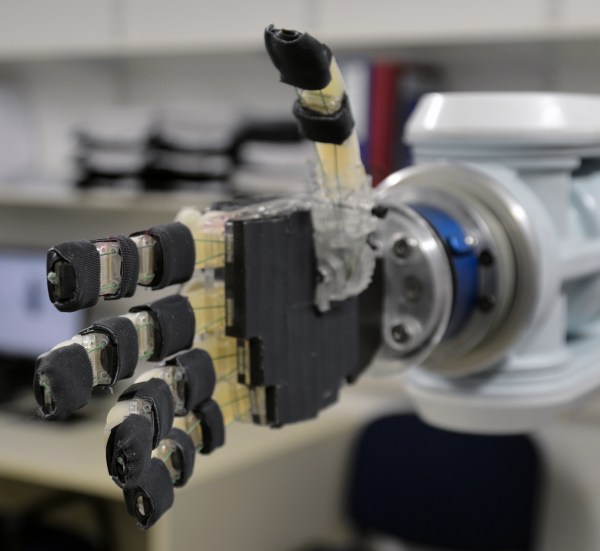
Hackaday Prize Semifinalist: OpenBionics Affordable Prosthetic Hands

The human hand is an amazing machine, and duplicating even a fraction of its abilities in a prosthetic is a daunting task. Flexible anthropomorphic prosthetics can reach tens of thousands of dollars and are beyond the means of many of the people who need them. So imagine the impact a $200USD prosthetic hand could have.

For such a low, low price you might expect a simple hook or pincer grip hand, but the OpenBionics initiative designed their hand from the outset to mimic the human hand as much as possible. The fingers are Plexiglas with silicone knuckles that are flexed by tendon cables running in sheaths and extended by energy stored in elastomeric material running along their dorsal aspects. Each finger can be selectively locked in place using a differential based on the whiffletree mechanism, resulting in 16 combinations of finger positions with only a single motor. Combined with 9 unique thumb positions, 144 unique grasp are possible with the open source hand built from hardware store and 3D printed parts. Stay tuned for a video of the hand in action after the break.

3D printing is beginning to prove it’s the next big thing in prosthetics. Hackers are coming up with all kinds of static artificial hands, from the elegant to super-hero themed. Maybe the mechanism that OpenBionics has come up with will find its way into these hands – after all, it is an open source project.


The 2015 Hackaday Prize is sponsored by:

Continue reading “Hackaday Prize Semifinalist: OpenBionics Affordable Prosthetic Hands”

Ctrl-X, Ctrl-V For DNA

Once upon a time, the aspiring nerdling’s gift of choice was the Gilbert chemistry set. Its tiny vials of reagents, rack of test tubes, and instruction book promised endless intellectual stimulation and the possibility of stink bombs on demand. Now a new genetic engineering lab-in-a-box Kickstarter, with all the tools and materials needed to create your own transgenic organisms, may help the young biohacker’s dreams come true.

The Kickstarter has been wildly successful. The initial goal was $1200AUD was met in a day, and currently stands at almost $6200AUD. Despite that success, color me skeptical on this one. Having done way more than my fair share of gene splicing, there seem to be a few critical gaps in this kit. For example, the list of materials for the full kit includes BL21 competent E. coli as the host strain. Those cells are designed to become porous to extracellular DNA when treated with calcium chloride and provided with a heat shock of 42°C. At a minimum I’d think they’d include a thermometer so you can control the heat shock process. Plenty of other steps also need fairly precise incubations, like the digestion and ligation steps needed to get your gene into the host. And exactly what technique you’d be using to harvest DNA from the animal, plant or fungal cells is unclear; the fact that most of the techniques for doing so require special techniques leads me to believe there’s a lot less here than meets the eye.

To be fair, I’ve been off the lab bench for the better part of two decades, and the state of the art has no doubt advanced in that time. There could very well be techniques I’m not familiar with that make the various steps needed to transform a bacterial culture with foreign DNA trivial. It could also be the case that the techniques I used in the lab were optimized for yield and for precise data, while the GlowGene kit provides the materials to get a “good enough” result. I hope so, because a kit like this could really expand the horizons of hackerdom and start getting the biohacking movement going.

[Thanks, Michael!]

Porsche-themed Mancave Clock: There Is No Substitute

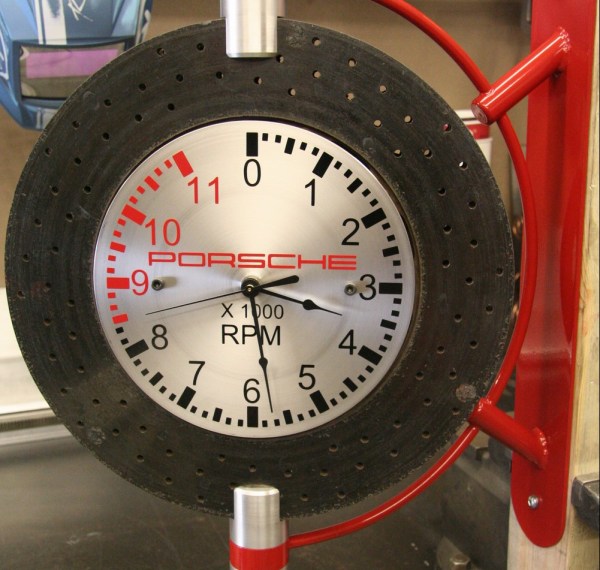
With an extra Porsche brake rotor lying about and a persistent friend to be silenced, [GordsGarage] decided to fabricate a one-of-a-kind man cave wall clock.

This was not to be a boring old hang-it-flat-on-the-wall design, though. The Porsche rotor is a composite design, with a steel hub and a ceramic disc weighing only a third of what an all-steel rotor weighs. That inspired [GordsGarage] to fabricate a wall bracket to hold the rotor and allow it to spin, showing off both sides. The business side has a brushed aluminum clock face with decals cut with a s vinyl-plotter and designed to look like a Porsche tachometer, while the reverse side has a nice custom badge for his friend’s shop. The build log shares some of the nice touches that went into the clock, like powder coated parts to mimic stock Porsche red brake calipers, and the secret [GordsGarage] logo.

It may not have been a clock for social good, but it’s a great design and a nice build that’s sure to brighten up his friend’s shop. And mancave warming presents are apparently a thing now, so we’ll be sure to keep our finger on the pulse of this social trend.

Golden Commodore C64 Brings The Bling To 8-Bit Computing

Sometimes, a hack is just a hack. And sometimes, a hack is nothing but a gold-plated Commodore C64.

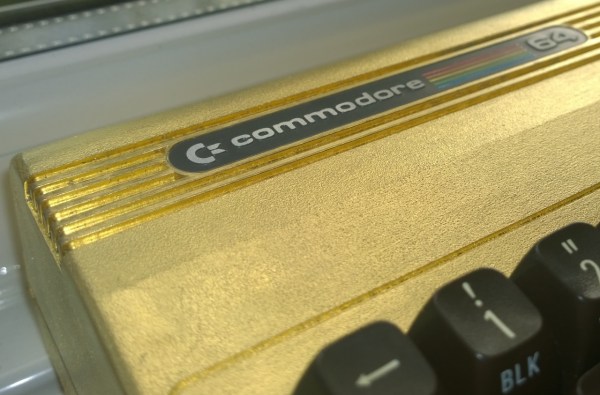
Alright, it’s not gold-plated, it’s gilded. For the uninitiated, gilding is the process of gluing gold powder or gold leaf to an object. Gold is amazingly ductile – a tiny nugget 5mm in diameter can be hammered into a sheet of gold leaf that can cover about a half a square meter. It’s extremely thin and delicate and has to be handled very gingerly, and the gilder’s craft is therefore very meticulous. For more on gilding, see this post on signmaking with gold leaf.

[thefuturewas8bit], who runs a vintage Commodore web store, did a great job gilding a C64 case, just because. The attention to detail is fantastic – notice that even the edges of the keyboard cutouts are gilded and burnished. A nice finishing touch is swapping out the stock red power LED for a yellow one – red simply clashes too much. Lest you think there’s nothing to learn from a purely aesthetic hack, [thefuturewas8bit] shares a great tip for removing the metal badges from a plastic case – spray them with freeze-spray from the back to pop off the glue. No need to dig at them with a screwdriver and gouge or bend them. Nice trick.

Any hack can earn extra points for style, and we think that gold works well on the C64.  But if gold is a little too overstated for you, you can always try to score a colorful new injection-molded case for your vintage Commodore.

Circular Saw + Innovative Fence = Unique DIY Table Saw

A table saw is often the first machine the aspiring woodworker wants for the shop. But even a lightweight contractor’s saw is not cheap, and a really good cabinet saw is both expensive and incredibly heavy. And any table saw is an intimidating machine that can liberate your fingers from your hand in a trice. Looking for a solution to all of these problems, [Seumas] has come up with a unique table saw conversion for a circular saw that improves safety and lowers the barrier to table saw ownership.

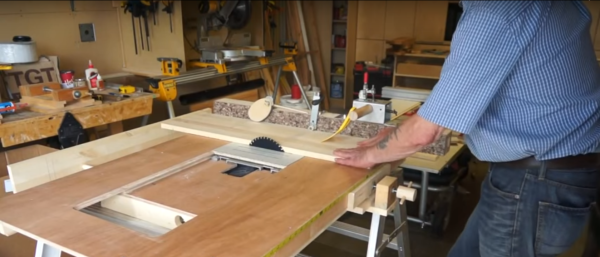
Flipping a low-cost circular saw upside down and attaching it to a table is old hat – we’ve seen plenty of examples of that before, including this recent post. Where [Seumas]’s idea shines is in the integration of the fence and the table. A typical fence needs to stay perfectly parallel to the blade while being dead square to the table, but still needs to be moved to adjust the width of cut. In [Seumas]’s design, the fence is fixed to the table, and the whole table slides left and right on high-pressure laminate rails. In theory, the fence will never go out of true, and the width of cut can be a lot wider than the typical table saw – an impressive 3 feet to the right of the blade.

As for safety, [Seumas] shows off quite a selection of DIY attachments in the video after the break. He builds his own Lexan blade guard, anti-kickback pawls, and stock hold-downs. Add in the little touches like shop-made clamps for locking the table, extending outfeed support, and built-in dust collection, and you can make yourself a pretty capable machine at the fraction of the cost of buying.

Continue reading “Circular Saw + Innovative Fence = Unique DIY Table Saw”

Over-the-top Hackerspace Donation Box Brings Out The Brony In You

“You’ll never believe how this happened, doc.” [Source: CRASH Space]
If you’re going to pass the hat for donations to your hackerspace, you might as well add to the value proposition and give potential donors a little something for their generosity. And what better way to cash in than to channel the inner Brony in your donors with a My Little Pony themed dollar-bill vortex box?

Sick of the boring cheezy-poof jug her hackerspace was using as a donation jar, not-a-Brony [Michelle] was inspired by the CRASH Space mascot Sparkles, pictured left, to build a new box that will maximize donations by providing donors with a multimedia extravaganza. The Plexiglas box, resplendent with laser-cut acrylic hearts and spangled with My Little Pony stickers, is fitted with a sensor so that donations trigger an MP3 of the MLP theme song. A scrolling LED marquee flashes a gracious message of thanks, and to complete the experience, a pair of fans creates a tornado of the fat stacks of cash in the bin.

Putting a little [Twilight Sparkle] into your donation box makes good financial sense, as does providing incentive to deposit bills rather than coins. This project reminds us of our recent post about a custom claw machine which could be leveraged as a value-added donation box – just add a coin slot. And rainbows.

Continue reading “Over-the-top Hackerspace Donation Box Brings Out The Brony In You”

No User Serviceable Parts Inside? The Rise Of The Fix-It Culture

pix-tv-repair-shop
[Source: 1950s Television]
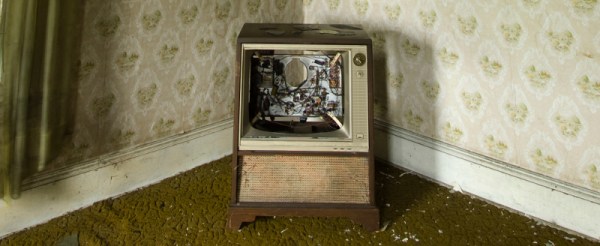
My first job out of high school was in a TV shop. I was hired mainly for muscle; this was the early 1980s and we sold a lot of console TVs that always seemed to need to be delivered to the third floor of a walk up. But I also got to do repair work on TVs and stereos, and I loved it. Old TVs from the 60s and 70s would come in, with their pre-PCB construction and hand-wired chassis full of terminal strips and point to point wiring that must have been an absolute nightmare to manufacture. We’d replace dodgy caps, swap out tubes, clean the mechanical tuners, and sometimes put a new picture tube in  – always the diagnosis that customers dreaded the most, like being told they’d need a heart transplant. We kept those old sets alive, and our customers felt like they were protecting their investment in their magnificent Admiral or Magnavox console with the genuine – and very, very heavy – walnut cabinet.

I managed to learn a lot from my time as a TV repairman, and I got the bug for keeping things working well past the point which a reasonable person would recognize as the time to go shopping for a new one. Fixing stuff is where I really shine, and my house is full of epic (in my mind, at least) repairs that have saved the family tens of thousands of dollars over the years. Dishwasher making a funny noise? I’ll just pull it out to take a look. You say there’s a little shimmy in the front end when you brake? Pull the car into the garage and we’ll yank the wheels off. There’s basically nothing I won’t at least try to fix, and more often than not, I succeed.

I assumed that my fix-it bug made me part of a dying breed of cheapskates and skinflints, but it appears that I was wrong. The fix-it movement seems to be pretty healthy right now, fueled in part by the explosion in information that’s available to anyone with basic internet skills.

Continue reading “No User Serviceable Parts Inside? The Rise Of The Fix-It Culture”