Droideka [Source: Wookieepedia]If ever any sci-fi robot form-factor made more sense than the Droideka of the Star Wars franchise, we’re not sure what it could be. Able to transform from a spheroid that rolls quickly onto the battlefield into a blaster-bristling tripodal walker, the Hollywood battle droid showed a lot of imagination and resulted in a remarkably feasible design. And now that basic design is demonstrated in a spherical quadrupedal robot that can transform from rolling to walking.
Intended as a proof of concept of a hybrid rolling-walking locomotion system, the QRoSS robot from Japan’s Chiba Institute of Technology is capable of some pretty amazing things already. Surrounded by a wire roll cage that’s independent of the robot’s legs, QRoSS is able to roll into position, unfurl its legs, and walk where it needs to go. Four independent legs make it sure-footed over rough terrain, with obvious applications in such fields as urban search and rescue; a hardened version could be tossed into a collapsed building or other dangerous environment and walk around to provide intelligence or render aid. The robot’s self-righting feature would be especially handy for that use case, and as you can see in the video below, it has a powered rolling mode that’s six times faster than its walking speed.
For a similar spherical transforming robot, be sure to check out the MorpHex robot with its hexapod design.
Thanks to the seminal work of Howard and Hanks et al, the world is intimately familiar with the story behind perhaps the most epic hack of all time, the saving of the crippled Apollo 13 mission. But Apollo 13 is far from the only story of heroic space hacks. From the repairs to fix the blinded Hubble Space Telescope to the dodgy cooling system and other fixes on the International Space Station, both manned and unmanned spaceflight can be looked at as a series of hacks and repairs.
Long before the ISS, though, America’s first manned space station, Skylab, very nearly never came to fruition. Damaged during launch and crippled both electrically and thermally, the entire program was almost scrapped before the first crew ever arrived. This is the story of how Skylab came to be, how a team came together to fix a series of problems, and how Skylab went on to success despite having the deck stacked against her from the start.
Heat can be a hacker’s best friend. A little heat can help release a stubborn nut cleanly, and a lot of heat can melt a rusty bolt clean off. An oxy-acetylene torch is handy for these applications, but if you need a more portable setup, and you want enough heat to melt rocks, you might want to look into this field-expedient thermic lance.
Thermic lances have been around a long time in the demolition industry, where cutting steel quickly is a common chore. Commercial thermic lances are just a bundle of steel fuel rods which are set on fire while oxygen is blown down a consumable outer tube. The resulting flame can reach up to 4500°C with impressive results. In need of a similarly destructive device, [NightHawkInLight] came up with a super-simple lance – a small disposable tank of oxygen and regulator, a length of Tygon tubing, and a piece of 5/8″ steel brake line. No need for fuel rods in this design; the brake line provides both fuel and oxygen containment. As you can see in the video below, lighting the little lance without the usual oxy-acetylene torch is no problem – a “wick” of twisted steel wool is all that’s needed to get the torch going. The results are pretty impressive on both steel and rock.
You say you’re fresh out of brake line and still need some “don’t try this at home” action? No problem at all – just hit up the pantry for the materials needed for this tinfoil and spaghetti thermic lance.
Forgot your apartment keys? If you’ve got a ritzy building with a doorman, no problem. If your digs are a little more modest, you might only have an intercom panel that calls up to your apartment so someone can buzz you in. But if nobody is home, you’re out of luck. That’s why [Paweł] spent an hour whipping up an intercom connected automation system pack full of goodies.
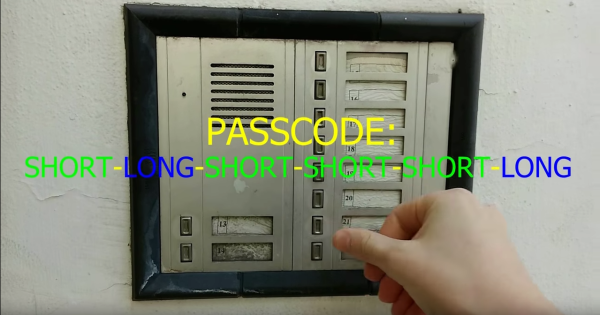
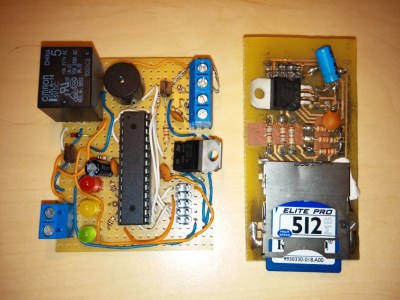
The design is pretty simple – an ATMega328P to snoop on the analog phone ringer in the apartment when the intercom call button is pushed, and a relay wired in parallel with the door switch to buzz him in. For added security, the microcontroller detects the pattern of button presses and prevents unwanted guests from accessing the lobby. Things got really fun when [Paweł] added a PCM audio module to play random audio clips through the intercom. As you can see in the video below, an incorrect code might result in a barking dog or a verbal put-down. But [Paweł] earns extra points for including the Super Mario Bros sound clip and for the mashup of the “Imperial March” with “The Girl from Ipanema”.
True, we’ve seen a slightly more polished but less [Mario] version of this project before, but the presentation of this particular hack has us grinning from ear to ear.
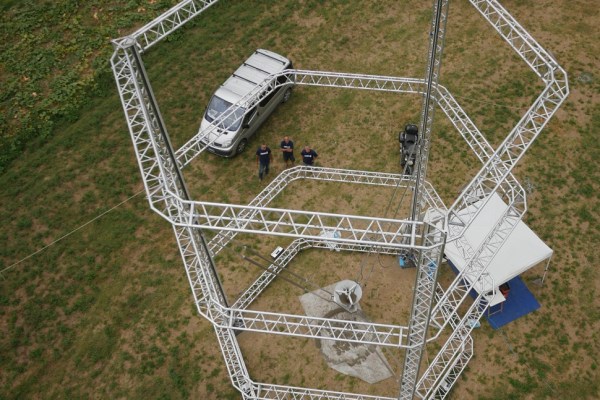
[Massimo Moretti] has a big idea – to build housing on the cheap from locally sourced materials for a burgeoning world population. He also has a background in 3D printing, and he’s brought the two concepts together by building a 12 meter tall delta-bot that can print a house from clay.
The printer, dubbed Big Delta for obvious reasons, was unveiled in a sort of Burning Man festival last weekend in Massa Lombarda, Italy, near the headquarters of [Moretti]’s WASProject. From the Italian-language video after the break, we can see that Big Delta moves an extruder for locally sourced clay over a print area of about 20 square meters. A video that was previously posted on WASProject’s web site showed the printer in action with clay during the festival, but it appears to have been taken down by the copyright holder. Still, another video of a smaller version of Big Delta shows that clay can be extruded into durable structures, so scaling up to full-sized dwellings should be feasible with the 4 meter delta’s big brother.
Clay extrusion is not the only medium for 3D printed houses, so we’ll reserve judgment on Big Delta until we’ve seen it print a livable structure. If it does, the possibilities are endless – imagine adding another axis to the Big Delta by having it wheel itself around a site to print an entire village.
After winning an online auction for an 1980s vintage Compaq Portable PC, [leadacid44] discovered why it only cost him $5USD – the keyboard was shot. Not willing to accept having forked out $45USD to ship a brick, he tore into the ancient machine and came up with a found-material solution to the wonky keyboard.
[leadacid44]’s very detailed writeup of the fix for his Compaq includes a thorough examination of the guts of the machine. He got it to boot to MS-DOS 5.0 off of a 20MB ISA hard drive card and began probing the keyboard problem. It turns out the Compaq keyboard has much in common with a modern touchscreen, in that it’s a capacitive keyboard. Unfortunately the foam disks used as springs under each key cap had degraded over the last 30 years, so [leadacid44] began a quest to replace them. After much experimentation and a few false starts, he created a sandwich of transparency film, closed-cell polyethylene foam, and a Mylar antistatic bag. Many discs were punched out with a leather punch and tediously placed in the body of each key switch, and the quick brown fox was soon jumping flawlessly over the lazy dog.
For most of us, hacking is a hobby, a pleasant diversion from reality. Yes, a lot of us work on projects which have the potential to change the world – witness the 2015 Hackaday Prize semifinalist list. But in general, almost any of us could walk away from the shop at any time without dire consequences. Indeed, that’s the reason a lot of our work benches are littered with projects started with the best of intentions but left unfinished for lack of funds, lack of interest, or lack of time. We’re free to more or less willingly shelve a project and come back to it whenever we please, or not at all.
But not everyone has that luxury. For some people, hacking is much more than a hobby – it’s a means of survival. Sometimes people are thrown into situations where they have to cobble together a solution to an immediate problem with whatever is at hand, when the penalty for failure is much higher than a cluttered bench and a bruised ego. I’ve already covered one such case, where biohacked insulin saved hundreds of lives in occupied Shanghai in WWII.
In this occasional series I’ll explore historical cases where hacking really counted; cases where lives were saved or improved by a hack performed under desperate conditions.
A Bustle in the Hedgerow
Unsurprisingly, war offers a lot of opportunities for field expedient solutions under dire circumstances, and battlefield conditions might be the most extreme example of hacking when it counts.
In the early days of the Invasion of Normandy during WWII, Allied forces were having a difficult time dealing with the bocage terrain of northern France. A mixture of pasture and woodland, the Normandy bocage was a natural killing field for Allied tanks because the woodlands took the form of hedgerows – earthen dikes topped with thick tangles of brush. Hedgerows separated pastures and kept livestock controlled, but also made things tough on infantry and mechanized cavalry alike. Climbing the steep hedgerows exposed the vulnerable bottom hull of the tanks to enemy fire, and waiting for engineers to demolish the hedgerows with explosive made them sitting ducks for German artillery. The Allied advance was seriously hampered by the hedgerows, and both men and materiel were being winnowed down from fixed German positions chosen specifically to take advantage of the bocage terrain.
Enter Sgt. Curtis Grubb Culin III. Sgt. Culin, a tanker himself, was acutely aware of how vulnerable he was in his Sherman M4. The hedgerows were the problem, one apparently known to Allied command prior to the invasion for which no provision had been made. In the tradition of soldiers at the front of every battle throughout history, Sgt. Culin and his fellow tankers had to improvise a solution.
While kicking around ideas, one of the men suggested setting saw teeth on the front of a tank to cut through the hedgerows. He later attributed the comment to “A Tennessee hillbilly named Roberts”, and it was met with general laughter from the group as a crackpot scheme. But Sgt. Culin saw the potential in the idea, and began to develop it into a prototype.
Raw materials for his prototype were not hard to come by. Czech hedgehogs, giant anti-tank barriers made of crossed steel beams, still littered the Normandy beaches. The failed German defenses were harvested with a cutting torch and welded to the underside of a tank to form a series of “tusks” across the hull between the tracks. Equipped with these tusks, the tank could now blast through the tangled roots of the brush-covered earth of the hedgerow dykes.
When demonstrated for General Omar Bradley, he was impressed enough to order them built in quantity for the tanks. Eventually the prototype became an engineered product (dubbed the “Culin Rhino Device”) that was fitted to many tanks before being shipped over from England. Rhino-equipped tanks ripped across Normandy and shredded the German battle plan, which assumed the hedgerows would funnel Allied forces through heavily defended chokepoints.
Without Sgt. Culin’s battlefield hack, and his inspiration by a hillbilly named Roberts whom history otherwise forgets, the invasion of Europe might have taken a very different course. The fact that he did the hack while under fire makes it all the more impressive, and is a perfect example of hacking when it counts.
Know of any more examples of hacking when it counts? Send us a tip for use in a future Hacking When it Counts article.





 The design is pretty simple – an ATMega328P to snoop on the analog phone ringer in the apartment when the intercom call button is pushed, and a relay wired in parallel with the door switch to buzz him in. For added security, the microcontroller detects the pattern of button presses and prevents unwanted guests from accessing the lobby. Things got really fun when [Paweł] added a PCM audio module to play random audio clips through the intercom. As you can see in the video below, an incorrect code might result in a barking dog or a verbal put-down. But [Paweł] earns extra points for including the Super Mario Bros sound clip and for the mashup of the “Imperial March” with “The Girl from Ipanema”.