Full Size Custom Claw Machine Built With Parts On Hand

You know how it goes – sometimes you look at your social calendar and realize that you need to throw together a quick claw machine. Such was the dilemma that [Bob Johnson] found himself in during the run-up to the Nashville Mini Maker Faire, and he came up with a nice design that looks like fun for the faire-goers.

Seeking to both entertain and enlighten the crowd while providing them with sweet, sweet candy, [Bob] was able to quickly knock together a claw machine using mainly parts he had on hand in the shop. The cabinet is nicely designed for game play and to show off the gantry mechanism, which uses aluminum angle profiles and skate bearings as custom linear slides. Plenty of 3D printed parts found their way into the build, from pillow blocks and brackets for the stepper motors to the servo-driven claw mechanism. A nice control panel and some color-coded LED lighting adds some zip to the look, and a Teensy LC runs the whole thing.

Like [Bob]’s game, claw machines that make it to Hackaday seem to be special occasion builds, like this claw machine built for a kid’s birthday party. Occasion or not, though, we think that fun builds like these bring the party with them.

Continue reading “Full Size Custom Claw Machine Built With Parts On Hand”
Traffic Light Tells You If The Internet Is Up

Some of us are not blessed with an always on, high availability internet connection. Sick of answering the constant “Is the internet up?” questions, go-to IT support dude [PatH] took matters into his own hands and developed an unmistakable traffic light display of internet status for his apparently low-reliability connection.

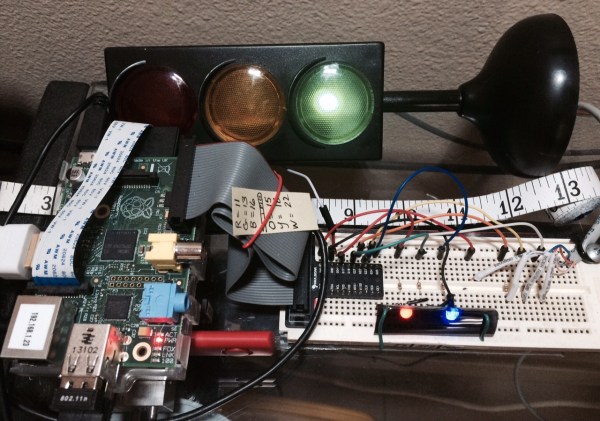
A toy traffic light from Amazon forms the core of the UI, and the lights are driven by a Raspberry Pi that pings a suite of 10 sites in round robin fashion. If a site is found to be unavailable, the Pi goes into “deep probe” mode to determine the extent of the outage, and lights up accordingly. If the light is green, the connection’s clean; if it lights up red, best go to bed. As a bonus, logs are kept of all deep probes, which may prove useful for diagnosing ISP issues.

A display like this could go a long way toward making sure you stay connected, and can reduce the workload for you as de facto IT support. Of course for a little more information about the connection speed with retro styling, you might want to throw a Dekatron at the job.

Smart Phone Camera Turns Laser Cutter Into Hi-Res Scanner

Getting decent macro photos always seems to be a chore. Some important detail always seems to be just outside of the depth of field, or you have to be zoomed in so close that you get great detail in one spot but miss the big picture. [Nate B] had such a problem while trying to document some PC boards, and he came up with a nifty hack that uses a laser cutter and a smart phone camera to do the job.

Pv150a-front
Click for detail.

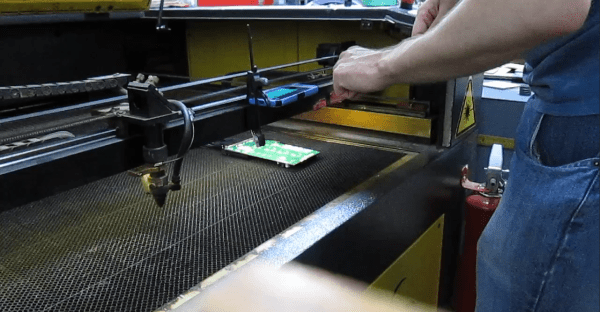
Having first tried scanning the boards with a flat-bed scanner but finding the depth of field unsatisfactory, [Nate B] then went on to his Samsung phone’s camera. Set to panorama mode, he manually scanned across the boards and let the camera stitch the images together. The results were better, but the wobblies got the better of him and the images showed it. He then decided to use a laser cutter — with the laser disabled, of course — as an impromptu X-Y stage to raster his camera above the boards. In a slightly cringe-worthy move, he gingerly clamped the phone to the cutter gantry, started the panorama, and let the cutter move over the board. This results in a rock-solid pictures of his boards with a lot of detail – perfect for his documentation. As a bonus, the honeycomb laser cutter bed makes for an interesting background texture.

Obviously anything could be used to raster a camera and achieve similar results, but full points here for maximizing available resources and not over-complicating a simple job. Yet another reason you can use to justify that laser-cutter purchase.

Continue reading “Smart Phone Camera Turns Laser Cutter Into Hi-Res Scanner”

How Biohackers Are Fighting A Two-front War On Antibiotic Resistance

We humans like to think of ourselves as the pinnacle of evolution on the planet, but that’s just a conceit. It takes humans roughly twenty years to reproduce, whereas some bacteria can make copies of themselves every 20 minutes. Countless generations of bacteria have honed and perfected their genomes into extremely evolved biological machines.

Most bacteria are harmless, and some are quite useful, even tasty – witness the lactofermented pickles and sauerkraut I made this summer. But some bacteria are pathogenic nightmares that have swarmed over the planet and caused untold misery and billions of deaths. For most of human history it has been so – the bugs were winning. Then a bright period dawned in the early 20th century – the Era of Antibiotics. At last we were delivered from the threat of pestilence, never more to suffer from plague and disease like our unfortunate ancestors. Infections were miraculously cured with a simple injection or pill, childhood diseases were no longer reaping their tragic harvest, and soldiers on the battlefield were surviving wounds that would have festered and led to a slow, painful death.

Now it seems like this bright spot of relief from bacterial disease might be drawing to an end. Resistant strains of bacteria are in the news these days, and the rise of superbugs seems inevitable. But is it? Have we run out of tools to fight back? Not quite yet as it turns out. But there’s a lot of work to do to make sure we win this battle.

Continue reading “How Biohackers Are Fighting A Two-front War On Antibiotic Resistance”

Scanning Electron Microscope Images And Animations Pulled By Impressive Teensy LC Setup

When you’ve got a scanning electron microscope sitting around, you’re going to find ways to push the awesome envelope. [Ben Krasnow] is upping his SEM game with a new rig to improve image capture (video link) and more easily create animated GIFs and videos.

The color scheme of the SEM housing gives away its 80s vintage, and the height of image capture technology back then was a Polaroid camera mounted over the instrument’s CRT. No other video output was provided, so [Ben] dug into the blueprints and probed around till he found the high-resolution slow scan signal.

To make his Teensy-LC happy, he used a few op-amps to condition the analog signal for the greatest resolution and split out the digital sync signals, which he fed into the analog and digital ports respectively. [Ben] then goes into a great deal of useful detail on how he got the video data encoded and sent over USB for frame capture and GIF generation. Reading the ADC quickly without jitter and balancing data collection with transmission were tricky, but he has established a rock-solid system for it.

Continue reading “Scanning Electron Microscope Images And Animations Pulled By Impressive Teensy LC Setup”

Slimline USB Charger For Tiny Ham Radios

The recent trend to smaller and smaller handy talkie (HT) transceivers is approaching the limits of the human interface. Sure, engineers could probably continue shrinking the Baofeng and Wouxun HTs further, but pretty soon they’ll just be too small to operate. And it’s getting to the point where the accessories, particularly the battery charging trays, are getting bulkier than the radios. With that in mind, [Mads Hobye] decided to slim down his backpacking loadout by designing a slimline USB charger for his Baofeng HT.

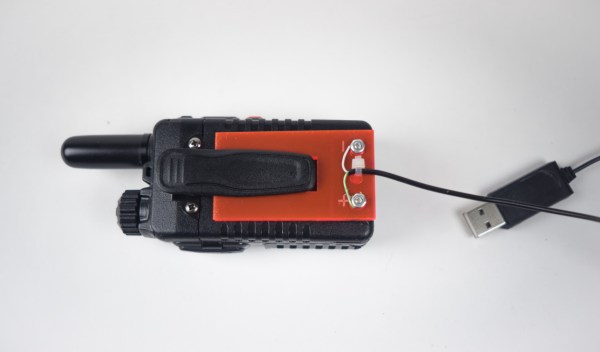
Lacking an external charging jack but sporting a 3.7 volt battery pack with exposed charging terminals on the rear, [Mads] cleverly capitalized on the belt clip to apply spring tension to a laser-cut acrylic plate. A pair of bolts makes contact with the charging terminals on the battery pack, and the attached USB cable allows him to connect to an off-the-shelf 3.7 volt LiPo USB charger, easy to come by in multicopter circles. YMMV – the Baofeng UV-5R dual-band HT sitting on my desk has a 7.4 volt battery pack, so I’d have to make some adjustments. But you have to applaud the simplicity of the build and its packability relative to the OEM charging setup.

This isn’t the first time we’ve seen [Mads] on Hackaday. He and the FabLab RUC crew were recently featured with their open-source robotic arm.