TIME’s Best Inventions Of 2008

tesla

Attempting to put our past behind us as quickly as possible, TIME has released what they feel are the best inventions of 2008. While there’s some pretty wishy-washy lab-only stuff on the list, we’re glad to see a lot of cool hardware made the cut. Some of our favorites are: The Tesla roadster proving electric cars can be fun. IBM breaking the petaflop barrier with LANL’s Roadrunner. The Large Hadron Collider for getting everyone scared about physics all over again. Have a look at the list for many other tech highlights from this year.

New WPA TKIP Attack

wifibox

[Martin Beck] and [Erik Tews] have just released a paper covering an improved attack against WEP and a brand new attack against WPA(PDF). For the WEP half, they offer a nice overview of attacks up to this point and the optimizations they made to reduce the number of packets needed to approximately 25K. The only serious threat to WPA so far has been the coWPAtty dictionary attack. This new attack lets you decrypt the last 12 bytes of a WPA packet’s plaintext and then generate arbitrary packets to send to the client. While it doesn’t recover the WPA key, the attacker is still able to send packets directly to the machine they’re attacking and could potentially read back the response via an outbound connection to the internet.

[photo: niallkennedy]

[via SANS]

Weasure, A Scale That Weighs And Measures

weasure

[John Peterson] created this postal scale device for a Renesas design contest. The Weasure not only calculates the package’s total weight but the dimensions as well. He built it using a SKP16C62P evaluation board that had an LCD, pushbuttons, and indicator LEDs. The original DigiWeigh parcel scale was modified to provide PWM output and tare control. He embedded photoresistors every inch along each axis. They were angle slightly upward and the surroundings were painted black to minimize reflection. The Weasure outputs everything via a serial connection so it can be used with shipping software to generate postage.

How To Destroy A Filesystem

rmrf

The G1 ‘execute every command you type‘ bug naturally spawned ‘rm -rf /’ jokes. rm is the Linux command for deleting files. The -r and -f flags will cause it to remove files recursively and ignore confirmation. Executed as root it will annihilate the entire filesystem. Won’t it? [Jon Hohle] decided to test exactly how destructive the command was to *nix systems. How functional would the system be afterwards? He tested it side by side with the Windows equivalent, both ‘format c:’ and ‘del /F /S /Q’. He wanted to see what protections were available and what would be left working. Linux ended up completely broken while Windows, thanks to file locking, actually shutdown cleanly… and never came back. Some OSes, like Solaris, refuse to run the command ‘rm -rf /’ to prevent accidents.

LED Menorahs

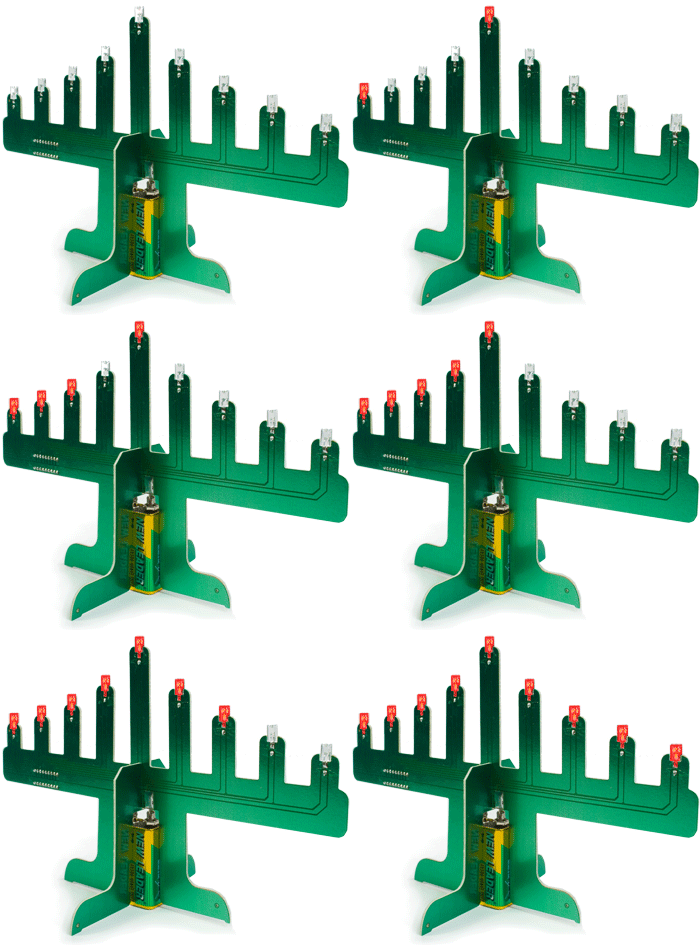
We’re barely past Halloween and people are already working on their next LED based holiday decorations. For Hanukkah, Gizmodo pointed out the PCB menorah pictured above. It uses a set of DIP switches to control which LEDs are lit. A couple years ago, Evil Mad Scientist Laboratories put together a tutorial for building a more minimal LED menorah. Each of the nine LEDs are soldered directly to the legs of an ATtiny2313 microcontroller. Every time you power up the device an additional LED is lit. [Ori] liked the project and decided to take a slightly different approach. He used an LM3914 DIP18 LED bar driver. A potentiometer controls how many of the LEDs are illuminated.

Android Executes Everything You Type

g1

This is one of the more bizarre bugs we’ve ever heard. The T-Mobile G1 has an open root shell that interprets everything you type as a command. It was discovered when a user just happened to type the word ‘reboot’ in a conversation and the phone immediately rebooted. A patch has already been rolled out to fix this issue. It also buttons up the earlier telnetd SUID problem.

[photo: tnkgrl]

PCjr 25 Years Later

pcjr

[Trixter], connoisseur of old hardware, is celebrating the 25th anniversary of the PCjr. IBM’s PCjr was killed only 18th months after being revealed and [Trixter] lays out exactly why. Overall, it was designed to be cheap to produce and sell, but many of the choices made it difficult to use. They used the CPU instead of DMA for floppy access; cheaper to make, but you couldn’t do much during disk reads because of it. The video memory scheme left little room for programs that could take advantage of it. It also had compatibility issues that made IBM clones a more attractive choice. [Trixter] ends by pointing out that some good came of it when the Tandy 1000 copyied the good ideas while leaving out the restrictive memory issues. He recommends Mike’s PCjr Page for more information on this classic machine.