Tour De Force Battery Hacking

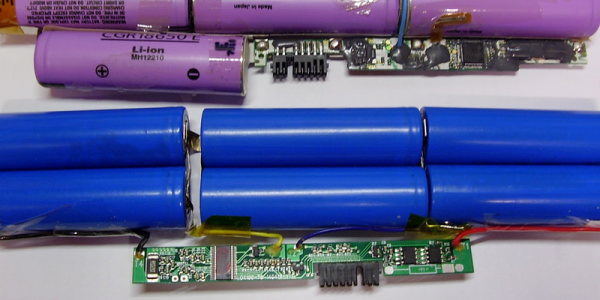
Lithium-Ion batteries are finicky little beasts. They can’t be overcharged, overdischarged, overheated, or even looked at funny without bursting into flames. Inside any laptop battery pack, a battery charge controller keeps watch over all the little cells, and prevents them from getting damaged.

Of course, any “smart” device will sometimes make the wrong choices, and then it’s up to us to dig inside its brains and fix it. When [Viktor] got a perfectly good battery pack with a controller that refused to charge the batteries, he started off on what would become an epic journey into battery controllers, and the result is not just a fixed battery, but a controller-reprogramming tool, software, and three reversed controller chips so far.
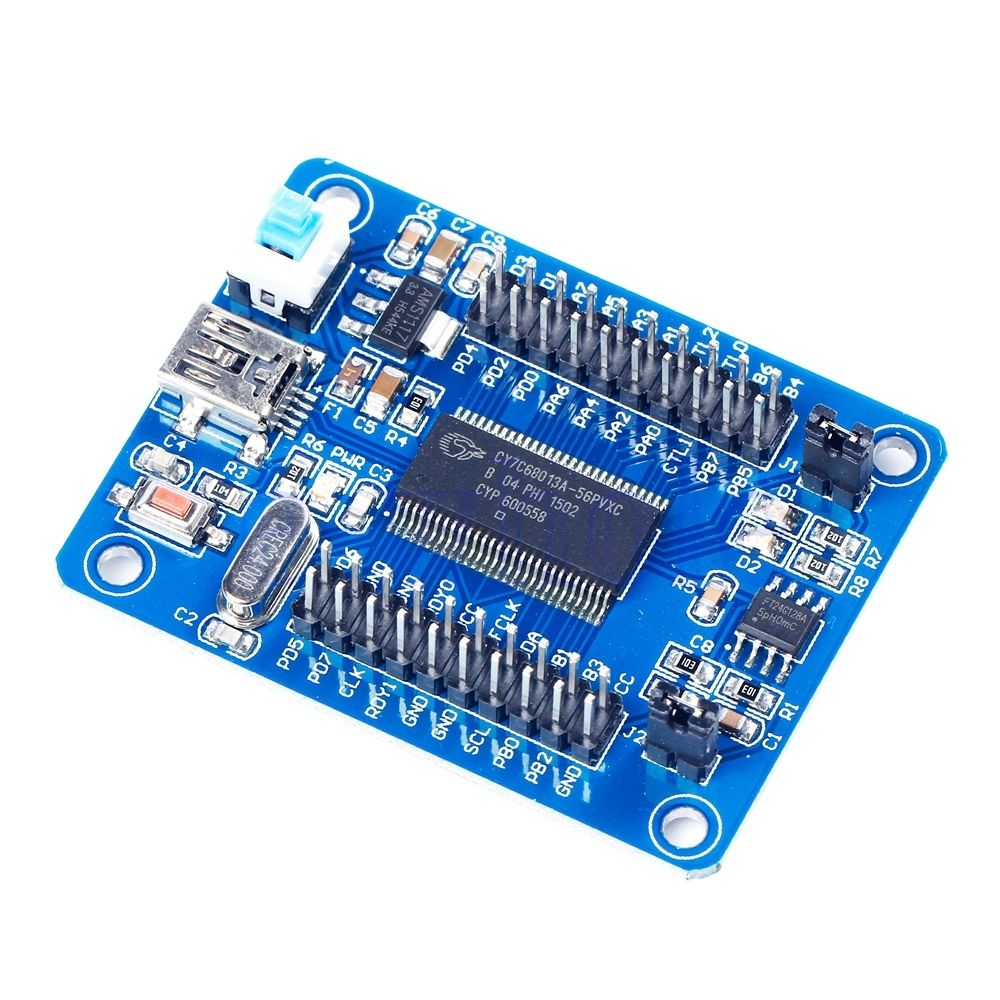
devbBattery controller chips speak SMBus, and [Viktor] started out by building a USB-SMBus tool. It’s a clever use of a cheap eBay development board for a Cypress CY7C68013A USB microcontroller. Flashed with [Viktor]’s firmware and running his software on the host computer, a SMBus scan is child’s play.

The rest of the story is good old-fashioned hacking: looking for datasheets, reading industry powerpoints, taking wild guesses, googling for passwords, and toggling the no-connect pins while booting the controllers up. We’re not going to argue with results: the bq8030, R2J240, and M37512 controllers have all given up their secrets, and tools to program them have been integrated into [Viktor]’s SMBusb tool.

In short, this is one of the nicest hard-core hacks we’ve seen in a while. Kudos [Viktor]! And thanks for the SMBus tool.
Amazon Dash Button Finds Your Phone

This scene replays quite often in our house: my wife has misplaced her cell phone so she asks me to call her. But where did I leave my cell phone? And the race is on! Who will find their phone first to call the other?

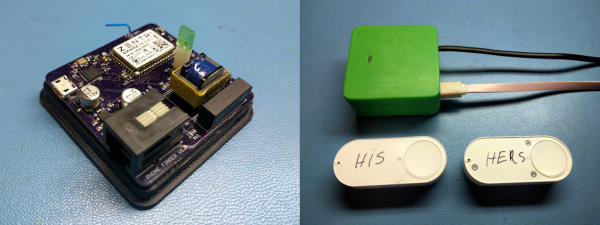
[Zapta] solves this problem with his Phone Finder. The system comes in two parts: a base station with WiFi that’s also connected to the house’s phone line, and an arbitrary number of Amazon Dash buttons that trigger dialing commands.

[Zapta] presses a Dash button, which connects over WiFi to the base station. The base station recognizes the MAC address of the button, looks up and dials the corresponding missing cell phone. This solves the need-a-phone-to-find-a-phone problem very neatly, and since Dash buttons are dirt cheap they can be scattered liberally around the house. They’re clearly marked “his” and “hers” suggesting a similar domestic dynamic.

If we were implementing the base station from scratch, we’d probably try to figure out how a single ESP8266 could do all of the heavy lifting, but browsing through [Zapta]’s GitHub and the included circuit diagram (PDF) demystifies the phone-line interface.

In the early days of cordless phones, we used to joke that a solution to losing them would be to attach a string and tie them to the wall. (Luddites!) We’re glad to see [Zapta] take this project in the opposite direction — using technological overkill to solve the unintended problems that arise from technological progress.

Fixing The Ampere: Redefining The SI Unit

We all know that it’s not the volts that kill you, it’s the amps. But exactly how many electrons per second are there in an amp? It turns out that nobody really knows. But according to a press release from the US National Institute of Standards and Technology (NIST), that’s all going to change in 2018.

The amp is a “metrological embarrassment” because it’s not defined in terms of any physical constants. Worse, it’s not even potentially measurable, being the “constant current which, if maintained in two straight parallel conductors of infinite length, of negligible circular cross-section, and placed 1 meter apart in vacuum, would produce between these conductors a force equal to 2 x 10⁻⁷ newton per meter of length.” You can’t just order a spool of infinite length and negligible cross-section wire and have it express shipped.

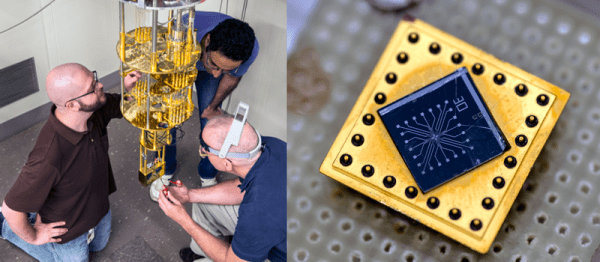
So to quantify the exact number of electrons per second in an amp, the folks at NIST need an electron counter. This device turns out to be a super-cooled, quantum mechanical gate that closes itself once an electron has passed through. Repeatedly re-opening one of these at gigahertz still provides around a picoamp. Current (tee-hee) research is focused on making practical devices that push a bit more juice. Even then, it’s likely that they’ll need to gang 100 of these gates to get even a single microamp. But when they do, they’ll know how many electrons per second have passed through to a few tens of parts per billion. Not too shabby.

We had no idea that the amp was indirectly defined, but now that we do, we’re looking forward to a better standard. Thanks, NIST!

Thanks [CBGB123B] for the tip!

HF-Powered Drone Antenna

Amateur radio has a couple of sweet allocations in the VHF bands, but because the signals don’t reflect off the ionosphere like shortwave signals, the use is limited basically to line-of-sight. One workaround is to use a repeater with a tall antenna, but that requires a lot of infrastructure or a mountainside lair.

fpv

What if you could just fly your antenna up in a drone? Well, for starters, you’d run out of batteries pretty quickly unless you could power it remotely. And if you try to tether it, the supply wires end up being too heavy to lift. Or do they?!?!

Continue reading “HF-Powered Drone Antenna”

Charliplexed 7-Segment Display Takes Advantage Of PCB Manufacturers

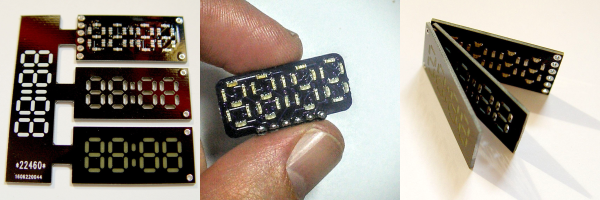
Cutting out precise shapes requires a steady hand, a laser cutter, or a CNC mill, right? Nope! All you need is PCB design software and a fabrication facility that’ll do the milling for you. That’s the secret sauce in [bobricius]’s very pleasing seven-segment display design.

His Hackaday.io entry doesn’t have much detail beyond the pictures and the board files, but we’re not sure we need that many either. The lowest board in the three-board stack has Charlieplexed LEDs broken out to six control pins. Next up is a custom-routed spacer board — custom routed by the PCB house, that is. And the top board in the stack is another PCB, this one left clear of copper where the light shines out.

We want to see this thing lit up! We’ve played around with using PCB epoxy material as a LED diffuser before ourselves, and it can look really good. The spacers should help even out the illumination within segments, while preventing bleed across them. Next step? A matrix of WS2812s with custom-routed spacers and diffusers. How awesome would that be?

All About Biosignals

DIY medical science is fun stuff. One can ferret out many of the electrical signals that make the body run with surprisingly accessible components and simple builds. While the medical community predictably dwells on the healthcare uses of such information, the hacker is free to do whatever he or she wants.

A good first start is to look at the relatively strong electrical signals coming off of the heart and other muscles. [Bernd Porr] has put together a simple bioamplifier circuit, and his students have made a series of videos explaining its use that’s well worth your time if you are interested in these things.
Continue reading “All About Biosignals”

RGB LEDs: How To Master Gamma And Hue For Perfect Brightness

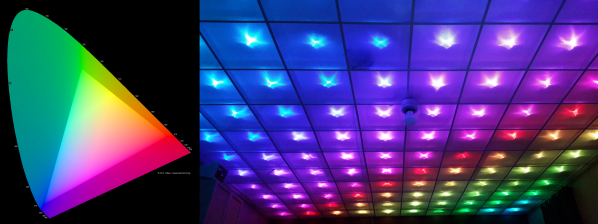
You would think that there’s nothing to know about RGB LEDs: just buy a (strip of) WS2812s with integrated 24-bit RGB drivers and start shuffling in your data. If you just want to make some shinies, and you don’t care about any sort of accurate color reproduction or consistent brightness, you’re all set.

But if you want to display video, encode data in colors, or just make some pretty art, you might want to think a little bit harder about those RGB values that you’re pushing down the wires. Any LED responds (almost) linearly to pulse-width modulation (PWM), putting out twice as much light when it’s on for twice as long, but the human eye is dramatically nonlinear. You might already know this from the one-LED case, but are you doing it right when you combine red, green, and blue?

It turns out that even getting a color-fade “right” is very tricky. Surprisingly, there’s been new science done on color perception in the last twenty years, even though both eyes and colors have been around approximately forever. In this shorty, I’ll work through just enough to get things 95% right: making yellows, magentas, and cyans about as bright as reds, greens, and blues. In the end, I’ll provide pointers to getting the last 5% right if you really want to geek out. If you’re ready to take your RGB blinkies to the next level, read on!

Continue reading “RGB LEDs: How To Master Gamma And Hue For Perfect Brightness”