Where You Are Influences What You Invent

[Timon] just bought a new PCB holder setup for his desk. It’s one of those spring-loaded jobbies that uses strong magnets to hold it up off of a work surface, and is made of metal so that you can reflow solder with it. It might be a clone of the PCBite, but frankly I’ve seen similar projects everywhere — it’s hard to say who is copying whom these days. And anyway, that’s not the point.
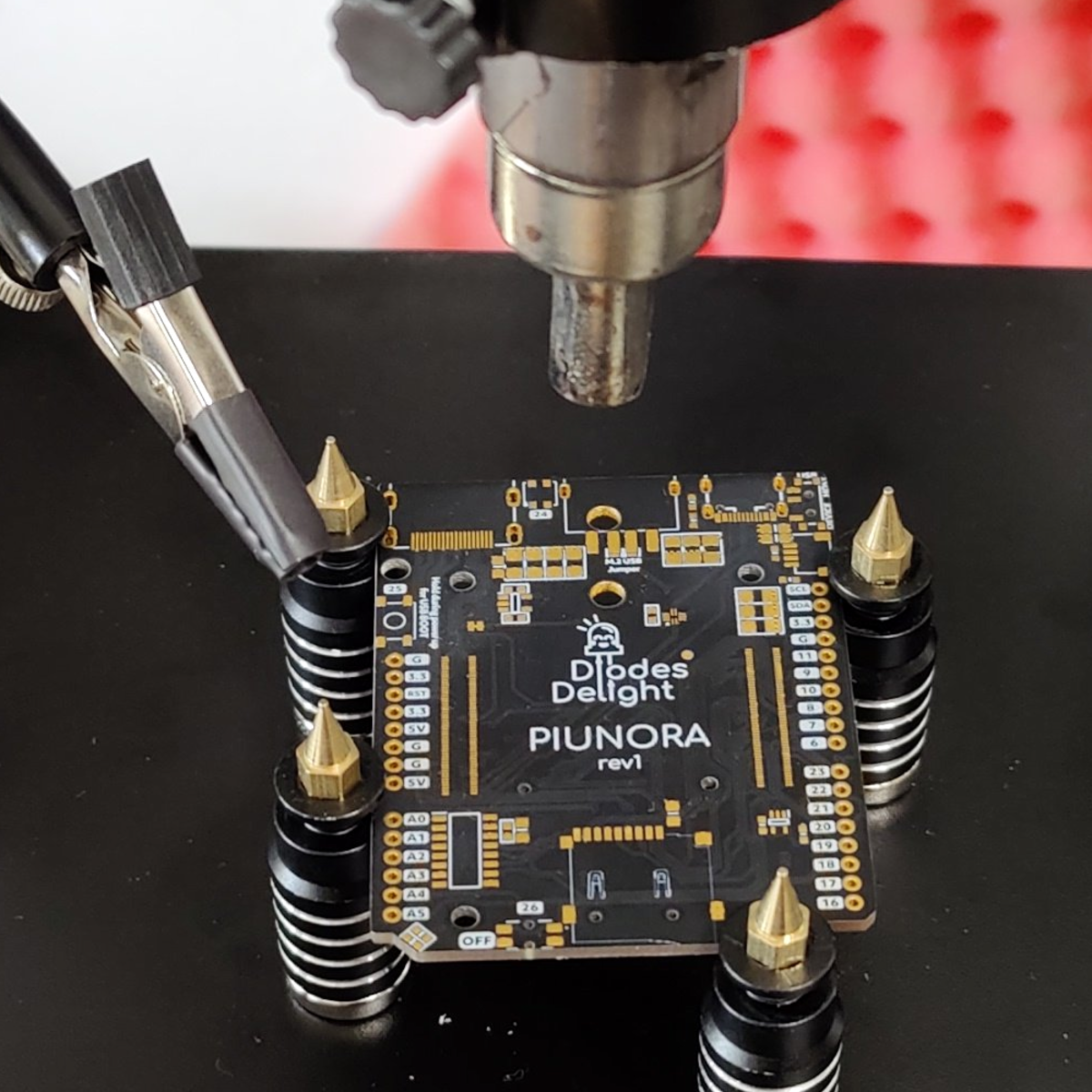
What struck me about the holders was their tops: they’re repurposed 3D printer nozzles. That’s a fantastic idea because they’re non-magnetic, heat tolerant, relatively uniform, and probably dirt cheap in Shenzhen, where the designer of this board almost certainly lives. Maybe he or she even works in a 3D printer factory? Who knows? But the designer almost certainly looked around for something that would fit the bill, and found the nozzles.

Indeed, there’s been a lot of innovation in all things board-holding coming out of China over the last decade. I can remember when the state of the art was a vise-like affair. (I still like my homebrew Stickvise clone for low, square jobs.)

But with cell phone repairs requiring the ability to hold and reflow ever stranger board shapes, there’s been a flourishing of repositionable holders. The pawn-pillar designs are cool, but their utility rests firmly in how strong the magnets are. (I wouldn’t buy the one linked, for instance, without trying it first-hand.) I really like the look of these jobbies, which have springs to maintain tension. (Will the 3D-printed plastic jaws hold up to multiple reflows?) Anyway, it’s no coincidence that the inventors of these devices are in the cellphone-repair capital of the universe.

The old saying is that necessity is the mother of invention. But what if, like with real estate, it’s location, location, location? You dream up solutions to problems around you, using parts that you’ve got on-hand. If that sounds a little fatalistic, consider that you can also change your surroundings, either physical or even virtual. Are you in the middle of the right challenges and opportunities?


Hackers And China

The open source world and Chinese manufacturing have a long relationship. Some fifteen years ago, the big topic was how companies could open-source their hardware designs and not get driven bankrupt by competition from overseas. Companies like Sparkfun, Adafruit, Arduino, Maple Labs, Pololu, and many more demonstrated that this wasn’t impossible after all.

Maybe ten years ago, Chinese firms started picking up interesting hacker projects and producing them. This gave us hits like the AVR transistor tester and the NanoVNA. In the last few years, we’ve seen open-source hardware and software projects that have deliberately targeted Chinese manufacturers, and won. We do the design and coding, they do the manufacturing, sales, and distribution.

But this is something else: the Bangle.js watch takes an essentially mediocre Chinese smartwatch and reflashes the firmware, and sells them as open-source smartwatches to the general public. These pre-hacked watches are being sold on Kickstarter, and although the works stands on the shoulders of previous hacker’s reverse engineering work on the non-open watch hardware, it’s being sold by the prime mover behind the Espruino JavaScript-on-embedded language, which it runs on.

We have a cheap commodity smartwatch, being sold with frankly mediocre firmware, taken over by hackers, re-flashed, re-branded, and sold by the hackers on Kickstarter. As a result of it being (forcibly) opened, there’s a decently sized app store of contributed open-source applications that’ll run on the platform, making it significantly more useful and hacker friendly than it was before.

Will this boost sales? Will China notice the hackers’ work? Will this, and similar projects, end up in yet another new hacker/China relationship? We’re watching.

Meet The Winners Of The Hackaday Prize Round Four: Redefine Robots

The judges’ ballots are in and we’re proud to present the ten winners of the fourth round of the 2021 Hackaday Prize. We love robots, and it’s obvious that you do too!  The number and range of projects submitted this year were overwhelming.

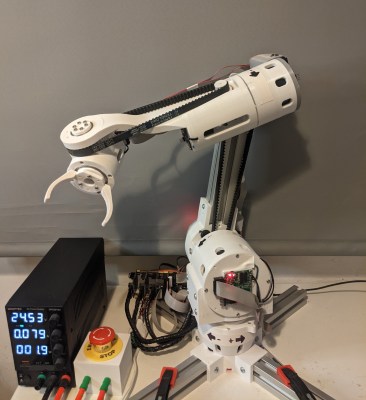
No robotics round is complete without a robot arm, and while a few of them were in the finals, we especially liked CM6, which really pulled out all the stops. This is research-grade robotics on a not-quite-student budget, featuring custom compliant mechanisms so that it can play well with its fleshy companions.

With six degrees of freedom, and six motors, the drivetrain budget can quickly get out of hand on builds like these, so we’re especially happy to see custom, open, brushless-motor driver boards used to reduce the cost of admission. Even if you’re not going to make a 100% faithful CM6 clone, you’ll learn a lot just from going through the build. Oh, and did we mention it has a software stack? Continue reading “Meet The Winners Of The Hackaday Prize Round Four: Redefine Robots”

Get Yer Halloween On!

Halloween is basically built for the hacker. Besides the obvious fabrication of absurd costumes, there’s also the chance to showcase your skills, be they mechanical, audio, or video. It’s also a great time to show off our coolest tricks to inspire the young proto-hackers. If you need inspiration, we’ve got 150 ideas.

[Brankly]’s Candy Dispenser
My personal problem with Halloween, though, is that I always start at the last minute, and my ideas far outreach my time budget. Or because it’s all done in the last minute, a whole bunch of ideas that should “just work” in theory run into the immovable object that is practice. At least that’s what happened with last year’s spooky sound effects — my son and I spent so much time collecting and recording scary audio samples that I ran out of time while still getting the sensitivity on the motion detector set just right, and then the battery died halfway through the night.

But this year will be different, I swear! I’m going to get it done early and test it out, with the luxury of time to debug the inevitable spiders. And you can swear too. Get started now on your Halloween project. Or at least next weekend.

What’s your favorite Halloween Hack?

Contests

If you need any more encouragement to fire up your black and orange hacking machine, think of Hackaday.io’s Halloween Hackfest. It runs until Oct 28, and all you have to do to enter is document your Halloween project on IO and press the “Submit” button. The deadline is the 28th, which still gives you a couple of nights to debug whatever didn’t work before the real deal. Prizes are shopping sprees at Digi-Key, and Adafruit is doubling the gift certificate if you use any Adafruit parts in the build.

If you don’t give a pumpkin about stupid ol’ Halloween, that’s cool too. (Grinch!) The 2021 Hackaday Prize has entered the final wildcard round. If your project didn’t fit in any of the previous categories, I’m pretty sure it’ll fit just fine in the anything-goes phase. Go nuts. We’d love to see what you’re working on.

Embrace The New, But Don’t Forget The Old

We were trading stories of our first self-made PCBs in the secret underground Hackaday bunker, and a couple of the boards looked really good for first efforts. Of course there were mistakes and sub-optimal routing, but who among us never connects up the wrong signals or uses a bad footprint? What lead me to have a hacker “kids these days have it so easy” moment was that all of the boards were, of course, professionally fabbed with nice silkscreens. They all looked great.

What a glorious time to be starting down the hardware path! When I made my first PCB, the options were basically laying down tape, pulling out the etch resist pen, or paying a bazillion inflation-adjusted dollars for a rapid prototype board. This meant that the aspiring hacker also had to have a steady hand and be at least casually acquainted with a little chemistry. The ability to just send your files out to a PCB house means that the barrier to stepping up your hardware game from plug-them-together modules is lower than it’s ever been.

But if scratching or etching your own PCB out of copper plate is very hands-on, very DIY, and very low-tech, it’s also very fast in comparison to even the most rushed service. Last weekend, I needed a breakout board for some eight-pin SOIC H-bridge chips for a turtle robot project with my son. Everything was hand-soldered and hot-glued in a Saturday afternoon and evening, so there was no time for a PCB order. A perfect opportunity for the Old Ways™.

We broke out a Sharpie, traced out where the SOIC pins would land, connected up the grounds, brought the signals out to friendly pads, and then covered the rest of the board in islands of copper just in case we’d need any prototyping space later. Of course, some of the ink lines touched each other where they shouldn’t, but before the copper meets the etchant it’s easy enough to scrape the spaces clear with a pin. The results? My boards look like they were chiseled out by a caveman, but they worked. And more importantly, we got it done within the attention span of a second grader without firing up a computer.

So revel in your cheap offshore PCB factories, hackers of today! It’s a miracle that even four-layer boards come back within a week without breaking the bank. But I encourage you all to try it out by hand as well. For large enough packages and one-offs, full DIY absolutely has the speed advantage, but there’s also a certain wabi sabi to the hand-drawn board. Like brush strokes in residual copper.

Finding The Right Hack Is Half The Battle

Sometimes you just get lucky. I had a project on my list for a long time, and it was one that I had been putting off for a few months now because I loathed one part of what it entailed — sensitive, high-accuracy analog measurement. And then, out of the blue I stumbled on exactly the right trick, and my problems vanished in thin air. Thanks, Internet of Hackers!

The project in question is a low-vacuum regulator for “bagging” fiberglass layups. What I needed was some way to read a pressure sensor and turn on and off a vacuum pump accordingly. The industry-standard vacuum gauges are neat devices, essentially a tiny little strain gauge on a membrane between the vacuum side and the atmosphere side, in a package the size of a dime. (That it’s a strain gauge is foreshadowing, but I didn’t know that at the time.) I bought one for $15 ages ago, and it sat on my desk, awaiting its analog circuitry.

See, the MPX2100 runs on 12 V and puts out a signal around 40 mV on top of a 6 V offset. That voltage level is inconvenient for modern 3.3 V microcontroller ADCs, and the resolution would get clobbered by the 6 V signal if I just put a voltage divider on it. This meant whipping together some kind of instrument amplifier circuit to null out the 6 V and amplify the 40 mV for the ADC. The circuits I found online all called for 1% resistors in values I didn’t have, and mildly special op-amps. No fun, for me at least. So there it sat.

Picture of sketchy-looking vacuum apparatus.
Cut the blue wire or the red wire? HX711 module and pressure sensor on the left.

Until I ran into this project that machetes through the analog jungle with one part, and it happened to be one I had on hand. A vacuum pressure sensor is a strain gauge, set up like a Wheatstone bridge, just like you would use for weighing something with a load cell. The solution? A load-cell ADC chip, the HX711, found in every cheap scale or online for under a buck. The only other trick was finding a low-voltage pressure sensor to work with it, but that turns out to be easy as well, and I had one delivered in two days.

In all, this project took months of foot-dragging, but only a few clicks and five minutes of soldering once I got the right idea. The industrial applications and manufacturers’ app notes all make sense if you are making hundreds or millions of these devices, where the one-time cost of prototyping up the hard bits gets amortized, but the hacker solution of using a weight-scale chip was just the ticket for a one-off. That just goes to show how useful sharing our tips and tricks can be — you won’t get this from the industry. So send us your success stories, and your useful failures too, and Read More Hackaday!

Getting Back Into Hackerspaces

Last week, I got my first chance to get out and about among the hackers in what feels like forever. Hackerspaces here in Germany are finally able to re-open for business-as-almost-usual, allowing access to reasonable numbers of people providing they’re immunized or tested, and wearing masks of course. And that meant that I got to take up [Andreas’] invitation to come see his Stereo Ninja inspection microscope project in person.

Stereo Ninja basically makes clever use of two Raspberry Pi cameras, swaps out the optics for greater enlargement, and displays the results on a 3D monitor — to be viewed with shutter glasses. This is one of those projects that you really have to see in person to “get it”. He’s still working on stripping the build down to make it simpler and more affordable, to make the project more accessible to the average hacker.

We talked about DIYing a 3D monitor. It turns out that the shutter glasses are cheap, and it looks like they’re synced by an IR pulse to the monitor. There should be a hacker solution for 3D to work with a fast gaming monitor at least. [Andreas] also pointed me to this great breakout board for the Raspberry Pi CM4 that breaks out both camera lanes for easy stereo / 3D capture. I got the tour of the FabLab, and we talked welding, metal 3D printing, software, hardware and assorted nerdy stuff. [Alex] showed up on his way out of town for the weekend — it’d been ages since we hung out.

In short, I remembered how it used to be in the before-times, when visits with other hackers, and to other hackerspaces, were possible. There’s this spontaneous and mutually inspirational kind of chat that’s just impossible remotely, and is tremendously important.

We’re not done with the COVID pandemic yet, I fear, and different parts of the world have entirely different trajectories. If you told me two years ago that I would be visiting hackerspaces with a mask and proof-of-vaccination, I would have thought you were crazy. But at the same time this brief visit gave me a little boost of hope for the future. We will get through all of this, and we’ll all meet up again at our local hackerspaces.