Bunnie Huang’s Shenzhen Guide Gets A New Edition – Written By Naomi Wu

If there’s one city which can truly claim to be the powerhouse of high-tech manufacturing here in the 21st century, it’s the Chinese city of Shenzhen. It’s likely that few people don’t own something made in that city or with parts that have passed through companies in the legendary electronic component markets of its Huaqiangbei district.

For years now the essential introduction to this world has come in the form of [Bunnie Huang]’s Essential Guide to Electronics in Shenzhen, a publication that unlocks the Chinese-speaking maze of vendors. All paper publications eventually become dated though, and this guide is no exception, so we’re very pleased to see a new version is on its way. Better still, it comes courtesy of Shenzhen native and maker extraordinaire [Naomi Wu], whose video series on YouTube has opened up so many corners of her city for those of us thousands of miles away. We can’t wait to see what she puts in it.

It’s also very good indeed on another level to see [Naomi]’s involvement, as earlier in the year she had to curtail her social media output under pressure from the Chinese government. We miss her unique window into the wonders of her city, and aside from her online shop it’s been concerning to hear very little from her of late. You can hear her talking about the book in a promotional video below the break.

Continue reading “Bunnie Huang’s Shenzhen Guide Gets A New Edition – Written By Naomi Wu”
Raspberry Pi 5 Goes Under The X-ray

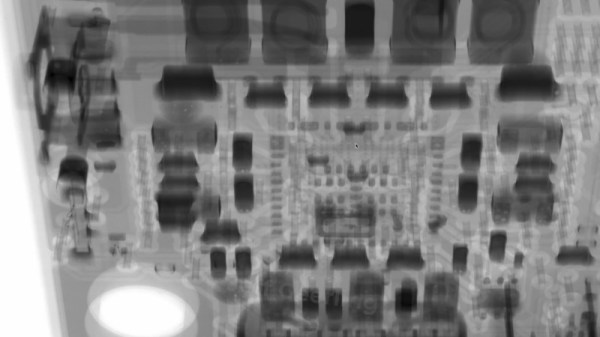
Most Hackaday readers will know to some extent what lies inside their computer, even if this is only at a block diagram level listing the peripherals. But what is physically on a modern computer board? [Jeff Geerling] has subjected a Raspberry Pi 5 to a medical imager, and shares with us the many layers of parts and PCB he found there. With a six-layer board and a heap of large BGA chips on it, there’s a lot to look at.

For readers who are used to working with printed circuit boards, it’s likely the techniques involved in the design will not be new. For us, the magic lies in the scale. The sheer number of interconnects on the board is impressive enough, but when it becomes possible to peer into the SoC package it becomes evident that there’s an internal PCB with some of the smallest vias we have ever seen. [Jeff] goes on to show us part by part around the board, on the way reminding us that some of the earliest Pi boards had to be reworked to replace Ethernet jacks without magnetics.

There’s a beauty to these ghostly images which might not be apparent to anyone who hasn’t stared obsessively at a PCB in a CAD package while it takes shape. The images show the work of the PCB designer’s art at a fine scale. We’d almost go as far as to suggest they be viewed as fine art instead of industrial design. Take a look, the video is below the break.

If this art is a bit big for you, then look at ASIC design – which takes things down to the microscopic level of the doped silicon structures within these amazing chips.

Continue reading “Raspberry Pi 5 Goes Under The X-ray”

How The First IPod Was Blown Wide Open

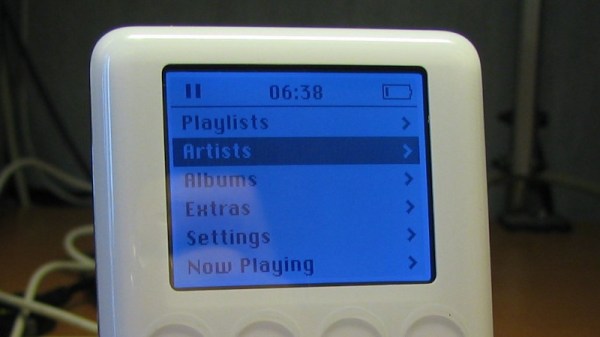
If someone makes a device, someone else will want to break it open and run their own software on it. When the original manufacturer is Apple this is never made easy, and as [Daniel Stenberg] reminds us in the case of one of the earlier iPod models it required an unusual approach.

In short, an HTML file was found which triggered a reboot, meaning a buffer overrun had been found in the firmware. After much experimenting, the memory location was found which would flash the backlight, and from there a piece of ARM code could be injected which would dump the firmware very slowly bitwise by flashing the light. Enough code could be extracted to find the address of the USB serial port, allowing new code to be made which dumped the firmware via USB. We remember the earliest models using FireWire instead of USB, so perhaps we can zero in on the 3rd or 4th generation. From there enough could be deduced to run the Rockbox music player firmware. We remember seeing friends doing this back in the day, something which was for a while the height of open-source coolness.

Fast forward twenty years or so, and we’re still covering people chipping away at Apple’s defenses. We don’t know whether a first-generation iPod could run Doom, but we know Rockbox was capable of it on other players.

When Is A 6502 Not Quite A 6502?

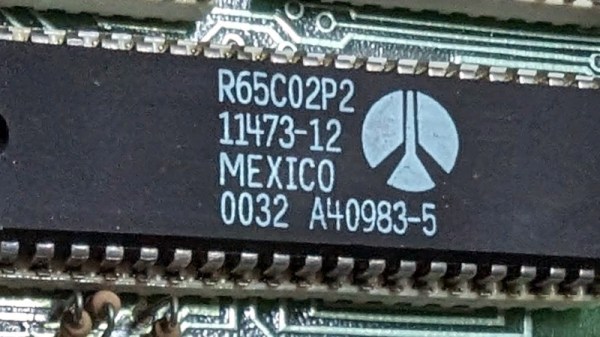
We all know that fake chips are a risk when it comes to buying parts on eBay or from Chinese markets such as AliExpress. It’s a simple enough scam, take a cheap chip and mark it as an expensive one, pocket the difference. It’s happened in several different forms, with everything from completely different devices through cheaper equivalents to incredibly, chips purpose fabricated to emulate better-known ones. We have a chance to see such a scam in action via [LinuxJedi], with a 6502 that wasn’t quite as it seemed.

The chip in question was a Rockwell 65C02 destined for an Acorn Atom, and when installed it failed to deliver the expected power consumption saving. Unsurprisingly when tested it turned out to be a fake, in this case a run-of-the-mill 6502 with new markings. The interesting part for Hackaday readers comes in the physical clues. The too-bright markings started to dissolve with a bit of acetone. A deeper investigation revealed the date and wafer codes did not agree with the branding. A new chip was secured which also turned out to be a fake, though in this case a real 65C02 rated for a lower clock speed than marked.

It’s evident that in-demand retro chips are likely to be an ever-greater minefield of fakes as time passes, and the number of survivors dwindles. It’s as well to be aware then and learn from any fakes like these posted online. It’s not the first fake chip we’ve brought you.

The Latest John Deere Repair Lawsuit Now Has The Go-Ahead

Long time readers will have followed the twists and turns of the John Deere repair saga, in which the agricultural machinery manufacturer has used DRM to restrict the repair of its tractors. It may be hot stuff on the prairies, but it matters to everyone because it’s a key right-to-repair battleground. Now the company’s attempt to throw out the latest class-action lawsuit, this time in Illinois. has failed, paving the way for a meaningful challenge.

This lawsuit is special because has the aim of determining whether or not Deere conspired to drive up the cost of repair and edge out independent mechanics. It comes against a backdrop in which their promised access to repair software which we reported on back in January has failed to materialize, and this is likely to figure as an act of bad faith.

A failing of corporate culture is that the organisation can in its own eyes, never be wrong. In Deere’s case they have accrued plenty of bad publicity in the years they’ve pursued this ill-advised business model, and in case that weren’t enough they’ve alienated their core customers out on the farms to the extent that a second-hand Deere from before the DRM era has more value than its newer counterparts. Deere genuinely do make very good tractors, so for farmers loyal for generations to turn their backs on them is a very significant story indeed. One has to ask, how much bad publicity and how many lawsuits do they have to have before someone at head office in Moline figures out that DRM in tractors (or anything else for that matter) isn’t the great idea they once thought it was? Maybe this one will finally herald the moment when that happens.

Header image: Nheyob / CC BY-SA 4.0

When Nearly Flat Isn’t Really Flat

An aerial photo of the UK city of Milton Keynes
Is Mk really flat? Thomas Nugent, CC BY-SA 2.0.

From where I am sitting, the earth is flat. The floor that runs the length of the unit my hackerspace sits in is flat, the concrete apron behind it on which we test our Hacky Racers is flat, and a few undulations in terrain notwithstanding, it remains flat as I walk up the road towards Stony Stratford.

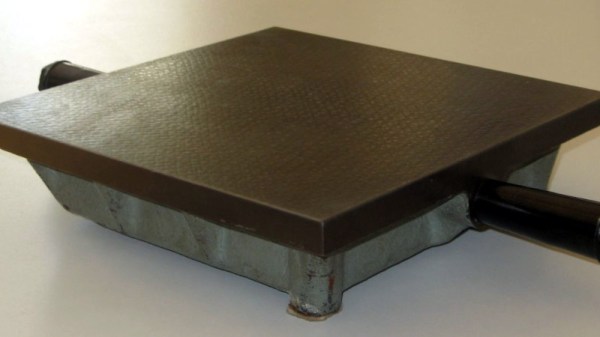
Of course, Hackaday hasn’t lost its mind and joined the conspiracy theorists, the earth is definitely spherical as has been known and proved multiple times since antiquity. But my trivial observation made in a damp part of Buckinghamshire still holds; that for a given value of flat which disregards a few lumps and bumps in the ground, my corner of the English city of Milton Keynes is pretty flat. Which leads from a philosophical discussion to an engineering one, if I can reasonably describe a city-sized area on an Earth-sized sphere as flat, how flat does a surface have to be to be considered flat? And from that stems a fascinating story of the evolution of precision machining. Continue reading “When Nearly Flat Isn’t Really Flat”

The Deere Disease Spreads To Trains

If the right-to-repair movement has a famous story, it’s the familiar green and yellow John Deere tractor. Farmers and mechanics have done their own repairs as long as there have been tractors, but more recent Deeres have been locked down such that only Deere-authorised agents can fix them. It’s a trend that has hurt the value of a second-had Deere, but despite that it appears to be spreading within the machinery world. Now there’s a parallel on Polish railways, as Polish-made Newag electric passenger trains have been found to give errors when serviced by non-Newag workshops.

At the heart of the problem are the PLCs which control all aspects of a modern rail traction system, which thanks to a trio of Poland and Germany based researchers have been found to play a range of nasty tricks. They’ll return bogus error codes after a set date which would presumably be reset by the official service, if the train has been laid up for a while, or even if they are detected via GPS to have visited a third-party workshop. Their work will be the subject of a talk at 37C3 which should be worth watching out for.

It will be especially interesting to juxtapose the reaction to this revelation with cases such as the Deere tractors, because of course Poland is part of the European Union. We’re not specialist EU competition lawyers, but we know enough to know that the EU takes a dim view of these types of practices and has been strong on the right to repair. Who knows, Polish trains may contribute further to the rights of all Europeans.