A Pulse Of Annoyance About Oscillators, Followed By A Flyback Of A Rant

Everyone likes to play with high voltages, right?. Even though the danger of death goes up with every volt, it’s likely that a few readers will have at some time or other made fancy long sparks. You’re reading this so you lived to tell the tale, and we’d only ever counsel only doing so safely, but the point of this piece lies not in the volts themselves but in a touch of frustration at the voltage generators. There’s a circuit I see so often which annoys me every single time, so here if you don’t mind I’m going to deliver both a little rant and a look into flyback converters.

It’s Got Coils, so It’s A Transformer
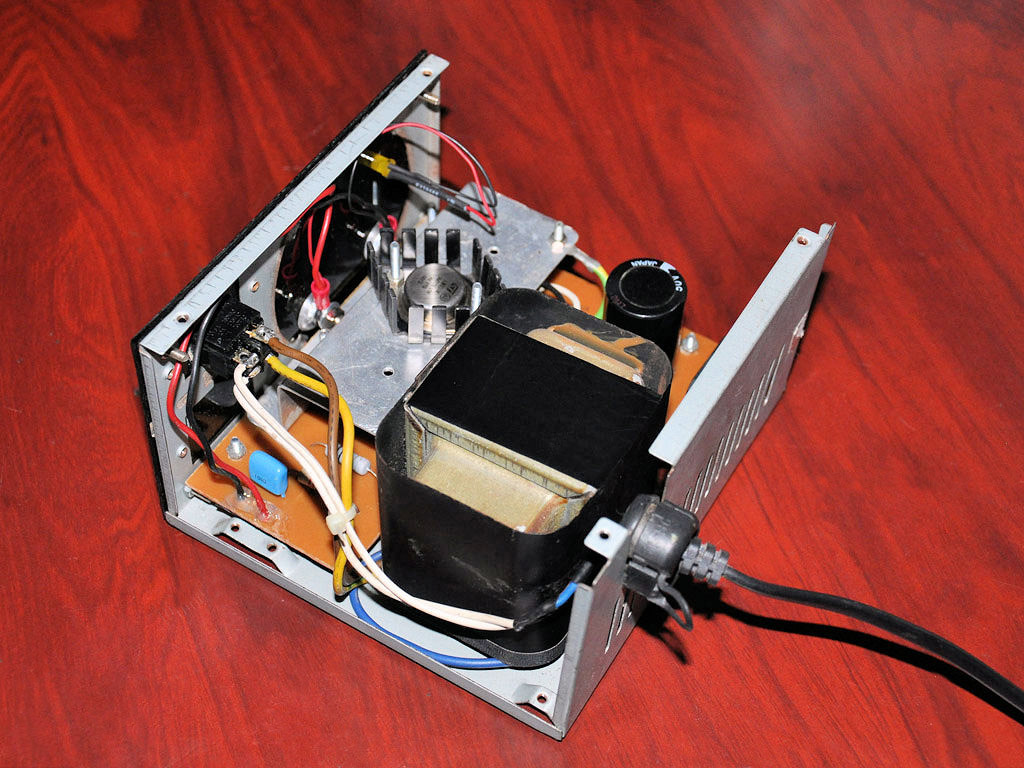
A power supply with the lid removed, visible is a large transformer
Linear power supplies with a mains transformer are a surprisingly rare sight now. Dilshan Jayakody, CC BY-SA 2.0.

How does a transformer work? An alternating current in a primary winding induces an opposite current in its secondary winding. The voltage out is equal to the turns ratio times the voltage in. Thus if you want to make a high voltage, it’s simply a case of finding a transformer with the right turns ratio, and applying the right AC to the input.

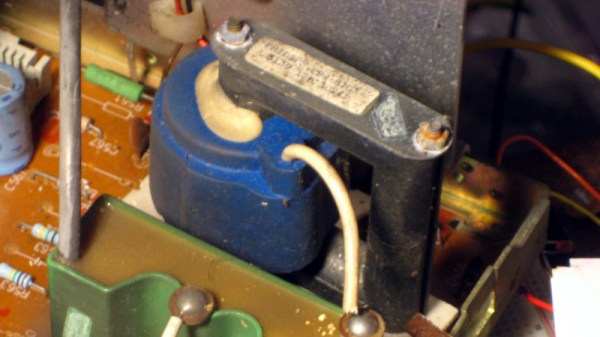
A handy choice for a high voltage transformer has been for years a TV line output transformer, also sometimes known as a flyback transformer. You could find these in CRT displays and TVs, and they consist of a square ferrite core with a big chunky high voltage overwinding for the CRT anode circuit and a load of lower voltage windings. TV designers were always out to save on parts costs, so they often had windings for all the voltage rails inside the set as well as the anode voltage, using the timebase as a crude switching power supply. Continue reading “A Pulse Of Annoyance About Oscillators, Followed By A Flyback Of A Rant”
Dark Trace CRTs, Almost The E-Ink Of Their Time

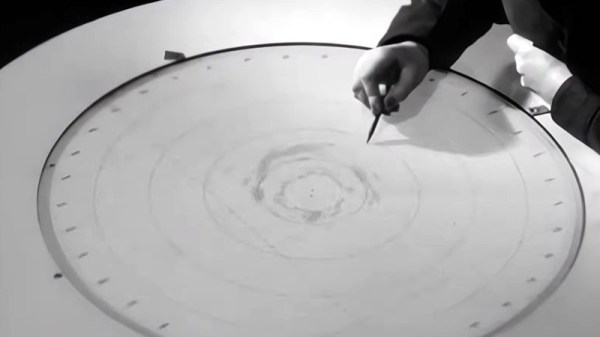
When you’ve been a fact-sponge for electronics trivia for over four decades, it’s not often that an entire class of parts escapes your attention. But have you seen the Skiatron? It’s a CRT that looks like a normal mid-20th-century tube, until it’s switched on. Then its secret is revealed; instead of the glowing phosphor trace we’d expect, the paper-white screen displays a daylight-readable and persistent black trace. They’re invariably seen in videos of radar installations, with the 360 degree scans projected onto large table-top screens which show the action like a map. It’s like e-ink, but from the 1940s. What’s going on?

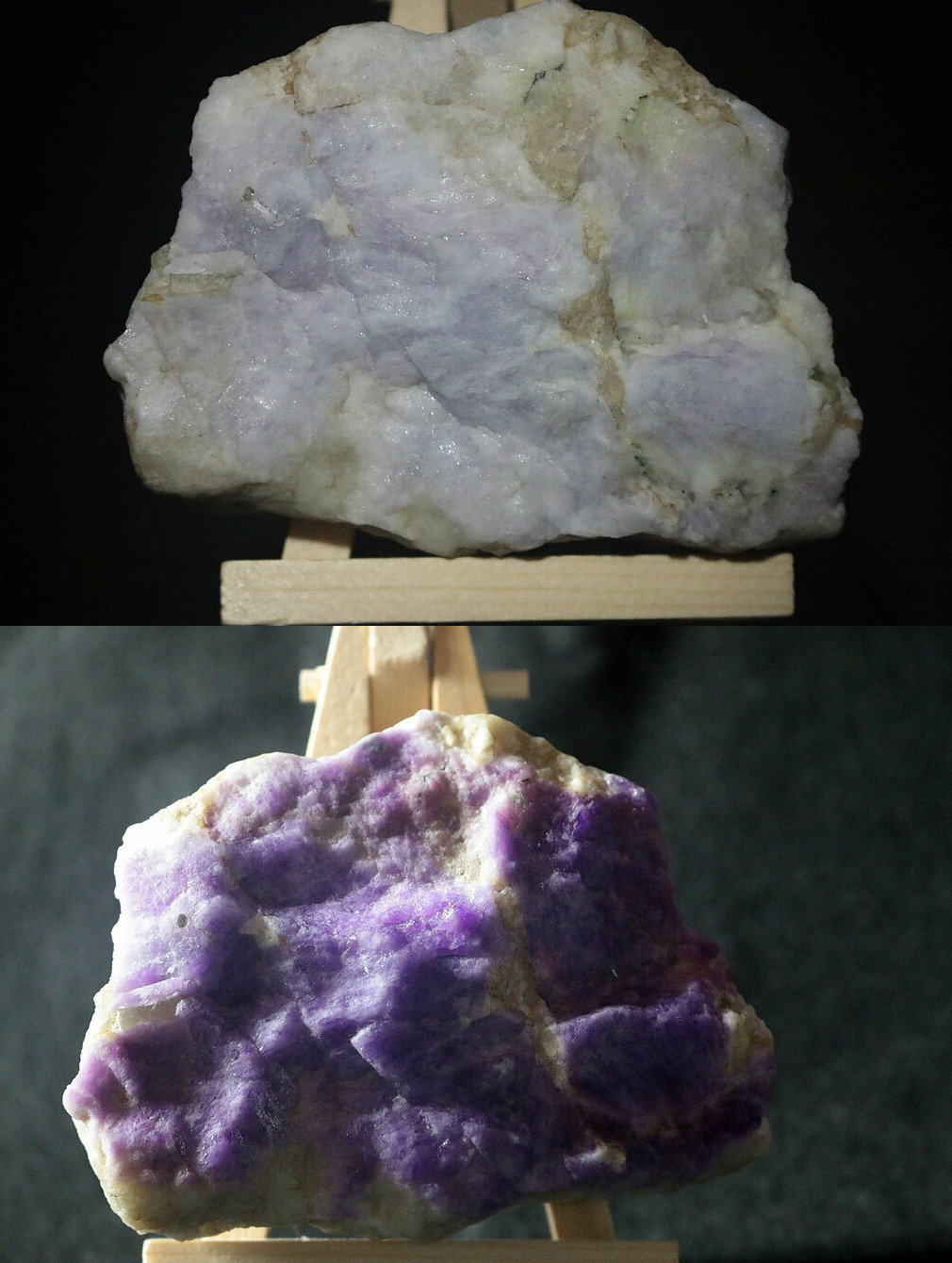
Two photos of the same crystalline rock, the top one is white, the bottom one is purple.
The tenebrescent mineral Hackmanite, before and after UV exposure. Leland Green…, CC BY-SA 2.0 and CC BY-SA 2.0.

The phosphor coating on a traditional CRT screen is replaced by a halide salt, and the property on which the display relies is called tenebrescence, changing colour under the influence of radiation. This seems most associated online with UV treatment of some minerals and gemstones to give them a prettier look, and its use a s a display technology is sadly forgotten.

A high-school physics understanding of the phenomenon is that energy from the UV light or the electron beam in the case of the tube, places some electrons in the crystal into higher energy levels, at which they absorb some visible light wavelengths. This is reversible through heat, in some substances requiring the application of heat while in others the heat of room temperature being enough. Of course here at Hackaday we’re hands-on people, so into the EPROM eraser went a small amount of table salt in a makeshift dish made of paper, but sadly not to be rewarded by a colour change.

On a real dark-trace CRT the dark trace would be illuminated from behind by a ring light round the glass neck of the tube. An interesting aside is that, unlike phosphor CRTs, they were more suitable for vertical mounting. It seems that small amounts of phosphor could detach themselves from a vertically mounted screen and drop into the electron gun, something that wasn’t a problem for tenebrescent coatings.

This display tech has shuffled off into the graveyard of obsolescence, we’re guessing because CRT technology became a lot better over the 1950s, and radar technologies moved towards a computerised future in which the persistence of the display wasn’t the only thing keeping the information on the screen. It seems at first sight to be a surprise that tenebrescent coatings have never resurfaced in other displays for their persistence, but perhaps there was always a better alternative whether it was ultra-low-power LCDs or more recently e-ink style devices.

For more bleeding-edge 1950s radar displays, we’ve previously brought you Volscan, a radar with an early form of GUI, which no doubt was one of those which consigned dark-trace CRTs to history.

Hackaday Prize 2023: Abuse A Reference Chip For A Cheap Instrument

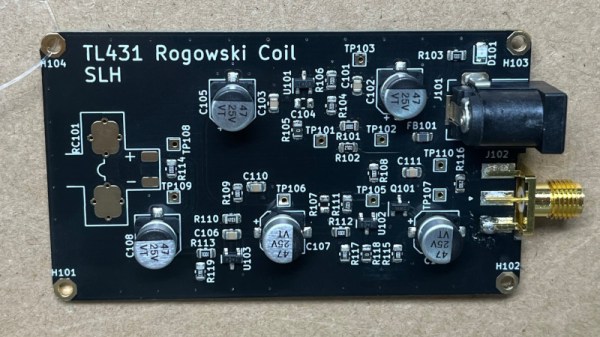
A Rogowski coil is a device for measuring AC current that differs from a conventional current transformer in that it has no need to encircle the conductor whose current it measures. They’re by no means cheap though, so over time we’ve seen some interesting variations on making one without the pain in the wallet. We particularly like [Stephen]’s one, because he eschews exotic devices for an interesting hack on a familiar chip. He’s taken the venerable TL431 voltage reference chip and turned it into an op-amp.

We had to look at the TL431 data sheet for this one and shamefacedly admit that since we’d only ever used the chip as a voltage reference, we hadn’t appreciated this capability. In this mode, it’s a op-amp with the inverting input connected to a fixed rail, so it can accept a feedback network to its non-inverting input just like any other. He’s using it as both integrator and amplifier, as well as, of course, in a more conventional power supply.

We like the instrument, and the use of the TL431 in an unexpected manner is the cherry on the cake. Here’s a previous Rogowski circuit using more conventional parts. You can dive a bit more into the theory, too.

Hackaday Prize 2023: Computer Vision Guides This Farm Mower

It’s a problem common to small-scale mixed agriculture worldwide, that of small areas of grass and weeds that need mowing. If you have a couple of sheep and enough electric fence there’s one way to do it, otherwise, if you rely on machinery, there’s a lot of hefting and pushing a mower in your future. Help is at hand, though, thanks to [Yuta Suito], whose pylon-guided mower is a lightweight device that mows an area defined by a set of orange traffic cones. Simply set the cones around the edge of the plot, place the mower within them, and it does the rest.

At its heart is a computer vision system that detects the cones and estimates distance from them by their perceived size. It mows in a spiral pattern by decreasing the cone height at which it turns, thus covering the whole area set out. Inside is a Raspberry Pi doing the heavy lifting, and because it’s designed for farmland rather than lawns, it has an adaptive track system to deal with obstacles. In its native Japan there is an ageing rural population, so it is particularly suitable for being operated by an older person. See it in action in the video below the break.

A robotic mower aimed at farms is certainly unusual here, but we’ve seen a lot of more conventional lawnmowers.

Continue reading “Hackaday Prize 2023: Computer Vision Guides This Farm Mower”

Hackaday Prize 2023: A 3D Printed Vertical Wind Turbine

We feature a lot of off-grid power projects here at Hackaday, whether they’re a micropower harvester or something to power a whole house. Somewhere in the middle lies [esposcar90]’s 3D-printed vertical wind turbine, which it is claimed can deliver 100 watts from its diminutive tabletop package.

It’s designed to be part of a package with another turbine but makes a very acceptable stand-alone generator. The arms have large scoop-like 3D-printed vanes and drive a vertical shaft up the centre of the machine. This drives a set of satellite gears connected to a pair of DC permanent magnet motors, which do the work of generating. For different wind situations, there are even some differing STL gear choices to speed up the motors. The motors are 12V devices, so we’re guessing the output voltage will be in that ballpark. However, it’s not made entirely clear in the write-up.

Continue reading “Hackaday Prize 2023: A 3D Printed Vertical Wind Turbine”

Normal Users Don’t Code On Their Mac, But Apple Keeps Trying

Most people use their computer to run pre-packaged programs: usually a web browser, games, or office applications. Whether the machine is a PC or a Mac, they don’t generally write their own software. For them, the computer is an appliance, and they do what their computer allows them to do.

It shouldn’t have to be that way, if only programming were easier. The Eclectic Light Company has a fascinating article looking at the various attempts that Apple has made to lure their users into creative programming.

Probably the most familiar of them all is AppleScript, with its origins in late 1993. Or maybe you’re thinking of Hypertalk, the scripting component of 1987’s Hypercard. That would go on to be a mainstay of mid-1990s multimedia software, but while it’s fallen by the wayside it’s AppleScript which still has support in the latest MacOS.

The biggest surprise for us lies in the forgotten products. 1989’s Prograph graphical language looks amazing. Was it simply before its time? In the modern era, Apple describes the reach of Shortcuts diplomatically: “its impact has so far been limited”.

Maybe the most forward-thinking line on programming from Apple came in 2007, even if it wasn’t recognized as such. The original iPhone didn’t have any third-party apps, and instead developers were supposed to write web apps to take advantage of the always-connected device. Would that be such a bad piece of advice to give a non-developer writing software for their Mac today?

Chromebooks Now Get Ten Years Of Software Updates

It’s an acknowledged problem with the mobile phone industry and particularly within the Android ecosystem, that the operating system support on a typical device can persist for far too short a time, leaving the user without critical security updates. With the rise of the Chromebook, this has moved into larger devices, with schools and other institutions left with piles of what’s essentially e-waste.

Now in a rare show of sense from a tech company, Google have announced that Chromebooks are to receive ten years of updates from next year. Even better, it seems that this will be retroactively applied to at least some older machines, allowing owners to opt in to further updates for the remainder of the decade following the machine’s launch.

Of course, a Chrome OS upgrade on an older machine won’t make it any quicker. We’re guessing many users will feel the itch up upgrade their hardware long before their decade of software support is up. But anything which saves e-waste has to be applauded, and since this particular scribe has a five-year-old ASUS Transformer just out of support, we’re hoping for a chance to jump back on that train.

There’s another question though, and it relates to the business model behind Chromebooks. We doubt that the hardware manufacturers are thrilled at their customers’ old machines receiving a new lease of life and we doubt Google are doing this through sheer altruism, so we’re guessing that the financial justification comes from an extra five years of making money from the users’ data.