Pulling Data From HDMI RF Leakage

A long-running story in the world of electronic security has been the reconstruction of on-screen data using RF interference from monitors or televisions. From British TV detector vans half a century ago to 1980s scare stories about espionage, it was certainly easy enough to detect an analogue CRT with nothing more than an AM broadcast radio receiver. But can this still be done in the digital age? It’s something [Windytan] has looked into, as she reconstructs images using leakage from HDMI cables.
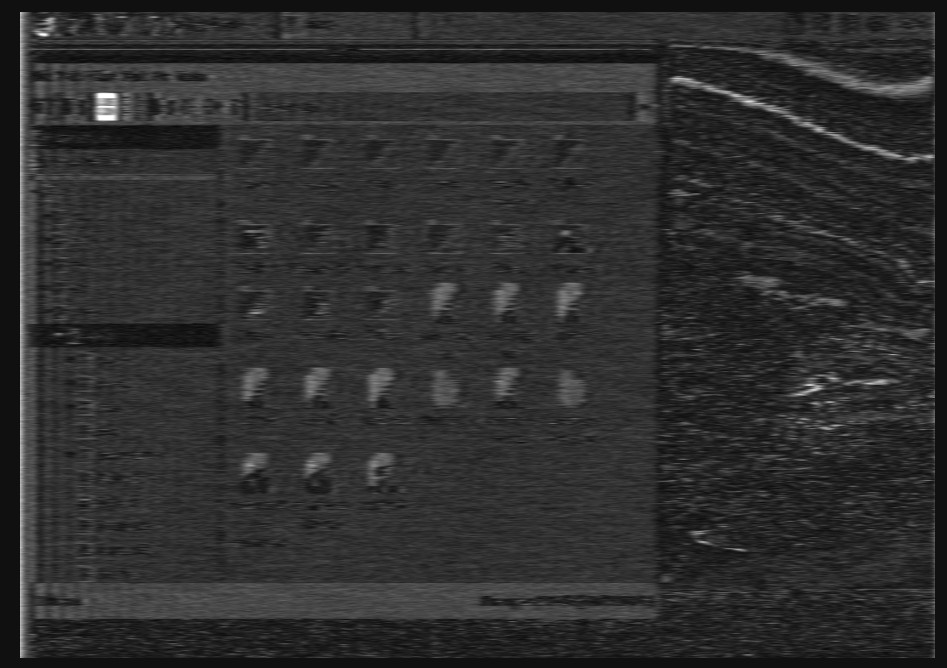
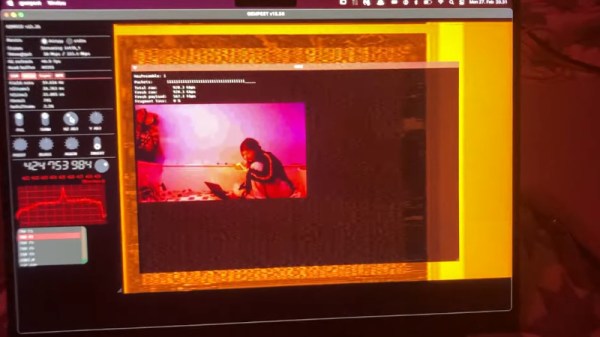
The tale starts with a mystery RF noise, soon identified as not unlike the scanning frequencies of a video signal. Plotting the noise intensities while treating the supposed scanning frequencies as video synchronization yields a shadowy version of her Raspberry Pi desktop, so she’s on to something. It’s important to note that this isn’t a video signal she’s receiving, but the noise associated with the bit transitions in an uncompressed digital video stream, so she quickly concludes that trying to resolve color would be futile.

It does however leave the tantalizing possibility of using this as a medium to wirelessly export data from a compromised machine, and it’s down this route she goes. She finally arrives on a scheme of encoding data as lines of individual colors that look like interference patterns over a desktop, and from there can send and retrieve files. It works for digital audio streams, and as shown in the video below, even an MJPEG video stream, hidden in the noise from a video signal. That’s impressive work, by any standard!

We covered those BBC detector vans in detail a while back.
Continue reading “Pulling Data From HDMI RF Leakage”

A Ground Source Heat Pump From An Air Conditioner

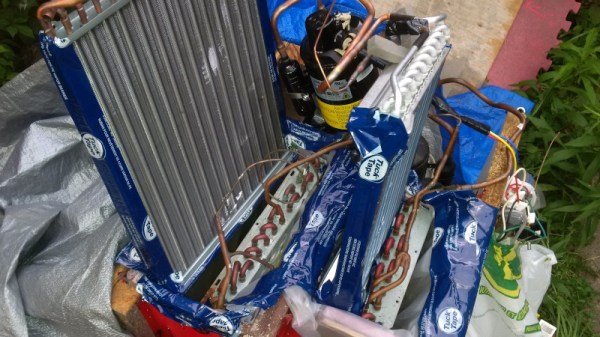
When it comes to lower-energy home heating, it’s accurate in all senses to say that heat pumps are the new hotness. But unless you happen to work with them professionally, it’s fair to say their inner workings are beyond most of us. Help is at hand though courtesy of [petey53], who made his own ground source heat pump for his Toronto house using a pair of window-mounted air conditioning units.

Continue reading “A Ground Source Heat Pump From An Air Conditioner”

Probably The World’s Most Expensive Bar Bot

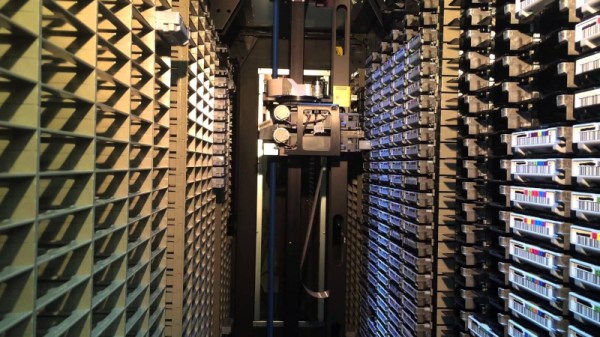
Bar bots, or robotized bartenders, are a fun feature of events in our community, because there’s nothing like a cocktail untouched by human hand. Usually they have a row of bottles and a slide on which you put the glass, but [SecurityWriter] relates a tale of an altogether much grander affair. Given a weekend with a group of friends and an enterprise-grade IBM tape library robot, they did what any sensible engineer would do. They turned it into a bar bot.

Most readers probably won’t have seen a consumer grade data tape for decades, but in the enterprise space they’re very much the most cost effective backup solution. Large corporations have vast numbers of them, and IBM sells robots which retrieve them automatically from huge storage racks. When a group of young techs were given the tedious task of cataloging the whole thing and found themselves stuck in an empty data center for a weekend, of course they produced what was probably the world’s most expensive automated drinking game. Stocking the shelving system with booze and using the command line control for the robot they were able to have it deliver their beverages, and shockingly they managed to do so without the whole thing breaking.

It’s a hack, even if it’s one of which by necessity no evidence remains. Sadly Hackaday doesn’t have a tape library, or you can bet we’d be tempted to give it a try ourselves. Never mind, we can continue to sample more conventional bar bots from time to time.

Probably The Most Over-Specified Calculator To Ever Be Manufactured

It’s possible quite a few of our older readers will remember the period from the 1960s into the ’70s when an electronic calculator was the cutting edge of consumer-grade digital technology. By the 1980s though, they were old hat and could be bought for only a few dollars, a situation that remains to this day. But does that mean calculator development dead?

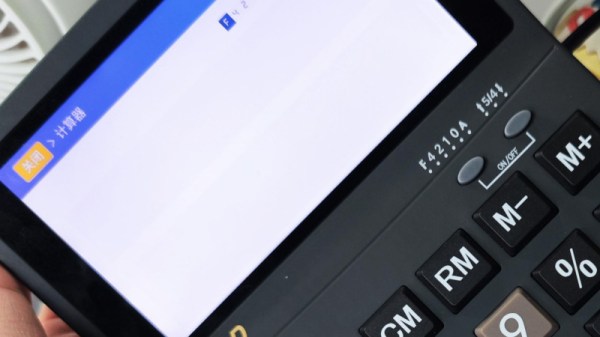
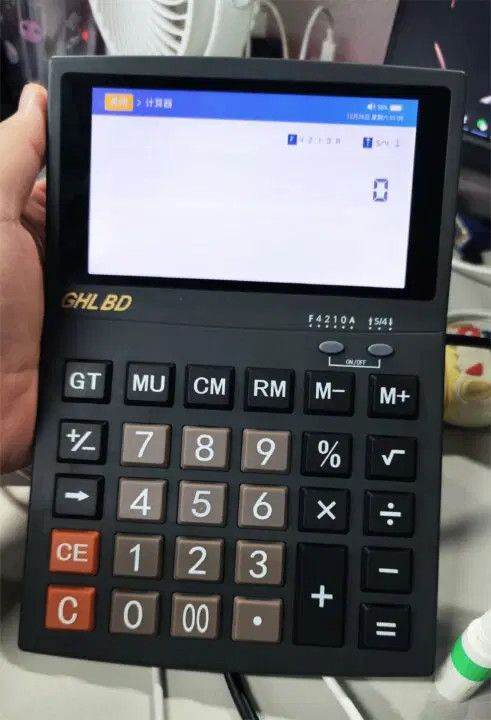
Perhaps not, as [Li Zexi] writes for CNX Software, when he reviews a simple non-scientific calculator that packs an Alwinner A50 tablet SoC and the Android operating system. As shipped they lack the Android launcher, so they aren’t designed to run much more than the calculator app. Of course that won’t stop somebody who knows their way around Google’s mobile operating system for very long — at the end of the review, there’s some shots of the gadget running Minecraft and playing streaming video.

These devices can be had for not a lot on the Chinese second-hand electronics market, and after an extensive teardown he comes to the conclusion that besides their novelty they’re an older specification so not really worth buying.

But it does beg the question as to why such a product was put into production when the same task could have been performed using very cheap microcontroller. Further, having done so they make it a non-scientific machine, not even bestowing it with anything that could possibly justify the hardware. Is there a use case he, and us, have missed? We’d love to know.

We cover a lot of calculator stories here at Hackaday. Sometimes they’re classic machines, but more often they’re modern takes on an old idea.


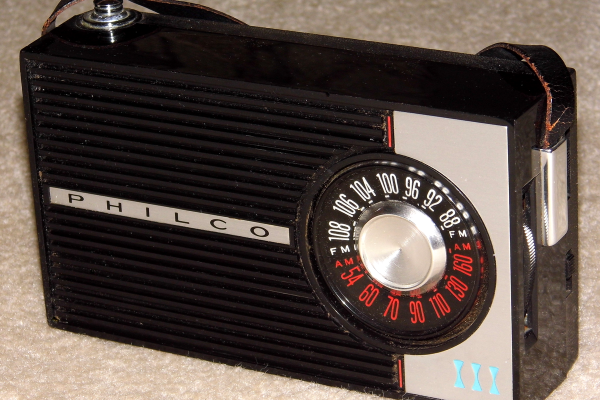
What’s Going To Happen To Legacy Broadcast Bands When The Lights Go Out?

Our smartphones have become our constant companions over the last decade, and it’s often said that they have been such a success because they’ve absorbed the features of so many of the other devices we used to carry. PDA? Check. Pager? Check. Flashlight? Check. Camera? Check. MP3 player? Of course, and the list goes on. But alongside all that portable tech there’s a wider effect on less portable technology, and it’s one that even has a social aspect to it as well. In simple terms, there’s a generational divide that the smartphone has brought into focus, between older people who consume media in ways born in the analogue age, and younger people for whom their media experience is customized and definitely non-linear.

The Kids Just Don’t Listen To The Radio Any More

A 1957 American family watching TV
We’re guessing this is no longer a scene played out in many homes. Evert F. Baumgardner, Public domain.

The effect of this has been to see a slow erosion of the once-mighty reach of radio and TV broadcasters, and with that loss of listenership has come less of a need for the older technologies they relied on. Which leaves a fascinating question here at Hackaday, what is going to happen to all that spectrum? Indeed, there’s a deeper question behind all that, is lower frequency spectrum even that valuable any more?

In the old days, we had analogue TV in several-MHz-wide channels spread across a large part of the UHF bands and some smaller chunks of VHF. Among that we had 20 MHz of FM broadcasting around the 100 MHz mark, and disregarding shortwave, then a MHz of AM down around 1 MHz. Europeans got a bonus band down there too: we’ve got Long Wave, over 100 kHz of AM goodness roughly centered around 200 kHz.

Continue reading “What’s Going To Happen To Legacy Broadcast Bands When The Lights Go Out?”

A Medium Format Camera From Scratch

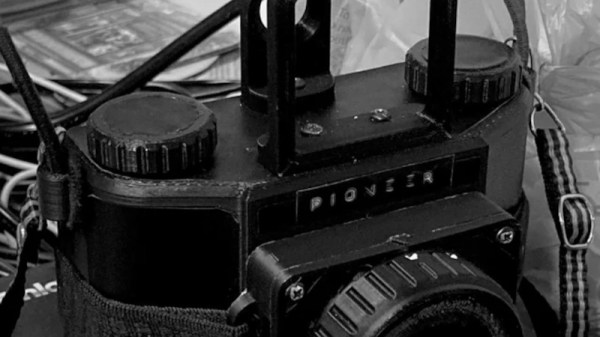
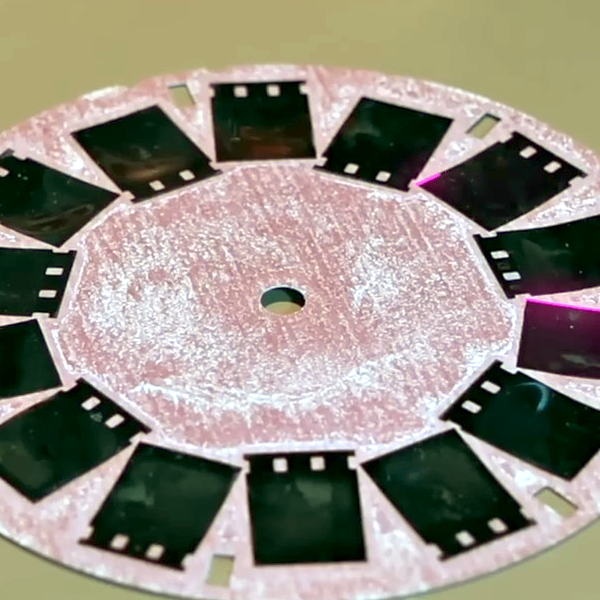
Film photography may now be something so outdated as to be unknown to our younger readers, but as an analogue medium it has enjoyed a steady enthusiast revival. There is still a bonanza of second-hand cameras from the days when it was king to be found, but for some photographers it’s preferable to experiment with their own designs. Among them is Reddit user [elelcoolbeenz], who has produced their own medium format camera for 120 roll film.

The camera has a plastic 3D printed body and a single meniscus lens, and perhaps most interestingly, a 3D printed shutter too. It’s heavily reminiscent of the Holga and Lomo plastic cameras that have carved a niche for themselves, and it gives the same photographic effects from its dubious quality optics.

There’s a snag of course, that the STLs are not yet available We say not yet, because this comes with a detailed explanation in that further work is required on the shutter and a more commonly available lens is found rather than a one-off. We still think it’s worthy of featuring at this stage though, because it serves to illustrate that building a camera is not impossible. We’d love to see more of them, though we expect few of them to go to the lengths this aluminium one did.

A CRT Audio Visualiser For When LEDs Just Won’t Do

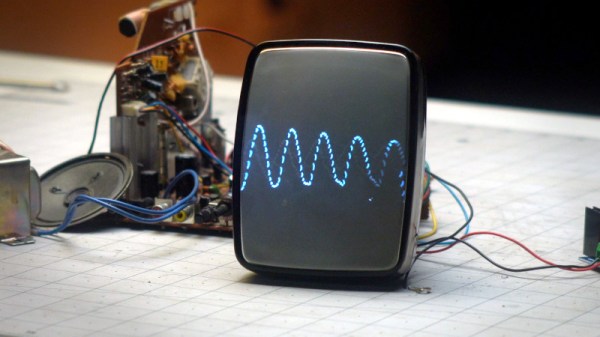
It has been a recurring feature of consumer audio gear since the first magic eye tube blinked into life, to have some kind of visualization of the sound being played. Most recently this has meant an LED array or an OLED screen, but [Thomas] has gone one better than this with a CRT television converted to perform as a rudimentary oscilloscope.

The last generation of commonly available monochrome televisions were small 5″ CRT models made in China. They never received digital tuners, so as digital TV has become the norm they are now useless to most people. Thus they can often be found for pennies on the second-hand market.

[Thomas]’s hack involves gutting such a TV and retaining its circuitry, but disconnecting the line driver from the deflection yoke. This would normally leave a vertical line on the screen as it would then be moved only by the frame driver at 50 Hz for PAL or 60 Hz for NTSC. By connecting an audio loudspeaker amplifier to the line deflection yoke he gets that low quality oscilloscope. It would be of limited use as an instrument, but few others will have such a cool audio visualizer. He’s viewing the screen in a portrait orientation, we’d be tempted to rotate the yoke for a landscape view.

It’s worth pointing out as always that CRT TVs contain high voltages, so we’d suggest reading up on how to treat them with respect.

Continue reading “A CRT Audio Visualiser For When LEDs Just Won’t Do”