New Part Day: ESP32-P4 Espressif RISC-V Powerhouse

It seems every day there’s a new microcontroller announcement for which the manufacturer is keen to secure your eyeballs. Today it’s the turn of Espressif, whose new part is the ESP32-P4, which despite being another confusingly named ESP32, is a high-performance addition to their RISC-V line-up.

On board are dual-core 400 MHz and a single-core low power 40 MHz RISC-V processors, and an impressive array of hardware peripherals including display and camera interfaces and a hardware JPEG codec alongside the ones you’d expect from an ESP32 part. It’s got a whopping 768 KB of on-chip SRAM as well as 8 K of very fast cache RAM for intensive operations.

So after the blurb, what’s in it for us? It’s inevitable that the RISC-V parts will over time displace the Tensilica parts over time, so we’ll be seeing more on this processor in upcoming Hackaday projects. We expect in particular for this one to be seized upon by badge developers, who are intent on pushing extra functionality out of their parts.So we look forward to seeing the inevitable modules with this chip on board, and putting them through their paces.

Thanks [Renze] for the tip.

The Surprisingly Simple Way To Steal Cryptocurrency

In the news a few days ago, the revelation that Luke Dashjr, a core Bitcoin developer, had his wallet compromised, and lost 200 BTC. A small fortune, and something of a shock. I’m guessing that someone with that expertise would not have left his private key lying around, so as a cryptocurrency non-enthusiast I’m left curious as to how the attackers might have done it. So I phoned a few friends who do walk those paths for an explanation, and the result was a fascinating conversation or two. The most probable answer is still that someone broke into his computer and copied the keys — straight-up computer theft. But there’s another possible avenue that doesn’t involve stealing anything, and is surprisingly simple. Continue reading “The Surprisingly Simple Way To Steal Cryptocurrency”

A Practical Glue Stick Oscillator

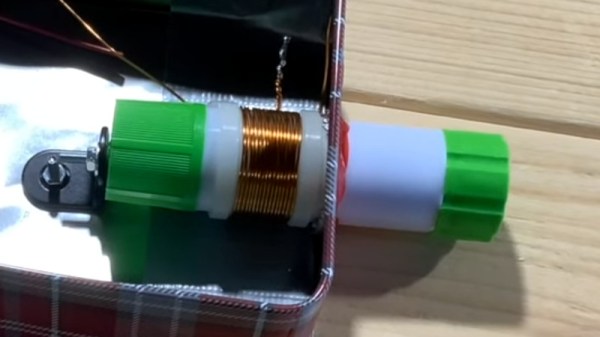
A few months ago we brought you some experiments from [Bill Meara, N2CQR], in which he investigated the use of a glue stick as the former for a permeability tuned inductor. His set-up was very much in the spirit of experimentation, and we’re very pleased to now see [Nick, M0NTV] has taken the idea and demonstrated it for the 7 MHz, or 40 meter, amateur radio band.

The result can be seen in the video below the break, and is housed in a tin enclosure that we’re guessing once contained toffees. The oscillator circuit comes courtesy of [Ashar Farhan VU2ESE] of BitX transceiver fame, but we’re most interested in the glue stick coil former which makes use of a small bracket for stability. With the glue removed, he’s mounted a ferrite ring in its glue carrier which is moved in and out of the coil. We’re guessing this could also be done with other permeability-altering materials, for example we’d follow [VU2ESE]’s lead and try a piece of brass.

The knurled glue feed knob protrudes through a hole in the tin, and we’re guessing there’s enough separation for an operator’s hand not to drag the frequency too much. All in all given that variable capacitors are now something of a rarity, it makes for a useful demonstration of a very cheap replacement. Meanwhile, you can read our notes on [N2CQR]’s work here.

Continue reading “A Practical Glue Stick Oscillator”

The Flight Of The Dremel

A few months ago we featured a model aircraft whose power plant came courtesy of an angle grinder. It was the work of [Peter Sripol], and it seems he was beseiged by suggestions afterwards that he might follow it up with a helicopter built using a Dremel rotary tool. Which he duly did, and the results can be seen in the video below the break.

The Dremel itself requires a gearing to drive the balsa-bladed rotor, and a tail rotor is mounted with its own motor at the end of a boom. The video has many entertaining failures which see him arrive at a set of balancing arms and a tailplane for stability. The result is a helicopter that flies after a fashion, and is even able to stay aloft for a few seconds rather than crashing to earth.

The machine lacks the full rotor pitch control of its commercial bretheren, indeed the only control is directional via the tail rotor. Still it deserves top marks for entertainment alone, and we wouldn’t mind a go ourselves. The original angle grinder craft can be seen here.

Continue reading “The Flight Of The Dremel”

Fool A Drone With A Fixed Battery

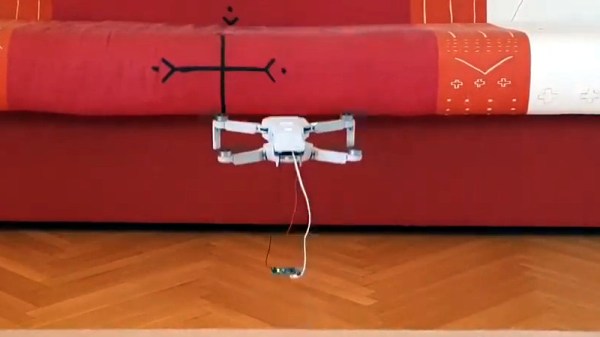
Lithium-ion and lithium-polymer rechargeable batteries have given us previously impossible heights of electronics power and miniaturization, but there’s a downside they have brought along with them. When a battery pack has to contain electronics for balancing cells, it’s very easy for a manufacturer to include extra functions such as locking down the battery. Repair a battery, replace cells, or use a third-party battery, and it won’t work. [Zolly] has this with a DJI Mavic Mini pack, and shares with us a method for bypassing it.

The pack talks to the multi-rotor with a serial line, and the hack involves interrupting that line at the opportune moment to stop it telling its host that things are amiss. Which is a good start — but we can’t help hacing some misgivings around the rest of the work. Disconnecting the balance line between the two cells and fooling the Battery Management System (BMS) with a resistive divider seems to us like a recipe of disaster, as does bypassing the protection MOSFETs with a piece of wire. It may work, and in theory the cells can be charged safely with an external balance charger, but we’re not sure we’d like to have a pack thus modified lying around the shop.

It does serve as a reminder that BMS boards can sometimes infuriatingly lock their owners out. We once encountered this with a second-generation iBook battery that came back to life after a BMS reset, but it’s still not something to go into unwarily. Read our guide to battery packs and BMS boards to know more.

Continue reading “Fool A Drone With A Fixed Battery”

The Problem With Passwords

By now it’s probable that most readers will have heard about LastPass’s “Security Incident“, in which users’ password vaults were lifted from their servers. We’re told that the vaults are encrypted such that they’re of little use to anyone without futuristic computing power and a lot of time, but the damage is still done and I for one am glad that I wasn’t a subscriber to their service. But perhaps the debacle serves a very good purpose for all of us, in that it affords a much-needed opportunity for a look at the way we do passwords. Continue reading “The Problem With Passwords”

Veteran Polaroid Camera Lives Again, With Film Conversion

Browsing the thrift stores will net an amazing array of old cameras for dirt cheap prices, meaning that a film enthusiast can have plenty of fun without wasting money they could spend on the film itself. Unfortunately many of the more interesting cameras are those which use film long out of production, leaving the photographer with a need to improvise using a more modern film that’s still in production.

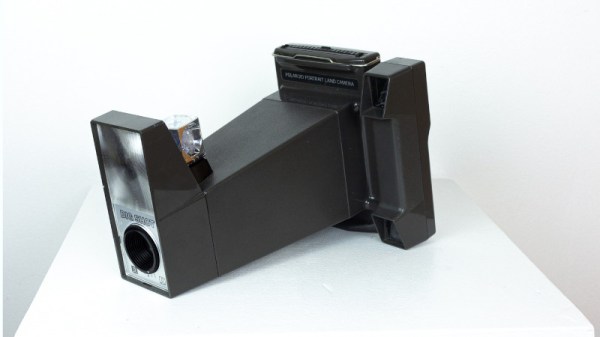
[Nicholas Morganti] has just such a camera, a Polaroid Big Shot, a 1970s instant camera designed for portrait work, for which the Polaroid 100 film packs are sadly a distant memory. Leave it on the shelf? Not likely, he’s adapted it to work with Fuji Instax 210, a readily available and cheap instant film.

Polaroid 100 and Instax 210 are almost the same size, but are not close enough for a direct fit. An Instax cartridge can be persuaded to fit into the Big Shot, but it’s a tight fit that puts strain on the aged Polaroid hinges. Even then the Polaroid rollers and photo ejection system are very different from those in the Fuji, so it involved a workflow in which the cartridge had to be unloaded in a darkroom between shots and processed through a real Fuji camera for the final picture.

His eventual solution takes a less camera-straining tack, still requiring a darkroom but taking an individual unexposed frame from an Instax pack and placing it in the Big Shot on an adapter plate. The result is a usable if a little cumbersome workflow for vintage Polaroid pictures, something plenty of instant photography enthusiasts will be thankful for. If you’re one of them, you might like to read our look at the process.