Dear Ubuntu…

Dear Ubuntu,

I hope this letter finds you well. I want to start by saying that our time together has been one of creativity and entertainment, a time in which you gave me the tools to develop a new career, to run a small electronics business, make fun things, and to write several thousand articles for Hackaday and other publications, but for all that it’s sadly time for our ways to part. The magic that once brought us together has faded, and what remains is in danger of becoming a frustration.

In our early days as an item you gave me for the first time a Linux distro that was complete, fast, and easy to use without spending too much time at the CLI or editing config files to make things happen; you gave me a desktop that was smooth and uncluttered, and you freed me from all those little utilities that were required to make Windows usable. You replaced the other distros I’d been using, you dual-booted with my Windows machines, and pretty soon you supplanted the Microsoft operating system entirely.

Ubuntu and me and a trusty Dell laptop, Oxford Hackspace, 2017.
Me and Ubuntu in 2017, good times.

We’ve been together for close to two decades now, and in that time we’ve looked each other in the eye across a variety of desktop and laptop computers. My trusty Dell Inspiron 640 ran you for over a decade through several RAM, HDD, and SSD upgrades, and provided Hackaday readers with the first few years of my writing. Even the Unity desktop couldn’t break our relationship, those Linux Mint people weren’t going to tear us asunder! You captured my text, edited my videos and images, created my PCBs and CAD projects, and did countless more computing tasks. Together we made a lot of people happy, and for that I will always be grateful. Continue reading “Dear Ubuntu…”

It’s DOOM, But In Teletext

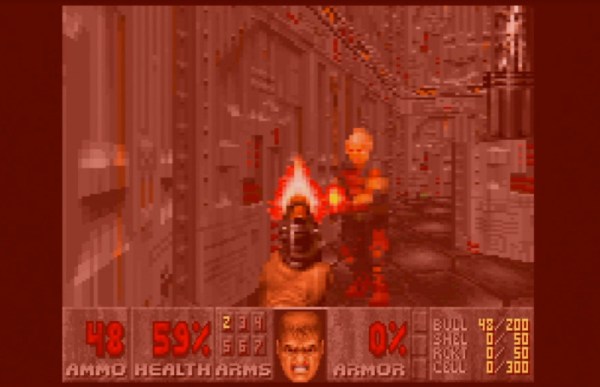
We’ve seen the 1993 id Software classic DOOM running on so many pieces of unexpected hardware, as “Will it run DOOM?” has become something of a test for any new device. But will it run in the circuitry of a 1970s or 1980s TV set? Not quite, but as [lukneu] has demonstrated, it is possible to render the game using the set’s inbuilt Teletext decoder.

Teletext is a technology past its zenith and which is no longer broadcast in many countries, but for those unfamiliar it’s an information service broadcast in the unseen lines hidden in the frame blanking period of an analogue TV transmission. Its serial data packets can contain both pages of text and rudimentary block graphics, and we’re surprised to learn, can include continuous streams to a single page. It’s this feature that he’s used, piping the game’s graphics as a teletext stream which is decoded by the CRT TV and displayed as a playable if blocky game.

Delving further, we find that DOOM is running on a Linux machine on which the teletext stream is created, and the stream is then piped to a Raspberry Pi which does the encoding on to its composite video output. More powerful versions of the Pi can run both processes on the same machine. The result can be seen in the video below, and we can definitely say it would have been mind-blowing, back when DOOM was king. There are plans for further refinement, of which we’d say that color would be the most welcome.

Continue reading “It’s DOOM, But In Teletext”

Get That Dream Job, With A Bit Of Text Injection

Getting a job has always been a tedious and annoying process, as for all the care that has been put into a CV or resume, it can be still headed for the round file at the whim of some corporate apparatchik. At various times there have also been dubious psychometric tests and other horrors to contend with, and now we have the specter of AI before us. We can be tossed aside simply because some AI model has rejected our CV, no human involved. If this has made you angry, perhaps it’s time to look at [Kai Greshake]’s work. He’s fighting back, by injecting a PDF CV with extra text to fool the AI into seeing the perfect candidate, and even fooling AI-based summarizers.

Text injection into a PDF is a technique the same as used by the less salubrious end of the search engine marketing world, of placing text in a web page such that a human can’t read it but a machine can. The search engine marketeers put them in tiny white text or offset them far out of the viewport, and it seems the same is possible in a PDF. He’s put the injection in white and a tiny font, and interestingly, overlaid it several times.

Using the ChatGPT instance available in the Bing sidebar he’s then able to fool it into an affirmative replay to questions about whether he should be hired. But it’s not just ChatGPT he’s targeting, another use of AI in recruitment is via summarizing tools. By injecting a lot of text with phrases normally used in conclusion of a document, he’s able to make Quillbot talk about puppies. Fancy a go yourself? He’s put a summarizer online, in the link above.

So maybe the all-seeing AI isn’t as clever as we’ve been led to believe. Who’d have thought it!

A Vintage Polaroid Camera Goes Manual

There once was a time when all but the most basic of fixed focus and aperture cameras gave the photographer full control over both shutter speed and f-stop. This allowed plenty of opportunity to tinker but was confusing and fiddly for non-experts, so by the 1960s and ’70s many cameras gained automatic control of those functions using the then quite newly-developed solid state electronics. Here in 2023 though, the experts are back and want control. [Jim Skelton] has a vintage Polaroid pack film camera he’s using with photographic paper as the film, and wanted a manual exposure control.

Where a modern camera would have a sensor in the main lens light path and a microcontroller to optimize the shot, back then they had to make do with a CdS cell sensing ambient light, and a simple analog circuit. He considered adding a microcontroller to do the job, but realized that it would be much simpler to replace the CdS cell with a potentiometer or a resistor array. A 12-position switch with some carefully chosen resistor values was added, and placed in the camera’s original battery compartment. The final mod brought out the resistors and switch to a plug-in dongle allowing easy switching between auto and switched modes. Result – a variable shutter speed Polaroid pack camera!

Sadly the film for the older Polaroid cameras remains out of production, though the Impossible Project in the Netherlands — now the heirs to the Polaroid name — brought back some later versions and have been manufacturing them since 2010. Hackers haven’t been deterred though and have produced conversions using Fuji Instax film and camera components, as with this Polaroid portrait camera, and [Jim]’s own two-camera-hybrid conversion.

The MOS CIA Lives On, In 74HCT

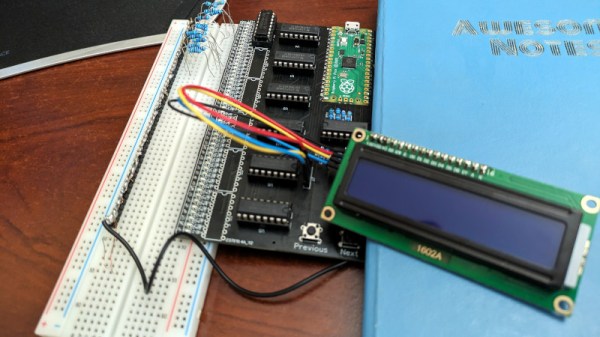
It’s always pleasing to see a project we covered in its early stages reach maturity, so were very happy to bring you an update on [Daniel Molina]’s 74HCT6526. It’s a long-running effort to produce in 74 logic a faithful replica of the MOS Technologies CIA, the integrated I/O and timer chip found in so many of the 1980s Commodore machines. When we first covered it there was only one PCB, now the project has grown to a stack of three, with the remaining functions intended to fit on two more boards.

It was very common at the time for chips such as the CIA to integrate a set of common 8-bit peripherals onto one piece of silicon, both in general purpose with almost all functions of the original now implemented. hips and in more manufacturer specific parts such as this one. A project like this one is valuable because it provides a dive into the now less-common  world of interfacing directly to a microprocessor data and address line. It’s unlikely that many Commodore 64s will end up with this stack of boards inside them, but it’s not impossible the design may help a few old machines when put on an FPGA.

Meanwhile, remember it’s not the only custom 1980s home computer chip replaced with 74 logic.

A Paste Extruder For Normal Printers

In the bright sunshine of a warm spring afternoon at Delft Maker Faire, were a row of 3D printers converted with paste extruders. They were the work of [Nedji Yusufova], and though while were being shown printing with biodegradable pastes made from waste materials, we were also interested in their potential to print using edible media.

The extruder follows a path set by similar ones we’ve seen before in that it uses a disposable syringe at its heart, this time in a laser-cut ply enclosure and a lead screw driven by a stepper motor. It’s part of a kit suitable for run-of-the-mill FDM printers that’s available for sale if you have the extra cash, but happily they’ve also made all the files available.

We’ve seen quite a few syringe extruders and at least one food printer, so there’s nothing particularly new about this one. What it does give you is a relatively straightforward build and a ready integration with some mass market printers you might be familiar with. Perhaps the most interesting part of this project isn’t even the extruder itself but the materials, after all having a paste extruder gives you the opportunity to experiment with new recipes. We like it.

A Free TV With A Catch: New Normal Or Inevitable Hardware Bonanza?

The dystopian corporate dominated future may have taken a step closer, as a startup called Telly promises a free 55 inch 4K TV with a catch — a second screen beneath the main one that displays adverts. The viewers definitely aren’t the customers but the product, and will no doubt have every possible piece of data that can be harvested from them sold to the highest bidder. There’s even a microphone and camera pointed at the viewer, to complete the 1984 experience. In a sense it’s nothing new, as certain TV manufacturers have been trying to slip adverts into the interfaces on their paid-for smart TVs for years.

Oddly we’re not convinced though, that the eventual outcome of this will be as sinister as readers might expect. Indeed if the past is anything to go by, it could even herald an eventual bonanza of 4K screens for hardware hackers. To explain why, we have to travel back to the late 1990s, when free hardware for adverts startups were last tried. Back then there were a spate of companies using the same model of free or super-cheap hardware, and without exception they ran into the fundamental problem that people who rely on a free product in exchange for adverts aren’t generally high value consumers who can bring in the revenue to support buying a ton of consumer electronics. The “free” hardware from several of these startups then found its way onto the surplus market — or in the case of CueCat barcode scanners, directly into the hands of hardware hackers, and was repurposed for use in the way our community knows best.

So yes. Telly represents all that’s wrong for the privacy of viewers about the current media landscape. But who knows, it might just spawn a hacking scene all of its own. As a final note we think that they’ll have an interesting time protecting their brand name if they ever enter the British market, where “telly” has been slang for television ever since the technology entered the mainstream.