Laser Cut Clips Save A Lamp From The Trash

Ikea have been known for years as a purveyor of inexpensive  yet stylish homewares, but it’s fair to say that sometimes their affordability is reflected in their insubstantial construction. Such is the case with the Sjöpenna lamp, whose construction relies on rubber bands. On [Tony]’s lamp these bands degraded with age, causing it to fall apart. The solution? A set of cleverly-designed laser-cut clips to replace them.

The challenge to replacing a stretchy material with a rigid one is that it must have enough ability to bend without snapping as it is put in place. For this he selected PETG, with 0.04″ (about 1 mm thick) hitting the sweet spot. His photos demonstrate with some green tape added for visibility, how the clip bends backwards just far enough to fit over where the rubber band once located, and then flips back neatly to hold it all in place.

If you have a collapsing Ikea lamp then this will be just what you need, but this hack goes further than that. A frequent requirement for repairs is some kind of clip, because clips are always the first to break, This technique for laser cutting them is a handy one to remember, next time your design needs a springy bit of plastic.


Not Can It Run DOOM, But Can DOOM Run It?

It’s the standard test for a hardware hack, half serious half in jest, “Can it run DOOM?”. The iconic early-90s shooter from id software has made an appearance on everything from toothbrushes to LEGO bricks, but nobody has yet posed the opposite question: Can DOOM run it?“. It’s one answered by [Danny Spencer], who has proved that it’s possible to perform computational tasks in the game by producing a working adding machine in a DOOM level.

If you’re familiar with the folks who build working computers within Minecraft, this is in a similar vein. Game elements are used to create logic elements, and from there more complex systems can be assembled. DOOM doesn’t have the in-game logic that Minecraft has, but by clever combination of monster behaviour with in-game actions involving rooms, buttons, and doors, it’s possible to create the simplest of building blocks, the NAND gate.

The video below the break shows the adder in action, first in operation (we like the monster-driven display!), and then a tour of the logic area with its rooms full of computational monsters. It’s important to note that this isn’t a computer, he hasn’t proved it as Turing complete, and that the maximum size of a DOOM level whatever it is will impose an upper limit on what can be done. But it does show that in theory at least a computer can be made in DOOM, and we’re sure people will continue this work.

Continue reading “Not Can It Run DOOM, But Can DOOM Run It?”

Non-Replaceable Battery? Not If This Proposed EU Law Passes!

A disturbing trend in consumer electronics has been a steady disappearance of replaceable batteries on our devices. Finding a mobile phone with a swapable battery is a struggle, and many other devices follow the trend by sealing in a Li-Po cell. The result is an ever-shorter life for electronics, and a greater problem with devices going to recycling or worse still, landfill. Hope is at hand though, thanks to a proposed European Union law that would if passed make batteries in appliances “designed so that consumers can easily remove and replace them themselves“.

In case any readers in the rest of the world wonder what it has to do with them, the EU represents such a huge market that manufacturers can neither ignore it, nor in most cases afford to make separate EU and rest-of-world versions of their products. Thus if the EU requires something for sale in its territories, in most cases it becomes the de facto norm for anything designed to be sold worldwide. We’ve already seen this with the EU’s right to repair legislation, and while we have not doubt that manufacturers will do their best to impede this new law we don’t think they will ultimately prevail.

Via 9to5Mac.

A Love Letter To My Lost Amiga

My first love was a black wedge. It was 1982, and I had saved up to buy a Sinclair ZX81. That little computer remains the only one of the huge number that I have owned over the years about which I can truly say that I understood its workings completely; while I know how the i7 laptop on which this is being written works I can only say so in a loose way as it is an immensely complex device.

Computing allegiance is fickle, and while I never lost an affection for the little Sinclair I would meet my true electronic soulmate around eight years later as an electronic engineering student. It no longer graces my bench, but this was the computer against which all subsequent machines I have owned would be measured, the one which I wish had not been taken from me before its time, and with which I wish I could have grown old together. That machine was a Commodore Amiga, and this is part love letter, part wistful musing about what could have been, and part rant about what went wrong for the best desktop computer platform ever made. Continue reading “A Love Letter To My Lost Amiga”

The Physics Behind The Collapse Of A Huge Aquarium

At the end of last week Aquadom, the world’s largest cylindrical aquarium, unexpectedly shattered and caused an emergency as it flooded both the Berlin hotel that housed it and the surrounding streets. From an engineering perspective it’s a fascinating story, because its construction was such that this shouldn’t have happened. We have an analysis of what might have gone wrong from [Luis Batalha] (Nitter), and from it we can learn a little about the properties of the plastic used.

The aquarium was made of an acrylic polymer which has an interesting property — at a certain temperature it transitions between a glass-like state and a rubber-like one. Even at room temperature the acrylic is well below the transition temperature, but as the temperature drops the acrylic becomes exponentially more brittle. When the outside temperature dropped to well below zero the temperature also dropped in the foyer, and the high water pressure became enough to shatter the acrylic.

Sadly few of the fish from the aquarium survived, but fortunately nobody was killed in the incident. News coverage shows how the force of the water destroyed the doors and brought wreckage into the street, and we’re guessing that it will be a while before any other hotel considers such a project as an attraction. Meanwhile we’ve gained a little bit of knowledge about the properties of acrylic, which might come in handy some day.

Header: Chrissie Sternschuppe, CC BY-SA 2.0.

It’s Ethernet, From An SPI Interface

Over the years as microcontrollers have become fast enough to do the heavy lifting, we have become used to 10 megabit Ethernet being bit-banged from interfaces it was never meant to emerge from. We think however that we’ve never seen one driven from an SPI interface, so this one from [Ivan] may be a first. With a cleverly designed transceiver using logic chips, it even offers a chance to understand something about the timing of an Ethernet interface, too.

The differential logic signals derived from a simple Ethernet transceiver can be read by an SPI bus, but for the lack of a clock line. The challenge was then to construct a circuit the would construct the required clock pulses from the state changes on the data line. This would become a monostable with XOR gate, and a shift register to handle the clock during the preamble phase.

The resulting circuitry fits neatly on a shield for the ST Nucleo 64 board, where while it might not be the obvious choice for an Ethernet shield it certainly does the job.

If unexpected Ethernet is your thing, how about the i2s peripheral on an ESP8266?

A Binaural Microphone For The Great Outdoors

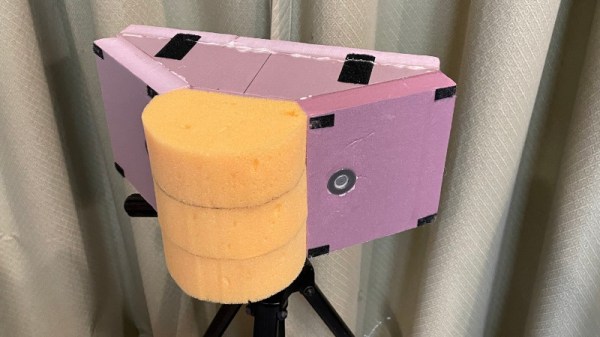
A binaural recording is designed to mimic as closely as possible the experience of listening through human ears, and thus binaural microphones are often shaped like the human head with the microphone cartridges placed where the ears would be. That’s not the only way to make a binaural microphone though, and the Crown Stereo Ambient Sampling System, or SASS, did the same thing with a pair of pressure zone microphones for outdoor recordings. [Filip Mulier] doesn’t have one of the originals, but he’s done his best to make a SASS-like microphone of his own.

The attractive thing about this design is its simplicity, making use of foam sheets for the main body, with packing board as a rain deflector and a couple of layers of non-woven cloth as a wind filter. Perhaps best of all though are the recordings, in which we hear ambient recording at its finest. Listen with headphones, we suggest the dawn chorus.

If binaural recording and stereo interests you, we’ve taken a closer look in the past.