Voyager 1 Talks Some Nonsense, But Is Still Working

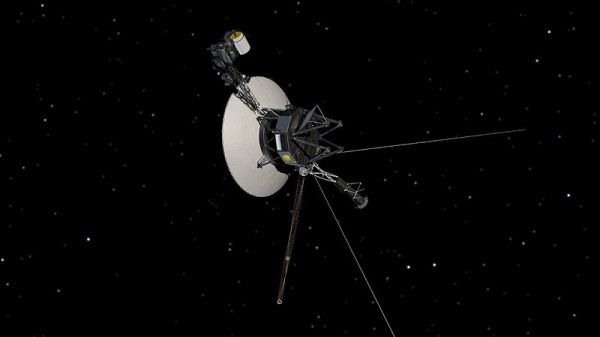
The Voyager 1 interplanetary probe was launched in 1977 and has now reached interstellar space where it is the furthest-traveled man-made object. It’s hugely exceeded its original mission and continues to return valuable scientific data, but there’s an apparent fault which is leaving its controllers perplexed. Onboard is an attitude control system which keeps the craft’s antennas pointing at Earth, and while it evidently still works (as we’re still in touch with the probe) and other systems are fine, it’s started returning incomprehensible data. Apparently it’s developed a habit of reporting random data, or states the antenna can’t possibly be in.

That a 45 year old computer is still working at all is testament to the skills of its designers, and at 14.5 billion miles away a repair is impossible however much we’d be fascinated to know about the failure modes of old electronics in space.  It’s postulated that they might simply live with the fault if the system is still working, issue a software fix, or find some way to use one of the craft’s redundant systems to avoid the problem. Meanwhile we can rest easily in our beds, because we’re still a couple of centuries away from its return as a giant alien sentient machine.

We’ve featured the Voyager program a few times before here at Hackaday, not least when we took a close look at one of its instruments.

Thanks [Jon Woodcock] for the tip.
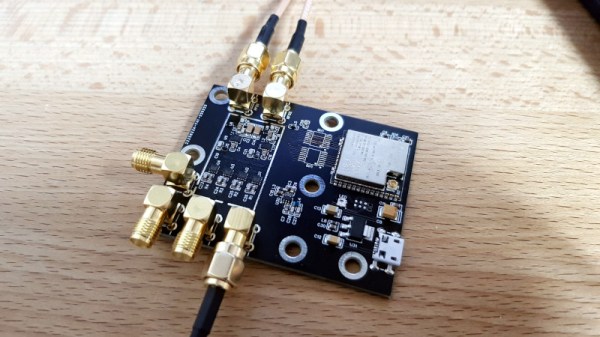
A Receive Antenna Switcher With An Espressif Brain

It’s not uncommon for a radio enthusiast to have multiple antennas for the same radio, so as you might expect it’s also entirely usual to have a bunch of coaxial cables dangling down for fumbling around the back of the rig to swap over.  If that describes your radio experience than you might be interested in the antenna switcher built by [g3gg0], which uses solid-state RF switches controlled by an ESP32 module.

At its heart is the MXD8625C RF switch, a tiny device designed for cellular phone applications that delivers only a fraction of a dB insertion loss and somehow negates the need for any blocking capacitors. It’s controlled by a GPIO line, and he’s hooked up a brace of them to allow the distribution of three antennas to a couple of radios with the handy option of switching in a preamplifier if required. Of even more interest we note that the device is suitable for transmitter switching too, with a maximum 36.5 dBm throughput that we calculate to be about 4.5 W. This board is fairly obviously for receive use, but perhaps the chip is of interest to anyone considering a transceiver project. Meanwhile the software is a relatively simple web-based control linking on-screen controls to GPIOs.

If you are interested in solid state RF switches, it’s always worth remembering that at lower frequencies they can be very simple indeed.

The Thin-Film Flexible 6502

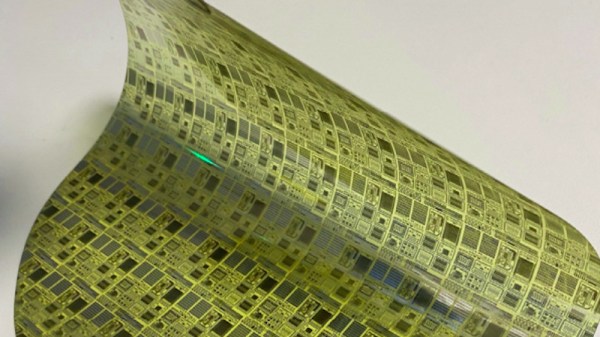
While our attention is mostly directed towards ever smaller-integrated silicon circuits providing faster and faster computing, there’s another area of integrated electronics that operates at a much lower speed which we should be following. Thin-film flexible circuitry will provide novel ways to place electronics where a bulky or expensive circuit board with traditional components might be too expensive or inappropriate, and Wikichip is here to remind us of a Leuven university team who’ve created what is claimed to be the fastest thin-film flexible microprocessor yet. Some of you might find it familiar, it’s our old friend the 6502.

The choice of an archaic 8-bit processor might seem a strange one, but we can see the publicity advantage — after all, you’re reading about it here because of it being a 6502. Plus there’s the advantage of it being a relatively simple and well-understood architecture. It’s no match for the MHz clock speeds of the original with an upper limit of 71.4 kHz, but performance is not the most significant feature of flexible electronics. The production technology isn’t quite ready for the mainstream so we’re unlikely to be featuring flexible Commodore 64s any time soon, but the achievement is the impressive feat of a working thin-film flexible microprocessor.

Meanwhile, if you’re curious about the 6502, we took a look at the life of its designer, [Chuck Peddle].

RIP John Birkett, Parts Vendor Extraordinaire

It is with sadness that we note the passing of John Birkett, proprietor of the legendary eponymous surplus radio and electronics store on an unassuming street in the British city of Lincoln, at the age of 93. He has been a fantastic source of esoteric parts and electronic assemblies for many decades, and though many of you from beyond where this is being written may never have heard of him the chances are that if you follow electronics enthusiasts from the UK you will have unwittingly seen parts which passed through his hands.

A typical Birkett advert from 1986
Gateway to a world of wonders: a typical Birkett advert from 1986.

There was a time when surplus stores were a relatively common sight, given their window of opportunity by the huge quantity of post-war and Cold War military gear at knock-down prices. My town had one when I was a kid, but though it sold its share of electronic goodies it was more of a place for sturdy olive green outdoor wear or all the 1930s British military uniform items you might ever need. J. Birkett was different, as a purely electronics store the shop rapidly became the go-to place for both the most necessary and the most unexpected of parts.

His motto was “Not a piece of junk in sight”, and though as with much surplus equipment there is plenty of junk to be found it was his eye in managing to stock the junk which was most interesting and useful that made his selection special. Such was its reach that most of his customers including me never made it to Lincoln and the store itself, instead we came to him through his mail-order business and attendance at radio rallies. I fondly remember the anticipation of receiving a Birkett parcel, and I still have plenty of parts that came from him. An FM tuner converted for use as a 2 meter receiver is still in a box somewhere, and I’m pretty certain my storage unit still holds a pair of Pye Cambridge VHF transceivers he supplied.

According to Google the shop remains open, and we hope that state of affairs will continue. Surplus may not be what it once was, but we thank John Birkett for what he gave to generations of British hardware hackers. May he rest in peace.

Header image: Oliver Mills, (CC BY-SA 2.0).

How The Roland 808 Cowbell Worked

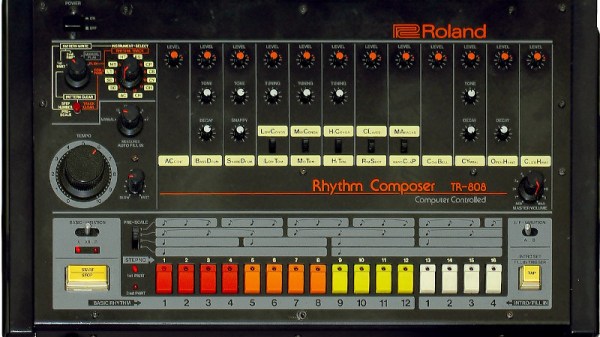
Every generation has an instrument which defines its sound, and for those whose formative musical years lie in the 1980s, a very strong contender to the crown is the Roland TR-808 percussion synthesizer. Its sounds can be recognized across a slew of hits from that era and every decade since, and though the original instrument wasn’t a commercial success it remains accessible through sample packs, emulations, and clones. The 808 was an all-analogue device that didn’t use samples, thus [Mark Longstaff-Tyrrell] has been able to reproduce its distinctive cowbell sound with reference to some of the original circuitry.

It shouldn’t come as too much of a surprise to find that the circuit is refreshingly simple. The trigger pulse is converted into an envelope which controls a pair of oscillators. The mixed output passes through a bandpass filter to create the distinctive sound on the output which you can hear in the video below the break. The circuit is recreated on a breadboard with the only concession to modernity being a microcontroller taking the place of the Schmitt trigger oscillators in the original.

Altogether it provides a fascinating insight into the synthesis behind a classic sound, and gives us an increased appreciation for the design skills of those Roland engineers who created it. We’ve looked at the 808 before a few times, including an explanation of the famous faulty transistors which contributed to its sound.

Continue reading “How The Roland 808 Cowbell Worked”

Large Scale Carbon Capture Without The Technology

We humans are in something of a pickle, as we’ve put too much carbon dioxide in the atmosphere and caused climate change that might even wipe us out. There may still be people to whom that’s a controversial statement, but knowing something needs to be done about it should be a position for which you don’t necessarily have to be a climate change activist glueing yourself to the gates of a refinery.

It’s obvious that we can reduce our CO2 emissions to tackle the problem, but that’s not the only way that atmospheric CO2 can be reduced. How about removing it from the air? It’s an approach that’s being taken seriously enough for a number of industrial carbon capture solutions to be proposed, and even for a pilot plant to be constructed in Iceland. The most promising idea is that CO2 from power stations can be injected into porous basalt rock where it can react to form calcium carbonate. All of which is very impressive, but is there not a way that this can be achieved without resorting to too much technology? Time for Hackaday to pull out the back-of-envelope calculator, and take a look. Continue reading “Large Scale Carbon Capture Without The Technology”

All The Sticky Labels You Could Ever Need: No DRM, Just Masking Tape

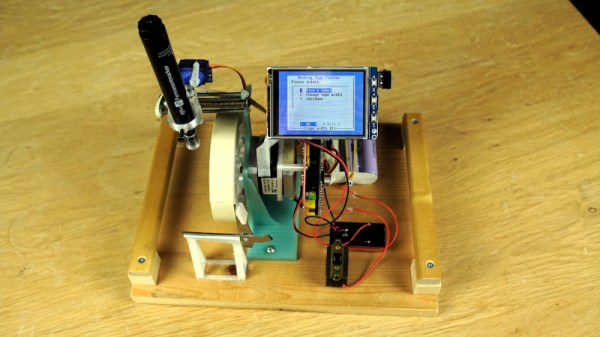
Printable sticky labels are a marvelous innovation, but sadly also one beset by a variety of competing offerings, and more recently attempts by manufacturers to impose DRM on their media. Fortunately they don’t have to rely on expensive printers or proprietary rolls of stickies, as [michimartini] demonstrates with the masking tape plotter. It’s a tiny pen plotter that writes your label onto the tape.

At its heart is the popular grbl G-code to motion parser, and its mechanism uses the lead screw axis from a DVD drive. Not for this project simply another hacked-apart drive mechanism though, for it has a custom-designed carriage for the axis. It’s 3D printed, and to ensure the least friction possible for a pen using only its weight to keep contact with the tape it was heated up once assembled to ensure all parts had a chance to bed in. Meanwhile the tape roll forming the X axis is turned directly by a standard stepper motor.

We like this project a lot, and look forward to any refinements to the idea. Meanwhile, it’s not the first custom label printer we’ve shown you.