Reverse Engineering Your Own Bluetooth Audio Module

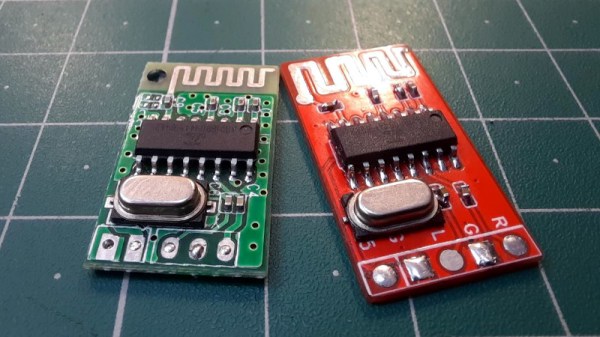
There was a time when we would start our electronic projects with integrated circuits and other components, mounted on stripboard, or maybe on a custom PCB. This is still the case for many devices, but it has become increasingly common for an inexpensive ready-built module to be treated as a component where once it would have been a project in its own right. We’re pleased then to see the work of [ElectroBoy], who has combined something of both approaches by reverse engineering the pinout of a Chinese Bluetooth audio chip with minimal datasheet, and making his own take on an off-the-shelf Bluetooth audio module.

The JL_AC6939B comes in an SOIC16 package and requires a minimum number of components. The PCB is therefore a relatively simple proposition and indeed he’s fitted all parts and traces on one side with the other being a copper ground plane. It’s dangerous to assume that’s all there is to a board like this one though, because many an engineer has come unstuck trying to design a PCB antenna. We’d hazard a guess that the antenna here is simply a wavy PCB line rather than an antenna with a known impedance and bandwidth, at the very least it looks to have much thicker traces than the one it’s copying.

It’s possible that it’s not really worth the effort of making a module that can be bought for relative pennies ready-made, but to dismiss it is to miss the point. We make things because we can, and not merely because we should.
A Robot Game To Open Your Hackerspace

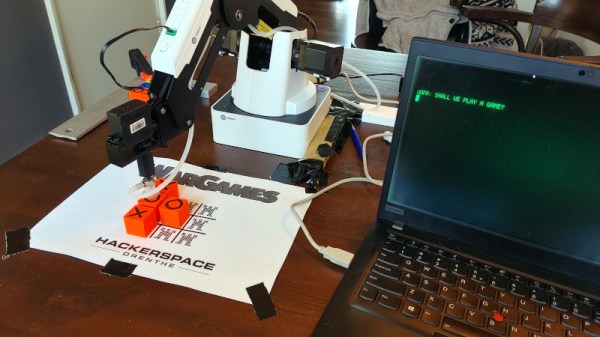
It’s always good to welcome a new hackerspace to the fold, and thus we’re pleased to hear about the upcoming opening of Hackerspace Drenthe, on the north-eastern edge of the Netherlands. Starting a new space during a global pandemic is something of a feat. As part of their opening something is required to demonstrate a robot for the curious public, and what could be more accessible than a robot arm playing tic-tac-toe!

It would be correct to say that a robot moving blocks with precision is not necessarily a ground-breaking achievement, but in its purpose of providing eye-candy for a hackerspace opening while also serving as an experiment for some of the students from the school adjacent to the space it is a success. The interface is a pleasingly retro War Games style terminal, and the software is written in Python. For the curious all can be found on a GitHub repository, and should you be in that region of Europe you can find Hackerspace Drenthe in the Netherlands border town of Coevorden and attend their opening on the 2nd of April.

Continue reading “A Robot Game To Open Your Hackerspace”

Label Your SMD Tapes With An Inkjet Printer

If you’ve ever had to use SMD components on tape outside the realm of the automated assembly machines for which they were designed, you’ll know that one tape looks very like another and it can be very annoying to keep track of which is which. We can’t help admiring [Yvo de Haas’] inkjet printer for SMD tapes then, which efficiently prints whatever identifying marks you need on the back of your tapes.

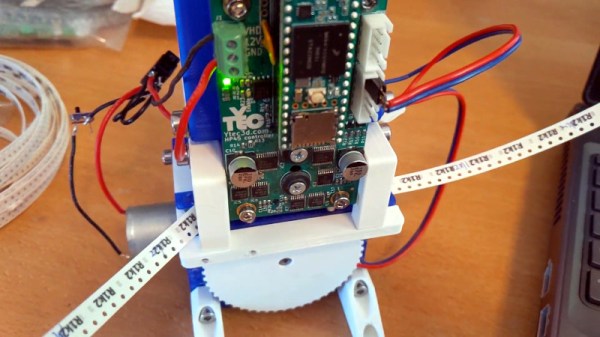
The printer uses the venerable HP45 inkjet cartridge, and teams it with a 3D printed mechanism and [Yvo]’s self-designed driver board. A worm gear motor and a sprocket take care of advancing the tape through the mechanism past the printhead, and there is a well-assembled piece of software to drive it all. With extremely comprehensive build instructions it should be within the reach of anyone who handles component tape, and from our experience of hand-labeling tape for kits we can see that it could be a Godsend. Take a look at it in action in the video below.

So far the tape-handling machinery we’ve seen has mostly been for cutting sections rather than labeling. We can see that this printer paired with a tape cutter should be essential equipment for anyone starting a kit business.

Continue reading “Label Your SMD Tapes With An Inkjet Printer”

A MiniDisc Optical Head Has A Few Surprises Up Its Sleeve

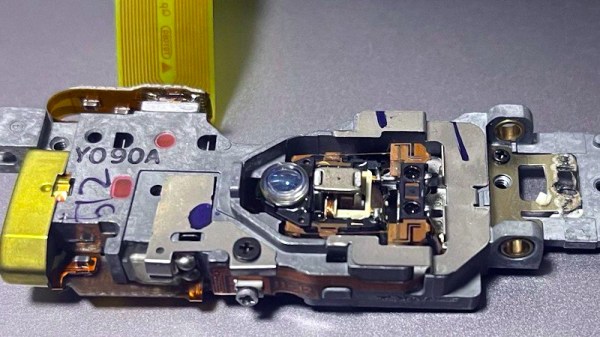
There was an odd era at the start of the 1990s when CDs had taken the lead from vinyl in pre-recorded music, but for consumer recordable formats the analogue cassette was still king. A variety of digital formats came to market to address this, of which Sony’s MiniDisc was the only one to gain significant traction outside the studio. These floppy-disk-like cartridges held a magneto-optical medium , and were the last word in cool until being swept away around the end of the decade by MP3 players. Hackaday alum [Nava Whitford] has disassembled a MiniDisc optical head to document how the physical part of the system worked.

The first surprise is that the MiniDisc was in fact a two-in-one system. The recordable discs were magneto-optical and wrote data by heating the disc with a laser under a magnetic field, while the pre-recorded discs used etched pits and lands in a similar way to the CD. Remembering the technical buzz around the system back in the day, either we audio enthusiasts glossed over this detail, or more likely, Sony’s PR did so to emphasize the all-new aspect of the system.

The teardown goes in depth into how while like a CD player there is a photodiode array involved, the extra components are a diffraction grating and a Wollaston prism, an optical component which splits polarized light into two beams. The photodiode array is more complex than that of a CD player, it’s speculated that this is to detect the different polarized beams as well as for the task of maintaining alignment with the track.

All in all this is a rare chance to look at something we know, but which few of us will probably have dismantled due to its relative scarcity compared to CD mechanisms. Definitely worth a look. Meanwhile if this era is of interest, take a look at a Hack Chat we did a while back looking at the MiniDisc’s would-be competitor.

Satellite Snoopers Pick Up Surprising TV Broadcast

While Internet based streaming services appear to be the future of television, there are still plenty of places where it comes into the home via a cable, satellite, or antenna connection. For most satellite transmissions this now means a digital multiplex carrying a host of channels from a geostationary satellite, for which a set-top box or other decoder is required. Imagine the surprise of satellite-watchers than when the Russian polar communications satellite Meridian 9 which has a highly elliptical orbit was seen transmitting old-style terrestrial analogue TV (ThreadReader Link). What on earth was happening?

How a Russian polar comms satellite picked up a TV station.

The TV signal in question comes from Turkmenistan, so were some homesick Turkmenistanis in an Antarctic base being treated to a taste of their country? The truth is far more interesting than that, because the signal in question comes from a terrestrial transmitter serving domestic TV viewers in Turkmenistan.

We’ve all heard of the idea that somehow every TV show ever transmitted is somewhere out there still traveling as radio waves across space, and while perhaps we can’t fly far enough out to check for 1960s Doctor Who episodes it’s true that the horizontal transmissions from a TV tower pass out into space as the earth curves away from them.

Thus Meridian 9 passed through the beam from the Turkmenistan transmitter which happened to be on a UHF frequency that matched one of its transponders, and the result was an unexpected bit of satellite TV. We’re indebted to the work of [@dereksgc] and [Scott Tilley] for bringing us this fascinating observation. We’ve featured [Scott]’s work before, most notably when he relocated a lost NASA craft.

A Fractal Papercraft Tree

Sometimes there are projects that we introduce with a bit of context, some background, and other times as with [RayP2]’s fractal papercraft tree, we introduce them simply because they are beautiful.

It’s a deceptively simple design of a repeating pattern of the same shape getting ever smaller with each iteration, and terminating in a tetrahedron with branches from each of its faces. It’s not origami, instead it’s a cut-and-glue design, and its construction is a surprisingly involved affair with some lateral thinking required to bend the tabs on the smaller branches. The design was first prototyped with plain paper, before a final version was made with card stock. The part that makes it exceptional is that he used shiny gold card stock with the gold side on the inside, meaning that when lit from the trunk the end of each branch glows attractively. Fitting the light required a modification to the trunk design, but this doesn’t take away from the whole.

The result is an attractive sculpture, a talking point, and something with a mathematical angle to boot, which we like. It’s certainly not been the first papercraft ptoject we’ve shown you, though perhaps these paper retrocomputers are a little less artistic.

Welcome To The Future, Where Your Microwave Thinks It’s A Steam Oven

It’s fair to say that many of us will have at some time inadvertently bricked a device by applying the wrong firmware by mistake. If we’re lucky then firing up some low-level reflashing tools can save the day and return the item in question to health, but we’re guessing that among you will be plenty of people who’ve had to discard a PCB or replace an inaccessible microcontroller chip as a result.

Spare a thought then for the consumer appliance manufacturer Electrolux, whose AEG subsidiary has bricked combi microwave ovens acrosss a swathe of Western Europe (Dutch, Google Translate link). They managed this improbable feat by distributing an over-the-air update that contains the firmware for a steam oven instead. Worse still, the update has disabled over-the-air updates, meaning that any fix requires physical access to the oven.

We can’t help sympathising with whichever poor AEG engineer has had the ultimate in bad days at work, but at the same time we should perhaps consider the difference between a computer and an appliance, and whether there should be a need for an oven to phone home in the first place. Sure, such devices have been computer-controlled for decades, but should a microcontroller doing a control task need constant updates?

We’re guessing this oven has some kind of cloud aspect to it which allows AEG to slurp customer data the user to control it via their app, but even so it should serve as a warning to anyone tempted by an internet-connected kitchen appliance. If the internet isn’t necessary for the food to be cooked, don’t connect it.

We feel sorry for anyone who might have put a pizza in the oven just before it was bricked, and watched in disappointment as their tasty meal remained uncooked.