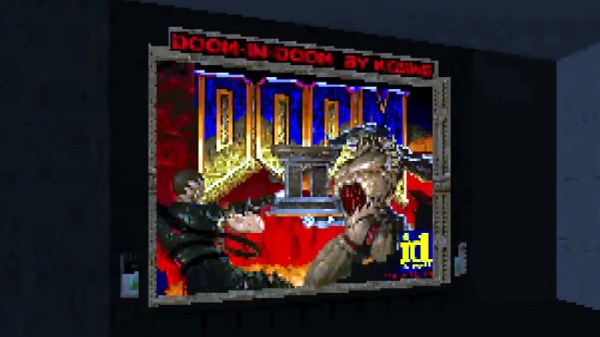
For years now, the standard test of any newly hacked piece of hardware has been this: can it run DOOM? id Software’s 1993 classic first-person shooter has appeared on everything, but here’s one from [kgsws] that’s a bit special. It’s DOOM, running inside DOOM itself.
So how has this feat been achieved? There’s a code execution exploit inside the original DOS DOOM II executable, and that has been used to run the more modern Chocolate Doom within the original. It appears as an in-game texture, giving an odd effect as if it’s being watched in a cinema.
The video below the break shows the game-in-game in action, but the real value lies in its in-depth description of the exploit, that takes us through some of the inner workings of the game and ably explains what’s going on. It finishes up with a specially made cinema WAD in which to play DOOM-in-DOOM, and even Hexen-in-DOOM. Pick up your trusty chainsaw, it’s going to be a long night.